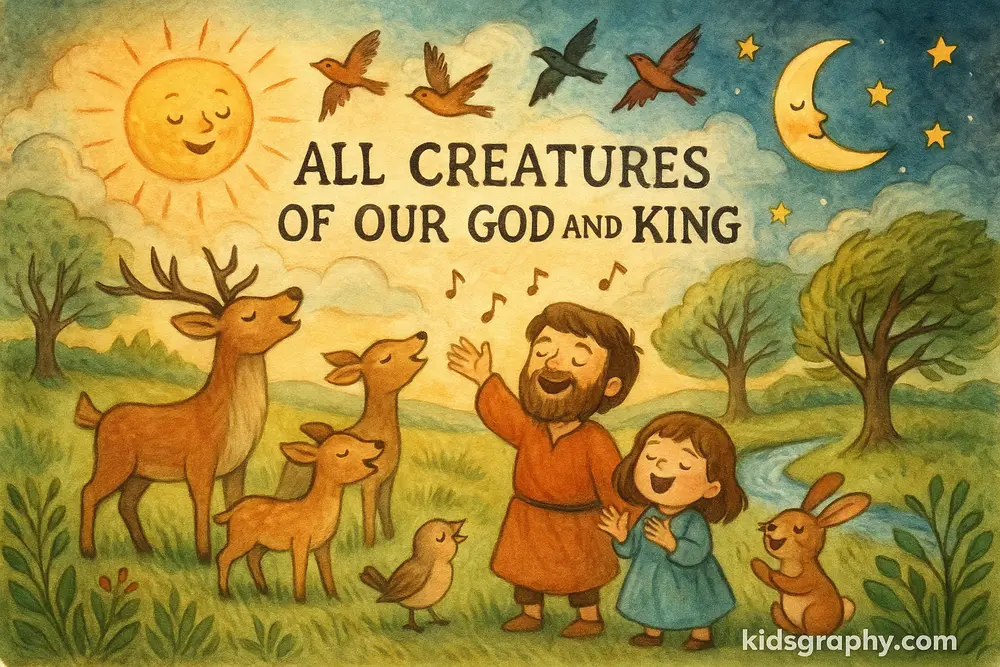
Here are the classic lyrics of “All Creatures of Our God and King,” presented line by line for clarity:
Verse 1
All creatures of our God and King,
Lift up your voice and with us sing,
Alleluia! Alleluia!
Thou burning sun with golden beam,
Thou silver moon with softer gleam,
O praise Him! O praise Him!
Alleluia! Alleluia! Alleluia!
Verse 2
Thou rushing wind that art so strong,
Ye clouds that sail in Heaven along,
O praise Him! Alleluia!
Thou rising morn, in praise rejoice,
Ye lights of evening, find a voice,
O praise Him! O praise Him!
Alleluia! Alleluia! Alleluia!
Verse 3
And all ye men of tender heart,
Forgiving others, take your part,
O sing ye! Alleluia!
Ye who long pain and sorrow bear,
Praise God and on Him cast your care,
O praise Him! O praise Him!
Alleluia! Alleluia! Alleluia!
Line by Line meaning of All Creatures of Our God and King
“All creatures of our God and King, / Lift up your voice and with us sing,”
All of creation—from animals to stars, from oceans to people—is called to lift up a joyful song to God, the Creator and King of all. We are not alone in our worship; all creation joins in!
“Thou burning sun with golden beam, / Thou silver moon with softer gleam,”
The sun and moon, in all their beauty and power, are called to join in praising God. Their light is a testimony of His glory, and even they are part of the great chorus of creation lifting their voices to the Creator.
“Thou rushing wind that art so strong, / Ye clouds that sail in Heaven along,”
The powerful wind and drifting clouds are invited to join in praise. As they move across the sky, they remind us of God’s strength, creativity, and control over all creation.
“Thou rising morn, in praise rejoice, / Ye lights of evening, find a voice,”
From the morning’s first light to the stars of night, the world is full of praise to God. The beauty of each part of the day declares His glory, and invites us to join the chorus of creation in joyful worship.
“And all ye men of tender heart, / Forgiving others, take your part,”
Those with kind hearts are called to forgive others—and in doing so, they join in creation’s praise. Forgiveness is an act of obedience and worship, reflecting the love of God in a hurting world.
“Ye who long pain and sorrow bear, / Praise God and on Him cast your care,”
If you’re going through pain or sorrow, you’re not excluded from worship—you’re especially invited. Praise God even in the storm, and give Him your worries and wounds, for He cares for you and walks with you.
Key Points
- “All Creatures of Our God and King” is a Christian hymn based on St. Francis of Assisi’s 1225 “Canticle of the Sun,” translated by William H. Draper in 1919.
- It calls all creation, including nature and humans, to praise God, emphasizing themes of gratitude and stewardship.
- The hymn is widely used across Christian denominations, especially during the Easter season, and appears in over 270 hymn books as of 2025.
- Research suggests its enduring popularity reflects its joyful message and connection to environmental care.
Introduction and Popularity
“All Creatures of Our God and King” stands as a beloved Christian hymn, known for its uplifting melody and poetic lyrics. Its widespread use across denominations, appearing in over 270 hymn books as of June 2025, underscores its enduring appeal. It is particularly associated with the Easter season, reflecting themes of renewal and joy, and has been featured in popular culture, such as the 1990 pilot episode of “Mr. Bean,” where the character humorously mumbles through the hymn, emphasizing its recognition beyond religious settings.
History and Background
Originating from St. Francis of Assisi’s 1225 “Canticle of the Sun,” written during illness near San Damiano, Italy, the hymn was translated by William H. Draper for a children’s festival in Leeds around 1910, published in 1919. It’s set to the 17th-century German tune “Lasst Uns Erfreuen,” enhancing its celebratory feel.
Author Details
St. Francis of Assisi (1181/1182 – 1226)
Born Giovanni di Pietro di Bernardone, St. Francis was an Italian Catholic friar and preacher, founding the Order of Friars Minor, Order of St. Clare, and Third Order of Saint Francis. Son of a prosperous silk merchant, Pietro di Bernardone, he never became a priest, focusing on poverty and nature, with the “Canticle of the Sun” reflecting his spiritual depth.
William Henry Draper (1855 – 1933)
Born December 19, 1855, in Kenilworth, Warwickshire, England, Draper died in 1933 in Clifton, Bristol. Educated at Cheltenham College and Keble College, Oxford, he earned a B.A. with honors and M.A. in 1880, ordained in 1880. He served as Curate of St. Mary’s, Shrewsbury; Vicar of Alfreton; Vicar of the Abbey Church, Shrewsbury; Rector of Adel, Leeds from 1899; and later at Temple Church, London (1919–1930). Known for translating 60 Latin, Greek, and German hymns, published in “The Victoria Book of Hymns” (1897) and “Hymns for Holy Week” (1899), his work on this hymn left a lasting legacy.
Comparative Analysis of Versions
| Aspect | Traditional (Hymnary.org) | Modern Adaptation (Sovereign Grace Music) |
|---|---|---|
| Verses | 3 verses, traditional language | 4 verses, updated language, additional themes |
| Focus | Nature and universal praise | Includes redemption, Christ’s return |
| Tune | “Lasst Uns Erfreuen” | May vary, often contemporary arrangements |
| Usage | Liturgical, Easter season | Contemporary worship, youth services |
This table highlights variations, ensuring readers understand its evolution.
More Hymn: All Creatures of Our God and King | Sovereign Grace Music
FAQs – “All Creatures of Our God and King,”
A: Over 270 as of 2025, per Wikipedia.
A: Yes, notably in “Mr. Bean” (1990).
A: It promotes environmental stewardship, resonating with modern concerns.
A: Traditionally “Lasst Uns Erfreuen,” a 1623 German melody.
Read More: Alas and Did My Savior Bleed Lyrics