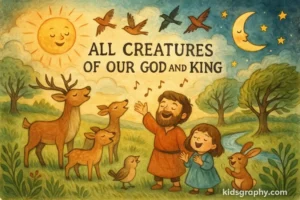
All creatures of our God and King,
Lift up your voice and with us sing
Alleluia, alleluia!
Thou burning sun with golden beam,
Thou silver moon with softer gleam,
O praise him, O praise him,
Alleluia, alleluia, alleluia.
Thou rushing winds that art so strong,
Ye clouds that sail in Heav’n along,
O praise him, alleluia!
Thou rising morn, in praise rejoice,
Ye lights of evening, find a voice.
O praise him, O praise him,
Alleluia, alleluia, alleluia.
And all ye saints of tender heart,
Forgiving others, take your part,
O sing ye, alleluia!
Ye who long pain and sorrow bear,
Praise God and on him cast your care:
O praise him, O praise him,
Alleluia, alleluia, alleluia.
Let all things their creator bless,
And worship him in humbleness,
O praise him, alleluia!
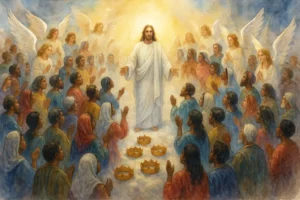
Praise, praise the Father, praise the Son,
And praise the Spirit, Three in One:
O praise him, O praise him,
Alleluia, alleluia, alleluia.
The Story Behind the Hymn
“All Creatures of Our God and King” traces its origins back to the 13th century. Its words were inspired by a poem written by Saint Francis of Assisi titled Canticle of the Sun, considered one of the earliest pieces of Italian literature. Saint Francis, known for his deep love of nature and humble devotion, wrote the poem as a celebration of God’s creation, calling upon the sun, moon, wind, water, and all living beings to praise the Creator.
The English hymn version was paraphrased and set to music by William H. Draper in the early 20th century. Draper composed it for a children’s choir in England and adapted it to the well-known German tune Lasst Uns Erfreuen (from 1623), giving this ancient poem new life in Christian worship settings.
Why the Hymn Resonates Today
The timeless appeal of All Creatures of Our God and King lies in its all-encompassing invitation to worship. It speaks not just to people, but to every part of creation—birds, skies, rivers, flames, and wind—turning the entire world into a symphony of praise.
Creation as Worship:
In a world increasingly disconnected from nature, the hymn calls us to remember that creation itself testifies to God’s majesty. It renews a sense of wonder for the environment, inviting believers to worship not only in church but in the everyday beauty of the world.
Unity and Simplicity:
This hymn transcends denominational lines and can be sung in churches of all traditions. Its repetitive Alleluias create unity in worship and lift spirits even in troubled times.
Spiritual Ecology:
In an age where ecological stewardship is urgent, this hymn reminds Christians that loving God also means honoring His creation.
The Music: Joyful and Triumphant
The tune Lasst Uns Erfreuen, with its bright and celebratory melody, perfectly complements the hymn’s message. First published in 1623 in Germany, the tune was popularized in English hymnals by Ralph Vaughan Williams in the early 20th century. Its rising lines, echoing phrases, and jubilant “Alleluia!” refrains give the hymn a majestic and communal quality.
Whether sung by a grand choir or a small congregation, the music uplifts the heart and turns worship into celebration. It feels ancient yet alive—sacred yet joyful.
A Legacy of Praise
Over the decades, All Creatures of Our God and King has remained one of the most beloved hymns in Christian worship. It is often sung during Earth Day services, creation-themed sermons, and harvest celebrations. Its powerful call to praise has made it a favorite in hymnals, school programs, and even contemporary Christian music covers.
Its reach has expanded globally, echoing the Psalmist’s words: “Let everything that has breath praise the Lord.”
Conclusion
All Creatures of Our God and King is more than a hymn—it’s a poetic anthem of creation. Rooted in the humility and awe of Saint Francis, and carried through centuries by music and translation, it reminds us that worship is not limited to words or buildings. Every breeze, bird, and beam of sunlight sings God’s glory.
Whether sung beneath a cathedral’s dome or beneath an open sky, this hymn stirs the soul to gratitude. It calls us to lift our voices—and our lives—in harmony with the entire universe, proclaiming “Alleluia!”