Every November, children ask, “What happened at the first Thanksgiving?” This short, kid-friendly version of the first Thanksgiving story for kids explains who the Pilgrims and the Wampanoag people were, what really happened in 1621, and why we still give thanks today.
6-minute read · Ages 6–10 · Includes 10 comprehension questions with answers and a printable worksheet.
We have kept the story simple and true to history, so it works for read-aloud time at home, a classroom history lesson, or homeschool. Answers to the questions are at the end for parents and teachers.
Printable tip: Want a paper copy? Use your browser’s Print option (Ctrl+P on a computer, or Share → Print on a phone) to print this page and use the questions as a worksheet at home or in class.
The First Thanksgiving: A Short Story for Kids
A Long, Hard Journey
In September 1620, a small wooden ship called the Mayflower set sail from Plymouth, England. On board were 102 passengers. Some of them were called Pilgrims. They wanted to live and worship God in their own way, which was not allowed in England at the time. Others were looking for a new life and new opportunities.
The ocean crossing took 66 long days. The ship was crowded, cold and damp. Storms tossed it up and down, and many people became seasick. Finally, in November, they saw land. It was the coast of what is now Massachusetts, in the United States.
Arriving in a New Land
The land was not empty. It was the home of the Wampanoag (say it: WAHM-puh-NO-ag) people, who had lived there for thousands of years. The Wampanoag knew the forests, rivers and seasons very well. They fished, hunted, and grew corn, beans and squash.
The Pilgrims built a small settlement they called Plymouth. But that first winter was terrible. They did not have enough food or warm houses, and many became very sick. By spring, about half of the passengers had died.
Help from Squanto and the Wampanoag
In the spring of 1621, a Wampanoag man named Tisquantum, often called Squanto, came to the settlement. Squanto spoke English, because years earlier he had been captured and taken to Europe before finding his way home.
Squanto taught the Pilgrims how to plant corn by putting small fish in the soil to help it grow. He showed them where to fish and which plants were safe to eat. The Wampanoag leader, Massasoit (MASS-uh-soyt), made an agreement with the Pilgrims to live in peace and help protect one another.
The Harvest Celebration of 1621
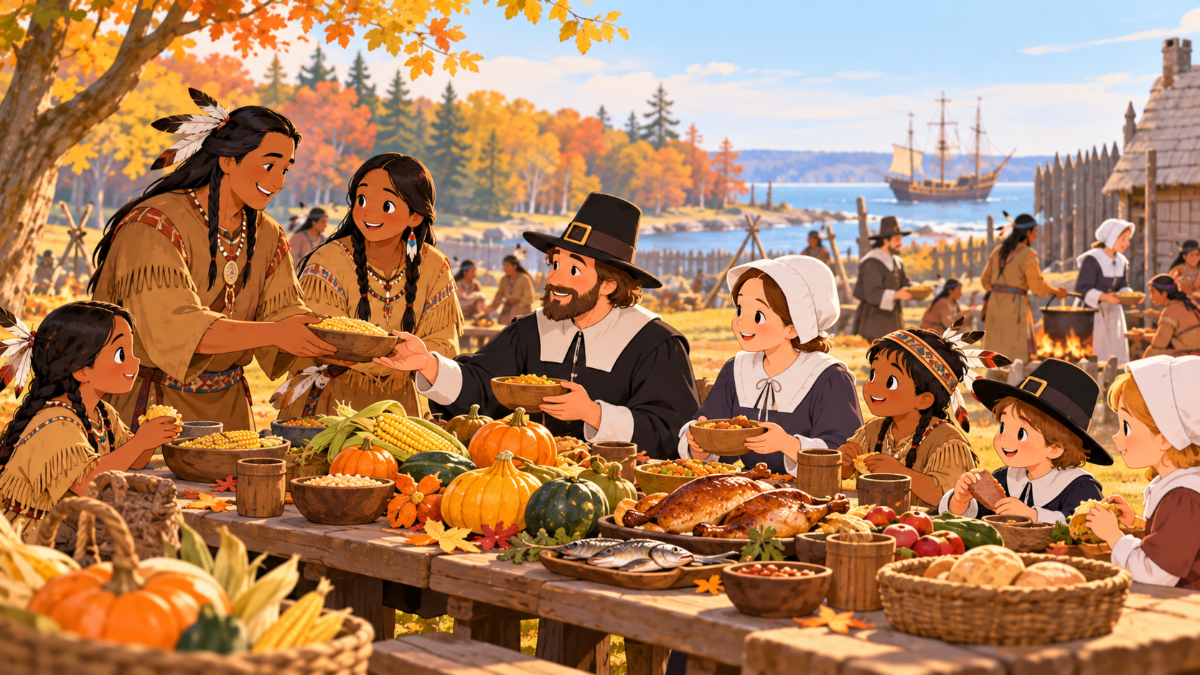
By autumn, thanks to hard work and help from their neighbors, the Pilgrims had a good harvest. To celebrate, they held a feast. When Massasoit and about 90 Wampanoag men arrived, they joined in, and they brought five deer to share.
The celebration lasted three days. People ate deer, wild birds such as ducks and geese (maybe turkey too), fish, corn, and squash. There were no pumpkin pies, potatoes or cranberry sauce yet! There were games, races and shooting contests.
The Pilgrims did not call it “Thanksgiving” back then. It was a harvest festival. But because people gave thanks for food, friendship and survival, we remember it today as the first Thanksgiving.
What Happened Next?
The peace between the Pilgrims and the Wampanoag lasted for about 50 years. Sadly, as more settlers arrived and took more land, things became much harder for the Wampanoag and other Native nations. Today, the Wampanoag people still live in Massachusetts, and many Native Americans remember Thanksgiving as a day of mourning as well as thanks. Learning the whole story helps us understand and respect everyone’s history.
How Thanksgiving Became a Holiday
For many years, different states held their own days of thanks. In 1863, during the Civil War, President Abraham Lincoln made Thanksgiving a national holiday. Today, Americans celebrate it on the fourth Thursday of November with family, food, and gratitude.
Key Facts About the First Thanksgiving
- When: autumn of 1621 (probably late September to early November).
- Where: Plymouth Colony, in present-day Massachusetts.
- Who: about 50 English colonists and about 90 Wampanoag people.
- How long: three days.
- What they ate: deer, wild birds, fish, corn and squash.
- Important people: Squanto (Tisquantum), Massasoit, and Governor William Bradford.
The Big Lesson: Why We Give Thanks
The first Thanksgiving reminds us that nobody can do everything alone. The Pilgrims survived because they received help, and they celebrated by sharing. Today, Thanksgiving is a time to thank the people who help us, share what we have, and be respectful of every family’s story.
Want more stories about thankfulness? Read our stories about gratitude for kids, or try these Thanksgiving Bible verses for kids for Sunday school.
Extend the Lesson: Thanksgiving History Activities
- Map the journey: Find England and Massachusetts on a map or globe and trace the Mayflower’s route across the Atlantic Ocean.
- Three Sisters garden: The Wampanoag grew corn, beans and squash together. Draw how the beans climb the corn while squash leaves shade the soil, or plant beans in a cup.
- Then and now menu: Make two columns, “1621 feast” and “Our Thanksgiving”, and compare the foods.
- Thank-you letter: Write a short letter from a Pilgrim child to Squanto, thanking him for his help.
- Sequence the story: Cut the key events into strips (ship sails, hard winter, Squanto helps, harvest feast, Lincoln’s holiday) and put them in order.
For more seasonal ideas, see our big list of fall activities for kids.
10 Comprehension Questions for Kids
Read the story first, then answer these questions out loud or on the printable worksheet.
- What was the name of the ship that carried the Pilgrims?
- How many days did the ocean journey take?
- Which Native American people lived in the land where the Pilgrims arrived?
- Why was the first winter so hard for the Pilgrims?
- Who was Squanto, and how did he help?
- Who was Massasoit?
- How long did the harvest celebration of 1621 last?
- Name two foods that were probably eaten at the first Thanksgiving.
- Which president made Thanksgiving a national holiday, and in what year?
- Why do you think it is important to give thanks? (Think-and-share question.)
Answers for Parents and Teachers
- The Mayflower.
- 66 days.
- The Wampanoag.
- They did not have enough food or shelter, and many people became sick.
- A Wampanoag man who spoke English; he taught them to plant corn, fish and find food.
- The leader of the Wampanoag, who made a peace agreement with the Pilgrims.
- Three days.
- Any two of: deer, ducks, geese, turkey, fish, corn, squash.
- Abraham Lincoln, in 1863.
- Answers will vary. Accept any thoughtful answer.
FAQ: The First Thanksgiving for Kids
How do you explain the first Thanksgiving to a child?
Explain that in 1621 the Pilgrims and the Wampanoag people shared a three-day harvest feast after the Wampanoag helped the Pilgrims survive in a new land. Keep it simple, honest, and focused on sharing and gratitude.
Did they eat turkey at the first Thanksgiving?
Maybe. Records mention “wild fowl”, which could have included turkey, but ducks and geese were more likely. We know for sure that the Wampanoag brought five deer.
Who were the Pilgrims?
The Pilgrims were a group of English people who left England so they could worship in their own way. They sailed on the Mayflower in 1620 and started Plymouth Colony.
What age is this story for?
This version is best for children ages 6–10 (Grades 1–4). For younger children, read it aloud and skip the “What Happened Next?” section if needed.