Every autumn, homes across India and around the world glow with tiny clay lamps. Diwali, the Festival of Lights, is one of the biggest celebrations of the year for Hindus, Sikhs, and Jains. This Diwali story for kids retells the tale many Hindu families share at Diwali: the adventure of Prince Rama and Princess Sita from the ancient epic, the Ramayana, and why a whole city lit lamps to welcome them home.
Reading time: about 8 minutes | Best for ages: 5–11 | Source: the Ramayana, traditionally credited to the sage Valmiki
The Diwali Story for Kids: Rama and Sita
Long, long ago, in the beautiful city of Ayodhya, there lived a wise and gentle king named Dasharatha. He had four sons, and the eldest, Rama, was loved by everyone. Rama was brave and kind, and he always kept his word. His wife, Princess Sita, was just as good-hearted, and Rama’s brother Lakshmana loved him so much that he followed him everywhere.
When King Dasharatha grew old, he decided to make Rama the next king. The whole city cheered. But one of the king’s wives, Queen Kaikeyi, wanted her own son, Bharata, to be king instead. Years before, the king had promised Kaikeyi two wishes. Now she asked for them: “Make Bharata king, and send Rama away to the forest for fourteen years.”
The king’s heart broke, but he had given his word. And Rama, who always kept promises, did not argue. “I will go,” he said calmly, “so that my father’s word is kept.”
Sita refused to stay behind. “Where you go, I go,” she said. Lakshmana picked up his bow. “And I go too.”
So the three of them left the palace and walked into the forest. They built a little hut of branches and leaves, ate fruit and roots, and lived simply among the trees and rivers. When Bharata found out what had happened, he was horrified. He went to the forest and begged Rama to come home, but Rama wouldn’t break the promise. So Bharata placed Rama’s sandals on the throne and ruled only in Rama’s name, waiting for his brother’s return.
Years passed peacefully. Then, one day, a golden deer with silver spots pranced past the hut. Sita had never seen anything so lovely. “Rama, could you catch it for me?” she asked.
Rama went after it, telling Lakshmana to guard Sita. But the deer was not a real deer. It was a trick sent by Ravana, the fearsome ten-headed king of the island of Lanka. When Rama struck it, it cried out in Rama’s voice, “Help, Lakshmana!”
Sita was frightened and begged Lakshmana to go. Before he left, many tellings say, he drew a line in the dirt around the hut. “Don’t step past this line, and you’ll be safe,” he told her.
As soon as both brothers were gone, an old holy man appeared at the hut, asking for food. Sita, kind as always, stepped over the line to give him some. In a flash, the holy man changed into Ravana. He grabbed Sita, put her in his flying chariot, and soared away toward Lanka. A brave old vulture named Jatayu tried to stop him but was badly hurt.
When Rama and Lakshmana came back, the hut was empty. They searched everywhere until they found Jatayu, who told them, with his last breath, which way Ravana had flown.
The brothers traveled south and met a kingdom of monkeys and bears. Their king, Sugriva, became Rama’s friend. And among the monkeys was Hanuman, the strongest and most loyal of all. Hanuman could leap over mountains.
“I’ll find Sita,” Hanuman promised. He took a deep breath, crouched, and leaped across the ocean to Lanka in a single jump. There, in a garden of ashoka trees, he found Sita, sad but brave. Hanuman gave her Rama’s ring to show that help was coming. Sita’s eyes filled with happy tears.
But how could an army cross the ocean? The monkeys and bears got to work. They carried rocks and boulders to the shore. Many tellings say they wrote Rama’s name on each stone, and the stones floated. Even a tiny squirrel helped, rolling in the sand and shaking grains into the gaps. Rama gently stroked the squirrel’s back to thank it, and some say that’s how squirrels in India got their stripes.
Across the bridge marched Rama’s army. A great battle began. Ravana was powerful, and his ten heads roared with anger. But Rama was steady and fearless. At last, Rama fired a mighty arrow, and Ravana fell. Good had defeated evil.
Rama and Sita were together again. And by now, the fourteen years were nearly over. It was time to go home.
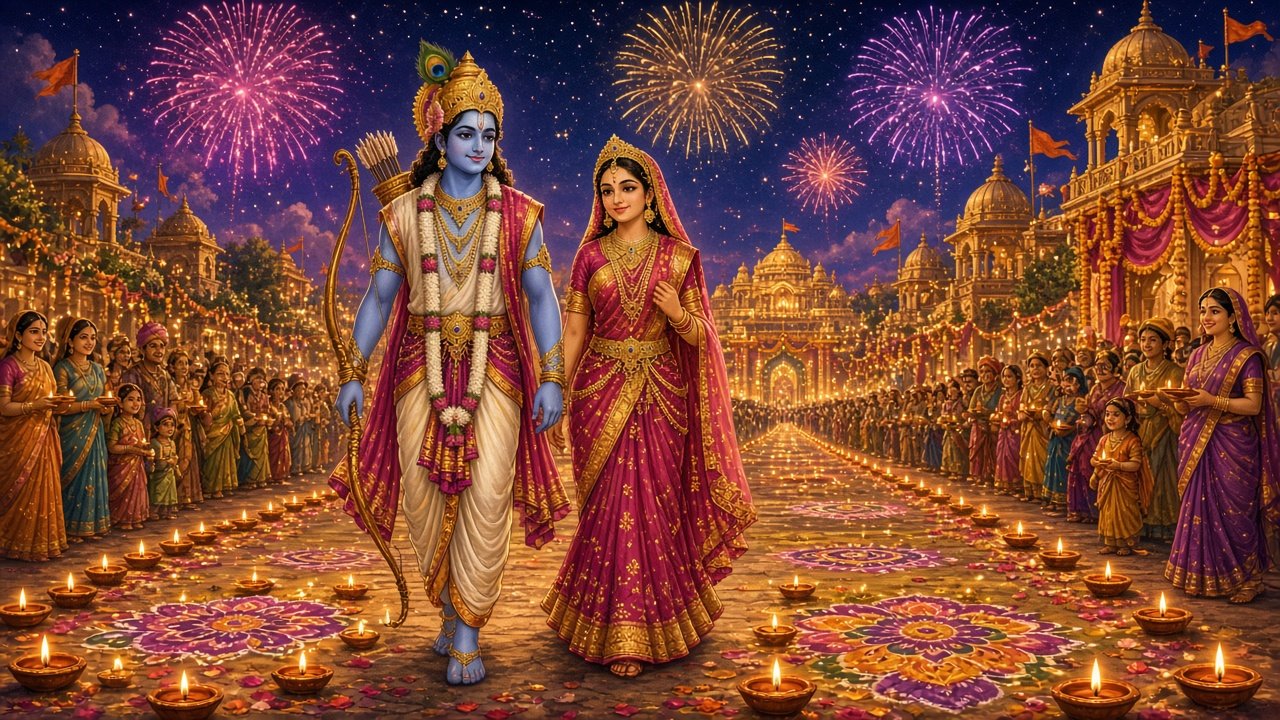
Back in Ayodhya, the people heard the news and were overjoyed. But it was the darkest night of the month, with no moon at all. How would Rama find his way? So every family filled little clay lamps with oil and lit them. They placed them on rooftops, windowsills, doorsteps, and along the riverbank. Soon the whole city sparkled like a sky full of stars.
Rama, Sita, and Lakshmana followed the shining lights all the way home. Bharata ran to greet his brother and gave him back his sandals and his throne. Rama became king, and he ruled with such fairness and kindness that people talked about it for thousands of years.
And that is why, every Diwali, families still light their lamps.
Moral of the Story
Light always wins over darkness, and good always wins over evil, even when it takes a long time. Rama kept his promises, Sita stayed brave, and friends like Hanuman, Jatayu, and even a tiny squirrel helped. No act of kindness is too small to matter.
Questions to Talk About After Reading
- Rama left home for fourteen years to keep his father’s promise. Why do you think keeping a promise mattered so much to him?
- Who helped Rama along the way? Which helper is your favorite, and why?
- The little squirrel could only carry a few grains of sand. Why did Rama thank it?
- Why do you think people lit lamps to welcome Rama home? How do you welcome someone special?
- What does “light winning over darkness” mean to you?
How Families Celebrate Diwali
Diwali usually lasts five days and falls in October or November, depending on the Hindu lunar calendar. The main night is the new moon of the month of Kartik, the darkest night, which is exactly why lamps matter so much. Families clean and decorate their homes, wear new clothes, draw bright rangoli patterns at the door with colored powder or rice, share sweets like ladoos and barfi, and set off fireworks. Many also pray to Lakshmi, goddess of wealth and good fortune.
Diwali has other stories too. Some families celebrate Krishna’s victory over the demon Narakasura. Jains remember the day Lord Mahavira reached moksha, and Sikhs celebrate Bandi Chhor Divas, honoring Guru Hargobind’s release from prison. The common thread is light, hope, and new beginnings.
Easy Diwali Activities for Kids
- Paint a diya: Buy plain clay lamps and decorate them with acrylic paint and glitter. Use a battery tea light to be safe.
- Chalk rangoli: Draw a big flower or star pattern on the sidewalk with colored chalk.
- Share sweets: Bake simple coconut ladoos with an adult and give them to neighbors.
For more heroes who kept their word against the odds, explore our legendary heroes stories for kids, or find another tale with a lesson in our moral stories for kids. Our bedtime stories collection has plenty more for quiet evenings.
Frequently Asked Questions
What is the main Diwali story?
Many Hindu families connect Diwali with Prince Rama’s return to the city of Ayodhya after 14 years in exile and his victory over the demon king Ravana. People lit rows of lamps to welcome Rama and Sita home.
Why do people light lamps on Diwali?
The small clay lamps, called diyas, celebrate light winning over darkness and good winning over evil. In the Rama story, they recall the lamps the people of Ayodhya lit to guide Rama, Sita, and Lakshmana home.
When is Diwali celebrated?
Diwali follows the Hindu lunar calendar, so the date changes each year. It usually falls in October or November, on the darkest night of the month of Kartik, the new moon.
Are there other stories connected to Diwali?
Yes. Many families also honor Lakshmi, goddess of wealth and good fortune, and some celebrate Krishna’s victory over the demon Narakasura. Jains, Sikhs, and some Buddhists also celebrate festivals at this time with their own meanings.
Where does the story of Rama and Sita come from?
It comes from the Ramayana, an ancient Sanskrit epic traditionally credited to the sage Valmiki. It has been retold in many languages and versions across India and Southeast Asia.
How can kids celebrate Diwali at home?
Kids can paint clay diyas, draw rangoli patterns with colored chalk or rice, share sweets with neighbors, wear new clothes, and read the Rama and Sita story together.