Kindness is one of the most important things we can teach children, and stories are one of the best ways to do it. These 10 short kindness stories for kids to read are original tales about sharing, helping, including others and being gentle with animals and nature. Each story takes two or three minutes to read and ends with a simple moral and a question to talk about together.
Ages 4–10 · 2–3 minutes per story · Each story includes a moral and a discussion question.
Read one each night at bedtime, use them for circle time or values lessons, or let older children read them on their own.
Printable tip: Want a paper copy? Use your browser’s Print option (Ctrl+P on a computer, or Share → Print on a phone) to print this page for bedtime reading or class.
1. The Umbrella
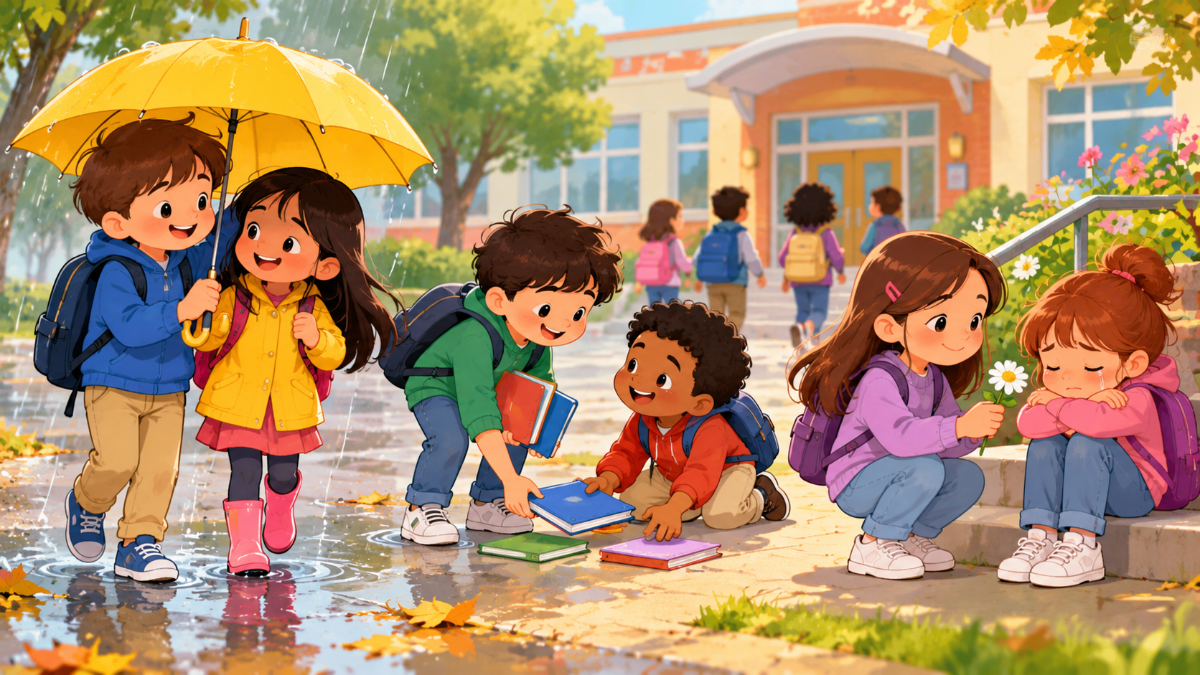
Rain poured down as the school bell rang. Lily opened her bright yellow umbrella and stepped outside. Near the gate stood a new boy named Sam, his hood pulled tight, getting wetter by the second.
Lily hesitated. Her umbrella was only big enough for one. Then she walked over. “Want to share?” she asked.
They squeezed under the umbrella together. Lily’s left shoulder got soaked, but Sam was smiling for the first time all week. By the time they reached Sam’s street, they had discovered they both loved dinosaurs and hated broccoli.
The next morning, Sam waited for Lily at the gate. “Want to sit together at lunch?” he asked.
Moral: A small act of kindness can be the start of a big friendship.
Talk about it: How do you think Sam felt before and after Lily shared her umbrella?
2. The Lost Puppy
Arjun was on his way to the park with his new football when he heard a whimper. Under a bench sat a tiny brown puppy with a red collar, shaking with fear.
Arjun really wanted to play. But he knelt down and spoke softly until the puppy crept closer. On its collar was a tag with a phone number. Arjun ran home with the puppy in his arms and asked his mom to call.
An hour later, a girl and her father knocked on the door. The girl burst into tears of happiness when she saw her puppy. “Thank you,” she said. “We looked everywhere.”
Arjun never made it to the park that day, but he didn’t mind one bit.
Moral: Kindness sometimes means putting someone else’s needs before our own plans.
Talk about it: What would you have done if you found the puppy?
3. The Biggest Cookie
Mia and her little brother Leo had baked cookies with Grandma. When they came out of the oven, one cookie was much bigger than the rest. Both children reached for it at the same time.
“I’m older,” said Mia. “It should be mine.”
Leo’s lip began to wobble. Mia looked at his face, then at the cookie. She remembered how Grandma always gave her the biggest slice of cake on her birthday.
Mia broke the cookie in half, gave Leo the slightly bigger piece and kept the other for herself. Leo beamed. “You’re the best sister,” he said, and he gave her a crumbly hug.
Mia decided that half a cookie with a hug tasted better than a whole cookie alone.
Moral: Sharing makes good things even better.
Talk about it: Why did Mia decide to share the cookie?
4. The Garden for Mrs. Rose
Mrs. Rose lived alone at the end of the street. Her garden used to be full of flowers, but since she’d hurt her knee, it had become a tangle of weeds.
One Saturday, Noah and his friends decided to help. They brought gloves, buckets and a bag of flower seeds. They pulled weeds, raked the soil and planted neat rows of marigolds.
Mrs. Rose watched from her window, then opened the door with a tray of lemonade. “No one has done anything like this for me in years,” she said, wiping her eyes.
Weeks later, the marigolds bloomed bright orange. Every time Mrs. Rose looked at them, she smiled, and so did Noah.
Moral: Helping others brings joy to them and to us.
Talk about it: Who in your neighborhood might need a little help?
5. The Girl Who Sat Alone
Every lunchtime, Priya sat at the end of the long table by herself. She ate quietly and looked at her book, but she wasn’t really reading.
One day, Zara noticed. She asked her friends, “Should we invite Priya to sit with us?”
“She’s so quiet,” said Ben. “She probably wants to be alone.”
“Maybe,” said Zara. “But maybe she just doesn’t know how to join in.”
Zara carried her lunch to the end of the table. “Can I sit here?” she asked. Priya looked up, surprised, and nodded. Soon they were laughing about their favorite cartoons. The next day, Ben and the others joined them too.
Moral: Including others can change someone’s whole day.
Talk about it: How can you tell if someone feels left out?
6. The Little Bird
After a stormy night, Kai found a baby bird on the grass beneath the old oak tree. It was too young to fly and was chirping for its mother.
Kai wanted to pick it up and take it home. But he remembered what his teacher had said: the mother bird might be nearby. So he asked his dad for help. Wearing gloves, his dad gently placed the bird back into its nest, which had slipped lower on a branch.
Kai watched from the window all afternoon. Finally, a larger bird swooped down with a worm. The baby bird opened its beak wide.
“Its mom came back!” Kai shouted.
Moral: Being kind to animals means caring for them gently and wisely.
Talk about it: Why was it a good idea for Kai to ask a grown-up for help?
7. The Broken Crayon
Ella had a brand-new box of 64 crayons. Her classmate Tom only had four stubby ones in a plastic bag. During art, Tom tried to color a sunset, but he didn’t have orange or pink.
Ella saw him frowning. She pushed her box across the table. “You can use mine,” she said.
Tom pressed too hard and the orange crayon snapped in two. He froze. “I’m sorry!” he said.
Ella shrugged and smiled. “Now we both have an orange crayon,” she said, handing him half.
Tom’s sunset was the best picture he had ever made. He drew a little yellow umbrella in the corner just for Ella.
Moral: Kindness means being forgiving when accidents happen.
Talk about it: How did Ella turn a broken crayon into something good?
8. Grandpa’s Glasses
Grandpa Joe loved reading the newspaper, but his eyes were getting tired. One morning, he couldn’t find his glasses anywhere.
His granddaughter Anya searched under cushions, behind the plant and inside the fridge (just in case). Finally, she found them on top of Grandpa’s head! They both laughed until their tummies hurt.
Then Anya had an idea. “Grandpa, can I read the newspaper to you?” she asked. She read slowly, sounding out the tricky words, and Grandpa helped with the hard ones.
It became their morning routine. Grandpa’s eyes got to rest, and Anya became the best reader in her class.
Moral: When we help others, we often learn and grow too.
Talk about it: What is something kind you could do for a grandparent or older friend?
9. The Kindness Rock
Ruby found a smooth grey stone at the beach. At home, she painted it blue and wrote “You Are Awesome” in white letters. She placed it on the wall outside the library.
The next day, a tired-looking man waiting for the bus picked up the rock and read it. He smiled, put it back and stood up a little straighter.
A week later, Ruby noticed three more painted rocks beside hers. “Be Brave,” said one. “Smile!” said another. “You Matter,” said the third.
Soon the wall was covered in colorful rocks, and nobody knew who had started it. Ruby kept her secret, but she grinned every time she walked past.
Moral: One small act of kindness can spread far and wide.
Talk about it: What message would you paint on a kindness rock?
10. The Two Snowmen
It had snowed all night. Jack and his neighbor Ollie each built a snowman in their front gardens. Jack’s was tall and grand. Ollie’s was small and wonky, because Ollie had only one working arm after an accident.
Some older kids walked by and laughed at Ollie’s snowman. Ollie’s face fell.
Jack walked over, scooped up a big handful of snow, and said, “Let’s make him even better together.” They gave the little snowman a scarf, a carrot nose and a big pebble smile.
When the older kids came back, Ollie’s snowman was the best on the street, and Jack and Ollie were building a snow fort side by side.
Moral: Real kindness means standing up for others and helping them shine.
Talk about it: How did Jack help Ollie when the older kids laughed?
What These Kindness Stories Teach
Across these ten stories, children see many different kinds of kindness:
- Sharing: The Umbrella, The Biggest Cookie, The Broken Crayon
- Helping: The Garden for Mrs. Rose, Grandpa’s Glasses
- Including others: The Girl Who Sat Alone
- Caring for animals: The Lost Puppy, The Little Bird
- Spreading positivity: The Kindness Rock
- Standing up for others: The Two Snowmen
How to Read These Stories with Your Child
- Pause and predict: Before the ending, ask “What do you think will happen next?”
- Name the feelings: Ask how each character felt at the start and at the end of the story.
- Connect to real life: Ask “Has anything like this ever happened to you?”
- Act it out: Younger children love acting out the stories with toys or puppets.
- Praise real kindness: When you notice your child being kind, name it: “That was just like Lily sharing her umbrella!”
Kindness Challenge for Kids
After reading the stories, try a one-week kindness challenge. Each day, choose one act of kindness and tick it off on the printable chart:
- Share something with a friend or sibling.
- Help with a chore without being asked.
- Invite someone new to play.
- Say something nice to three people.
- Write a thank-you note.
- Make a card for someone who is sick or lonely.
- Help an animal or care for a plant.
More Kindness Stories to Read
Love these stories? Discover more classic tales about kindness and caring:
- The Lion and the Mouse: a tiny mouse proves that no act of kindness is ever wasted.
- The Good Samaritan: Jesus’ famous story about helping a stranger in need.
- The Kind-Hearted Merchant and the Birds: a gentle tale of compassion.
- The Four Harmonious Friends: a Buddhist story about respect and working together.
- Browse our full collection of moral stories for kids.
FAQ: Kindness Stories for Kids
What is a good short story about kindness for kids?
“The Umbrella” and “The Kindness Rock” are great choices. Both are short, easy to read and show how one small kind act can make a big difference.
How do you teach kindness to children through stories?
Read the story together, then ask how the characters felt and what they could have done differently. Follow up with a real-life kindness activity, like the kindness challenge above.
What age are these kindness stories for?
They are written for children aged 4–10. Younger kids enjoy listening, while children aged 7 and up can read them independently.