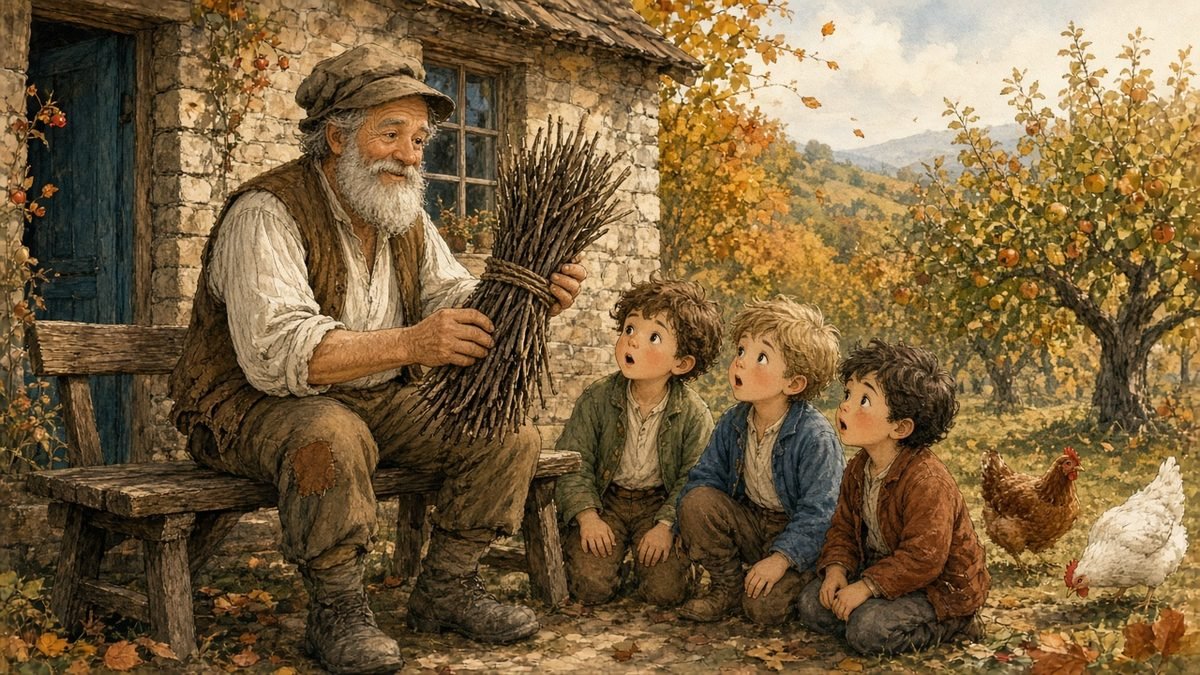
The Bundle of Sticks story is one of Aesop’s fables, the short animal and people stories said to come from ancient Greece more than 2,500 years ago. In some books it’s called “The Old Man and His Sons” or “The Father and His Sons.” The lesson is simple and strong: we’re much harder to break when we stick together.
This retelling is for children ages 5 to 12 and takes about 8 minutes to read aloud. It’s a great story for brothers and sisters who argue, which is to say, almost all of them.
Part 1: Three brothers who never stopped arguing
Once upon a time, an old farmer lived on a small farm at the edge of a village. He had a stone cottage, a few apple trees, a cow, some hens and three sons. He loved his sons more than anything.
The only trouble was that his sons argued all day long.
They argued at breakfast about who got the biggest piece of bread. They argued in the fields about who was doing the most work. They argued in the evening about whose turn it was to fetch water from the well.
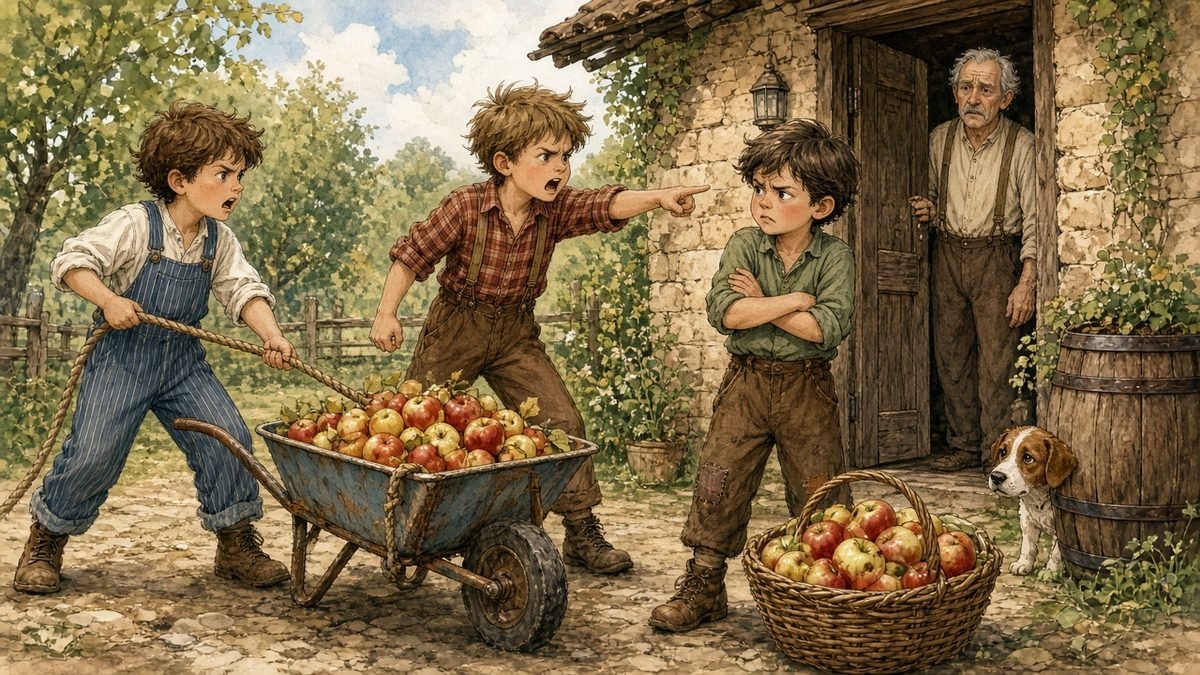
“I picked more apples than you,” the oldest son said one autumn afternoon, pointing at the wheelbarrow.
“No, you didn’t. Half of those are mine,” said the middle son.
“You’re both wrong,” shouted the youngest. “I found the best ones!”
They pulled the wheelbarrow this way and that until it tipped over, and the apples rolled everywhere across the yard.
The old farmer stood in the doorway and shook his head. He had tried everything. He had asked them nicely to stop. He had given them long talks by the fire. He had even made them work in separate fields. Nothing worked for long.
“I’m getting older,” he thought. “One day I won’t be here to look after them. If they keep fighting like this, anyone could take advantage of them. I have to find a way to show them.”
Part 2: A strange request
That evening, the farmer called his three sons to the bench outside the cottage.
“I’d like each of you to go into the woods,” he said, “and bring me back one stick. It should be about as long as your arm and as thick as your thumb.”
The sons looked at each other. It seemed like a very odd thing to ask. But they did as they were told.
When they came back, the farmer took all three sticks, plus a few more he had gathered himself. He laid them side by side and tied them tightly together with a piece of rope. Now he held a thick, sturdy bundle.
He handed the bundle to his oldest son.
“Break it,” he said.
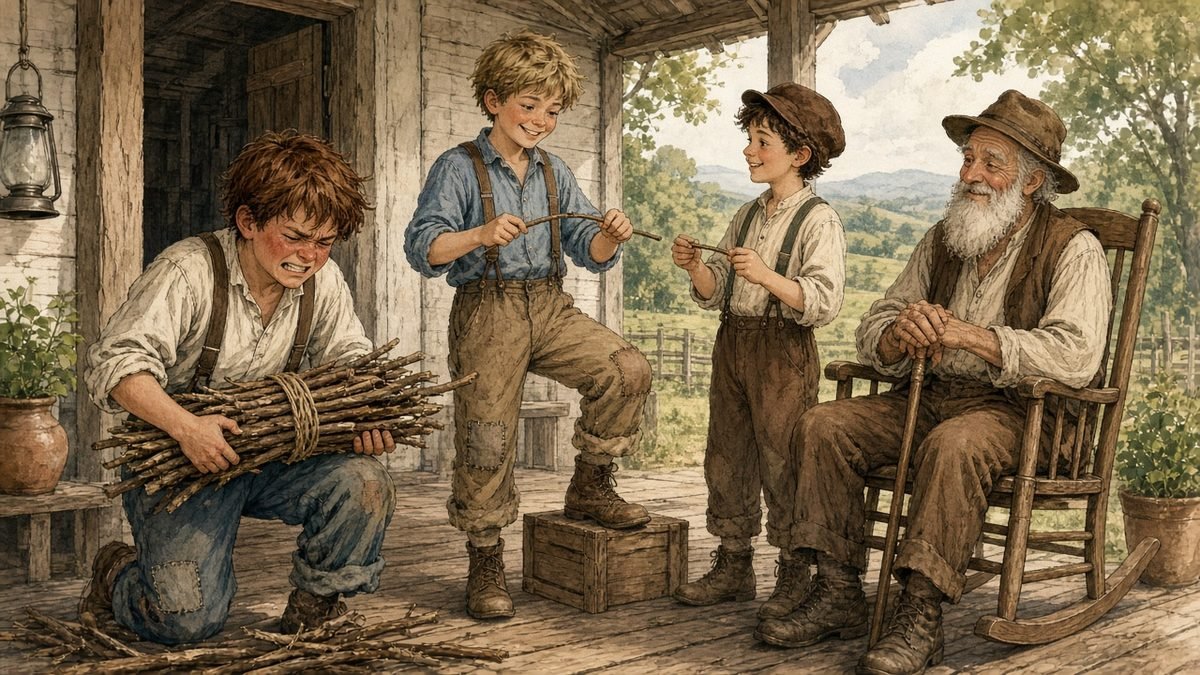
The oldest son laughed. “That’s easy.” He put the bundle over his knee and pushed down hard. Nothing happened. He pushed harder. His face turned red. The bundle didn’t even bend.
“Let me try,” said the middle son, grabbing it. He twisted and pulled with all his strength. He couldn’t break it either.
“You’re both weak,” said the youngest son. He stomped on the bundle. He sat on it. He even tried to bend it around a fence post. It stayed in one piece.
“It can’t be done, Father,” the youngest finally said, out of breath. “Nobody could break that.”
Part 3: One stick at a time
The old farmer smiled. He took the bundle back, untied the rope and gave each son a single stick.
“Now try,” he said.
Snap. Snap. Snap.
Each son broke his stick in half with hardly any effort at all.
The brothers stared at the broken pieces in their hands. Then they looked at their father.
“Do you see?” the farmer asked gently. “One stick alone is easy to break. But when the sticks are tied together, no one can break them, not even the three of you.”
He looked at each son in turn.
“You are like these sticks. If you stand together and help each other, nothing in the world will be able to break you. But if you keep fighting and pulling apart, anyone can break you, one at a time.”
The brothers were quiet for a long time. The youngest son spoke first.
“I’m sorry I said the best apples were mine,” he mumbled.
“I’m sorry I tipped over the wheelbarrow,” said the middle son.
The oldest son put an arm around each of his brothers. “We’ll try to be more like the bundle,” he said.
Part 4: Stronger together
The brothers did try. They didn’t become perfect overnight. Brothers never do. They still argued sometimes about the bread at breakfast. But now, when they started to quarrel, one of them would pick up a stick and hold it up, and they’d all laugh and stop.
They started working in the fields side by side. With three of them pulling together, the plowing went twice as fast. When a storm knocked down the fence, they fixed it in one afternoon. When the cow got stuck in the mud, it took all three of them to pull her out, and they did.
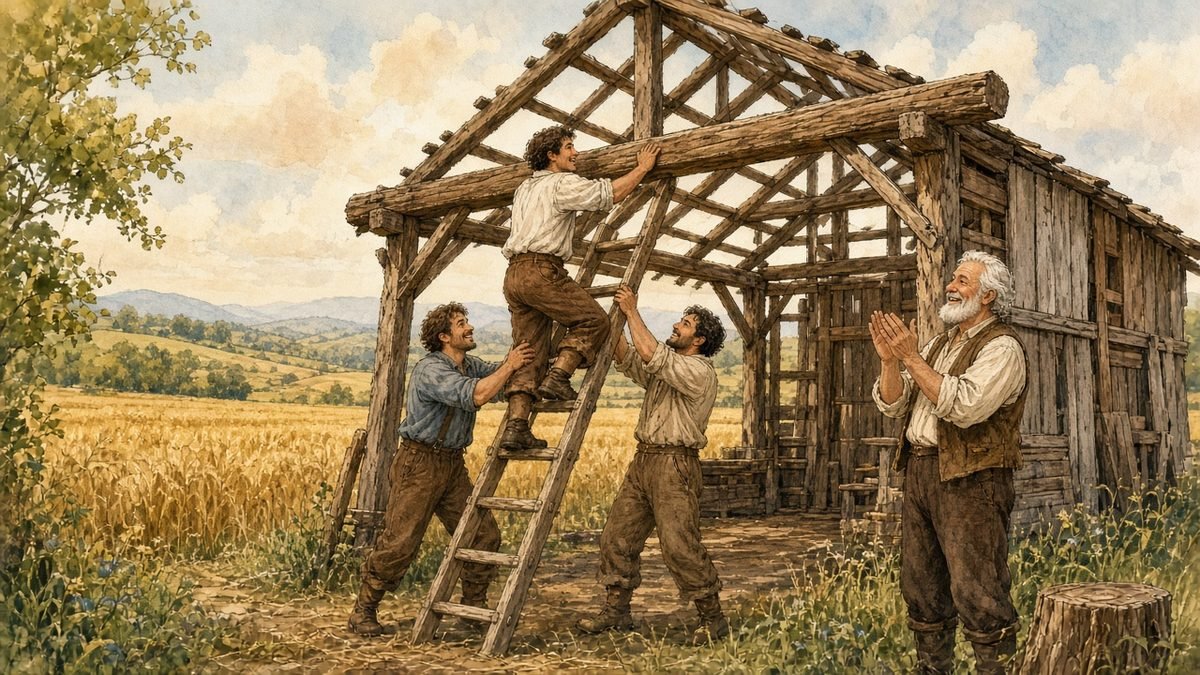
Years went by. The brothers grew into strong young men. One spring, they decided to build a new barn. It was a huge job. The beams were heavy, and the roof was high. None of them could have done it alone. But together they lifted every beam, hammered every nail and raised the roof before summer.
The old farmer, now very gray, sat in his chair and watched them work. When the last beam went up, he clapped his hands.
“That,” he said proudly, “is a bundle nobody can break.”
The End
Moral of the story: Union gives strength
Many old books end this fable with the words “Union gives strength” or “United we stand, divided we fall.” When people stick together and help each other, they’re much stronger than when they argue and pull apart. That’s true for families, friends, teams and whole communities.
What kids can learn from The Bundle of Sticks
- Teamwork makes us strong. Three sticks together were harder to break than any one stick.
- Fighting makes us weaker. When the brothers argued, they wasted their energy on each other.
- Showing can teach better than telling. The farmer’s long talks didn’t work, but one bundle of sticks did.
- Apologizing helps fix things. The brothers started to change once they said sorry.
- Family is worth protecting. Brothers and sisters can be each other’s best helpers.
Questions to talk about with your child
- Why was the old farmer worried about his sons?
- Why couldn’t the brothers break the bundle? Why could they break one stick easily?
- What did the bundle of sticks stand for?
- Can you think of a time when working together made something easier?
- What can you do the next time you start to argue with a brother, sister or friend?
Try it at home: the bundle of sticks experiment
Kids love testing this fable for themselves. Collect a handful of thin, dry twigs or wooden craft sticks. Have your child snap one twig. Then tie five or six together with string or a rubber band and ask them to try again. The bundle is much harder to break. Ask them what that has to do with the story, and let them explain it back to you in their own words.
Summary: The Bundle of Sticks
An old farmer has three sons who argue all the time. He asks each one to bring him a stick, then ties the sticks into a bundle. None of the sons can break the bundle, but each easily breaks a single stick. The farmer explains that they are like the sticks: strong together and weak apart. The brothers learn to work as a team, and years later they build a barn together.
For another story about friends who are stronger together, read The Four Harmonious Friends.
Read More: Belling the Cat: A Story About Bravery and Teamwork
Frequently asked questions
What is the moral of the Bundle of Sticks story?
The moral is “Union gives strength.” People who stick together are much stronger than people who argue and act alone.
Who wrote The Bundle of Sticks?
It’s one of Aesop’s fables. Aesop is traditionally described as a storyteller who lived in ancient Greece around 600 BC, although historians aren’t sure about the details of his life. His fables were passed down and written down by many people over the centuries.
What is another name for The Bundle of Sticks?
It’s also called “The Old Man and His Sons,” “The Father and His Sons” and sometimes “The Bundle of Rods.”
What age is this story good for?
It works for ages 5 to 12. Younger kids enjoy the stick-breaking, and older kids can talk about what “united we stand, divided we fall” means in real life.
How can I use this story with siblings who fight?
Read it together, then try the stick experiment above. Afterward, you can use a simple stick as a family signal. When an argument starts, holding up a stick is a playful reminder to work it out as a team.