The Crane and the Crab story comes from the Panchatantra, an ancient collection of Indian animal fables written to teach young princes how to think wisely. It’s also told as “The Cunning Crane and the Crab” or “The Heron and the Crab.” In the story, a sly old crane tricks the fish of a pond, until a sharp-eyed crab works out what’s really going on.
This retelling is for children ages 5 to 12 and takes about 9 minutes to read aloud. The original ending is quite harsh, so this version is gentler. You’ll find a note about the original in the FAQ below.
Part 1: An old crane who was too slow to fish
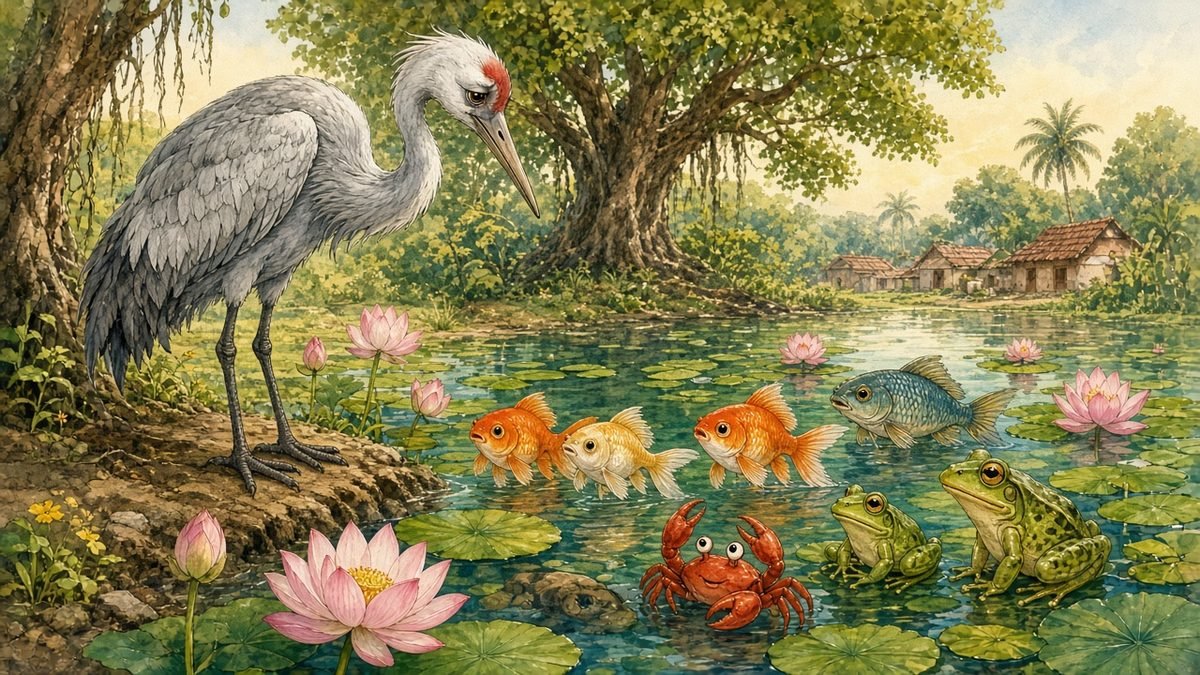
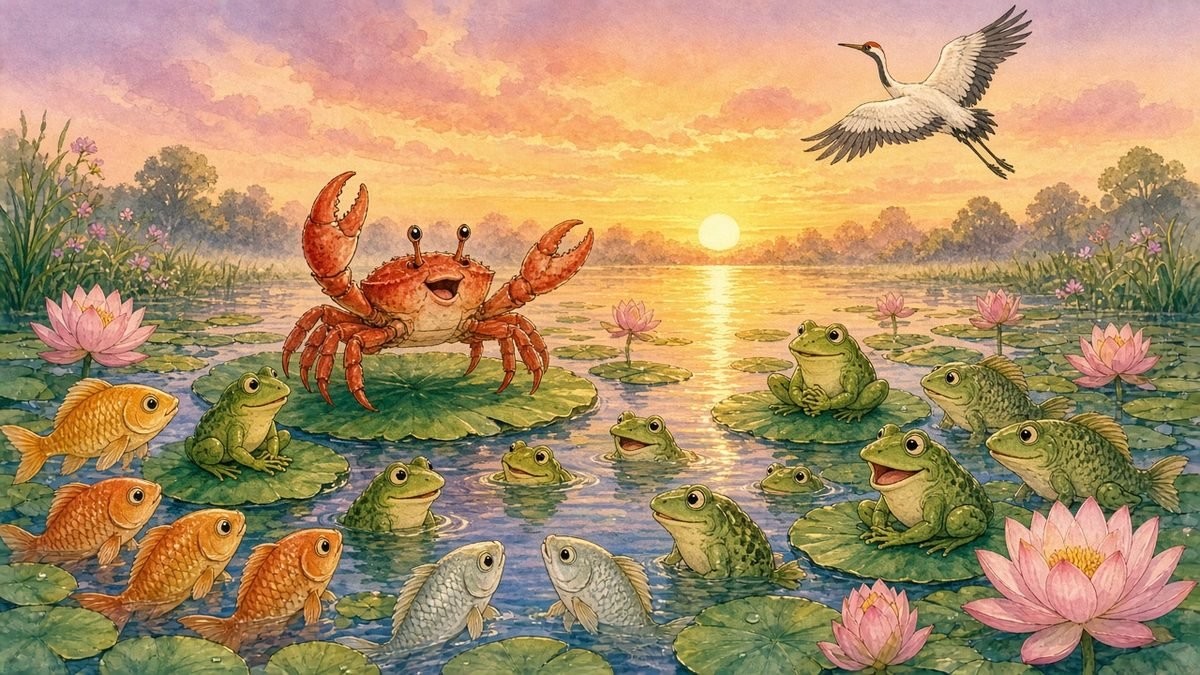
Long ago, beside a forest in India, there was a beautiful pond full of pink lotus flowers. Fish of every color swam in its cool water. Frogs sang on the lily pads, a slow old turtle napped on a rock, and a red crab lived in the mud near the shore.
At the edge of the pond lived an old gray crane. When he was young, he had been the best fisher around. He could stand perfectly still on one leg and snatch a fish in the blink of an eye. But now he was old. His eyes weren’t as sharp, and his neck wasn’t as quick. Most days, the fish swam away before he could catch them.
“I’m getting hungrier and hungrier,” the crane grumbled one morning. “If I can’t catch the fish, I’ll have to trick them into coming to me.”
So he came up with a plan.
Part 2: The crane’s sad story
The next day, the crane stood at the edge of the pond with his head hanging low. He didn’t try to catch a single fish. He just sighed loudly, over and over.
The fish noticed. So did the frogs. Finally the red crab scuttled over.
“What’s the matter, Uncle Crane?” asked the crab. “You haven’t caught anything all day.”
The crane sighed again, even louder. “Oh, my friends, I can’t bear to eat today. I’ve heard terrible news. A wise man passing by told me that no rain will fall here for many years. Soon this pond will dry up completely. All of you will be left on the hot mud with no water at all.”
The fish gasped. The frogs stopped singing. Even the old turtle opened one eye.
“What can we do?” cried a little orange fish.
The crane lifted his head, as if he’d only just had an idea. “Well,” he said slowly, “on the other side of the hills there’s a big, deep lake. It never dries up, not even in the hottest summer. I’m old, but my wings still work. I could carry you there, one at a time, in my beak.”
“You would do that for us?” asked the fish.
“Of course,” said the crane, looking very kind. “What are neighbors for?”
Part 3: One fish at a time
The fish were so frightened of the drought that they lined up at the edge of the pond, pushing and splashing to be first.
“Me first! Me first!”
Every morning, the crane picked up one fish in his beak and flew off over the hills. Every afternoon, he came back alone, looking pleased and well fed.
“Is the lake beautiful?” the fish would ask.
“Oh, wonderful,” the crane would answer. “Your friends are very happy there.”
Day after day, more fish went. The pond grew quieter.
The red crab watched all of this from his lily pad. Something about it bothered him.
“Why does the crane always come back so full,” he wondered, “when he says he can’t eat because he’s too sad? And why has nobody ever come back to visit?”
The crab didn’t want to scare anyone without a reason. So he decided to find out for himself.
Part 4: The crab takes a ride
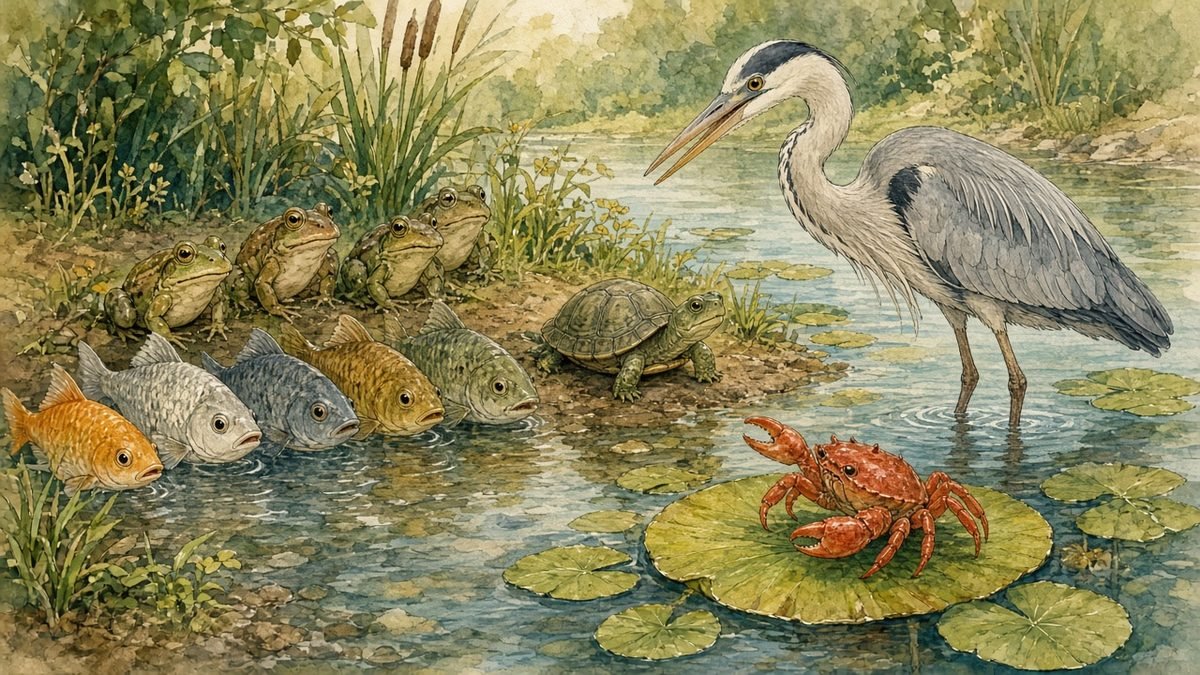
“Uncle Crane,” said the crab one morning, “I’m worried about the drought too. Will you take me to the big lake today?”
The crane thought about it. He’d never tasted crab before. “Climb aboard,” he said with a smile. “You’re too big for my beak, so hold on to my neck.”
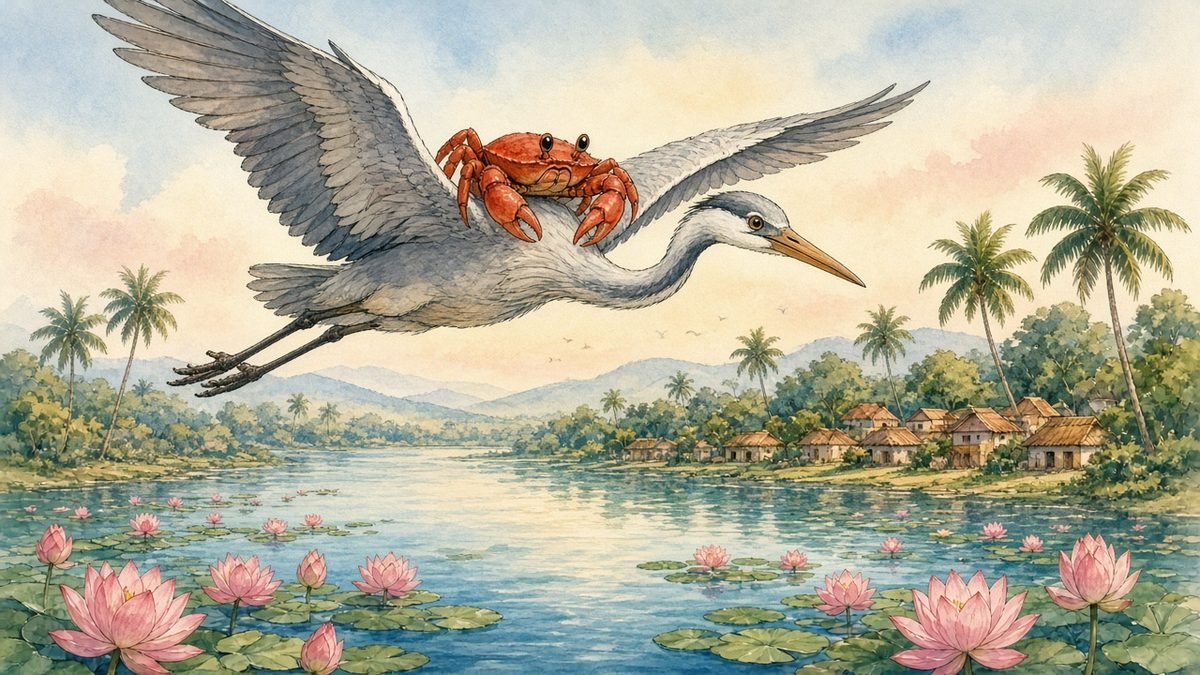
The crab climbed onto the crane’s back and wrapped his claws gently around the crane’s long neck. Up they flew, over the trees and over the hills.
The crab looked down, searching for a big, deep lake. But there wasn’t one. All he could see were dry, rocky hills. Then the crane began to drop toward a flat gray rock. Behind the rock was a tiny, muddy puddle. And in that puddle, crowded together and gasping, were the fish from the pond.
The crab understood everything at once. There was no lake. The crane had been keeping the fish in that little puddle so he could eat them whenever he liked.
The crab tightened his claws around the crane’s neck. Not enough to hurt him badly. Just enough to make the point.
“Ow!” squawked the crane. “What are you doing?”
“I’ve seen your ‘beautiful lake,'” said the crab. “Now listen carefully. You’re going to carry every one of those fish back to our pond, right now. And I’m going to hold on to your neck the whole time.”
Part 5: Home again
The crane had no choice. All afternoon he flew back and forth, back and forth, carrying fish from the muddy puddle to the lotus pond. The crab rode on his neck every trip, keeping a firm grip.
When the very last fish splashed safely into the pond, the crab let go and hopped down onto a lily pad.
“Now go,” he told the crane, “and don’t ever come back to trick my friends again.”
The crane rubbed his sore neck with his wing. He was too embarrassed to say a word. He flapped off into the orange sunset and was never seen at the pond again.
That evening, the fish, frogs and turtle gathered around the crab’s lily pad.
“How did you know?” asked the little orange fish.
“I didn’t know,” said the crab. “But his story didn’t make sense. So I asked questions and went to see for myself.”
The frogs began to sing again, and the pond was full of happy splashing.
And the rain? It came that very summer, just as it always did.
The End
Moral of the story: Don’t believe everything you hear
The crane told a scary story so the fish would trust him without thinking. The crab noticed that the story didn’t add up, and he checked before he believed it. When someone’s words and actions don’t match, it’s smart to slow down, ask questions and find out the truth.
What kids can learn from The Crane and the Crab
- Think before you trust. Kind words aren’t always kind intentions.
- Fear can trick us. The fish were so scared that they didn’t stop to think.
- Notice when things don’t add up. The crab saw that the crane was always full and nobody ever came back.
- Be brave for others. The crab took a risk to protect his friends.
- Tricks don’t last. Sooner or later, the truth comes out.
Questions to talk about with your child
- Why did the crane tell the fish the pond would dry up?
- What made the crab suspicious?
- What would you have done if you were one of the fish?
- Why is it important to check before believing something scary?
- Who is a grown-up you can ask when something doesn’t seem right?
Summary: The Crane and the Crab
An old crane who can no longer catch fish tells the creatures of a pond that it will soon dry up. He offers to fly the fish to a faraway lake, one at a time, but secretly traps them in a muddy puddle to eat later. A clever crab notices that the crane’s story doesn’t make sense and asks for a ride. When he sees the truth, he holds on to the crane’s neck and makes him fly every fish back home. The crane leaves in shame.
For more Panchatantra stories, try The Monkey and the Crocodile, where a monkey thinks fast to escape a trick, and The Blue Jackal.
Read More: The Talkative Tortoise
Frequently asked questions
What is the moral of the Crane and the Crab story?
Don’t trust someone blindly just because their words sound kind. Think for yourself, and check before you believe a story that seems too good or too scary to be true.
Which book is The Crane and the Crab from?
It comes from the Panchatantra, a collection of Indian fables traditionally credited to a scholar named Vishnu Sharma. It appears in the first book of the collection, often called “The Loss of Friends.”
How does the original story end?
In the traditional version, the crane eats the fish he carries away, and the crab finds a pile of fish bones on the rock. The crab then grips the crane’s neck so hard that the crane doesn’t survive. This retelling keeps the trick and the clever crab but uses a gentler ending for young children.
Is it a crane or a heron in the story?
It depends on the translation. Some books call the bird a crane, some a heron and some a stork. The story is the same either way: a long-legged water bird who tries to trick the fish.
What age is this story for?
This gentle version works for ages 5 to 12. Older kids might enjoy comparing it with the original ending and talking about why storytellers change details for different audiences.