The Selfish Giant story is a fairy tale by the Irish writer Oscar Wilde, first published in 1888 in his book “The Happy Prince and Other Tales.” It’s a short, beautiful story about a giant who shuts children out of his garden and finds that spring won’t come without them. It’s been read aloud to children ever since.
This retelling is in simpler words for kids ages 6 to 12 and takes about 10 minutes to read aloud. The ending is gentle but a little sad, and it has a Christian meaning, so we’ve included a note for parents below.
Part 1: The giant’s garden
Every afternoon, on their way home from school, the children used to play in the Giant’s garden.
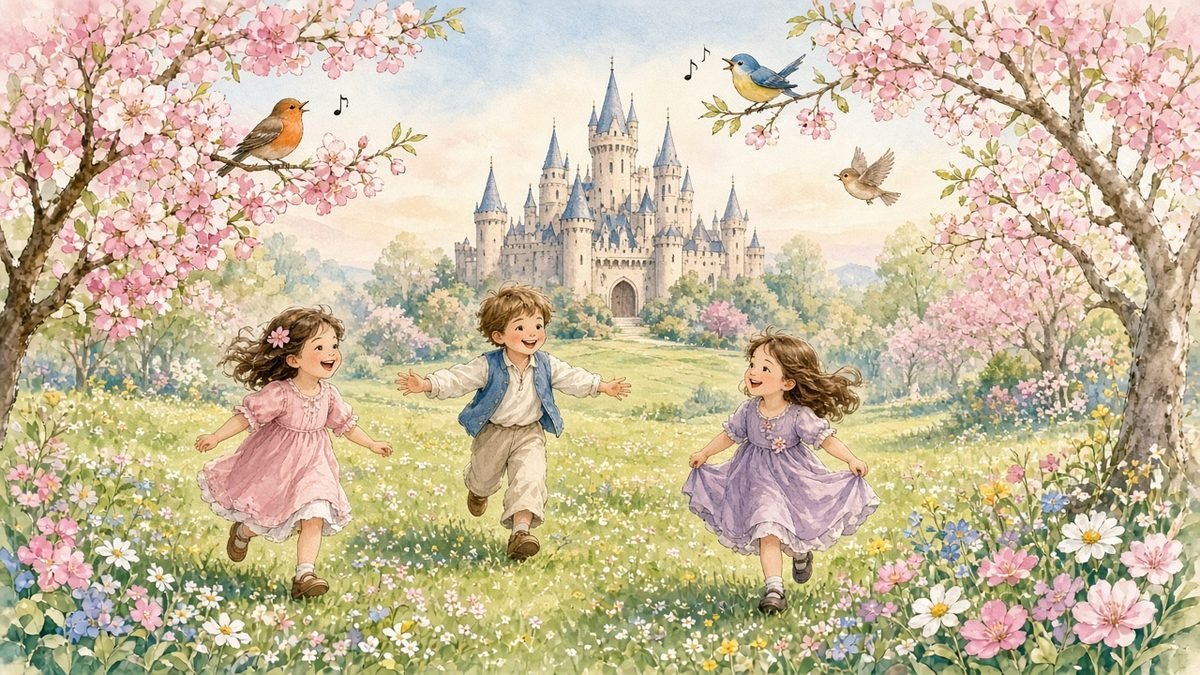
It was a large, lovely garden with soft green grass. Flowers grew here and there like stars. There were twelve peach trees that burst into pink and white blossoms in the spring and gave rich fruit in the autumn. Birds sat in the trees and sang so sweetly that the children would stop their games to listen.
The Giant who owned the garden had been away for a long time, visiting his friend, an ogre who lived far away. He stayed for seven years. Then he decided to go home to his own castle.
When he arrived, he saw the children playing in his garden.
“What are you doing here?” he roared in a very gruff voice. The children ran away.
“My own garden is my own garden,” said the Giant. “Anyone can see that. I’ll let no one play in it but myself.”
So he built a high stone wall all around it and put up a sign that said:
TRESPASSERS WILL BE PROSECUTED
He was a very selfish Giant.
Part 2: The winter that wouldn’t leave
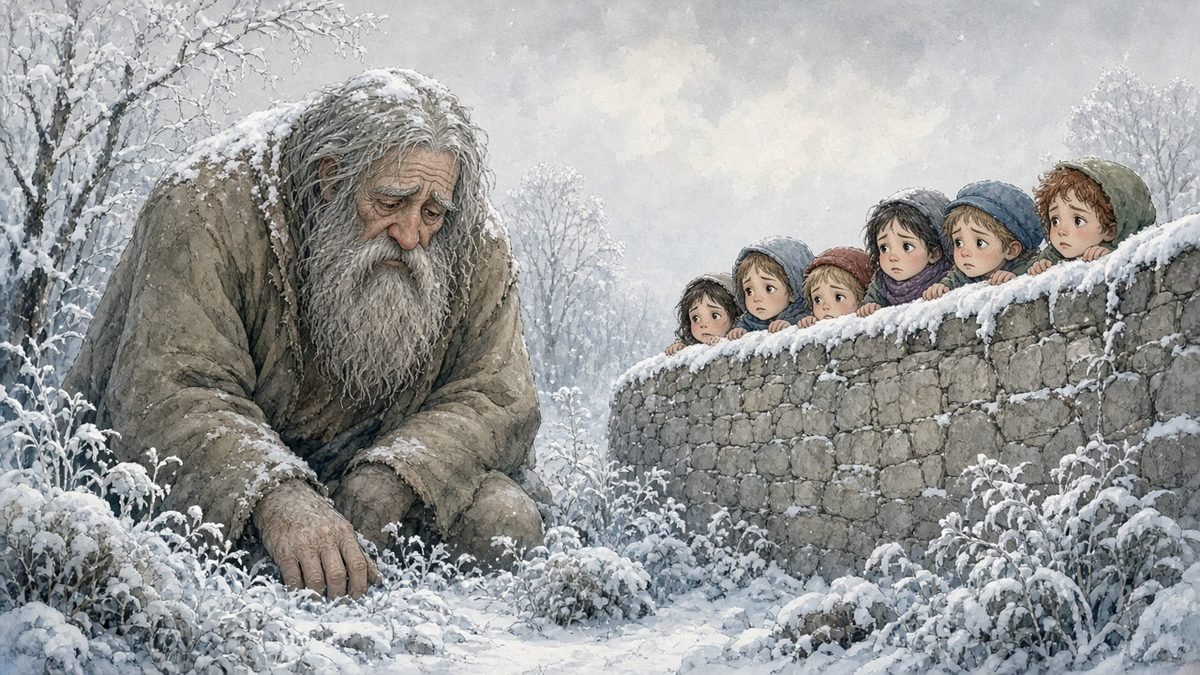
The poor children had nowhere to play. The road was dusty and full of hard stones. After school, they would walk around the high wall and talk about the beautiful garden inside.
“How happy we were there,” they said to each other.
Then spring came. All over the country, there were little blossoms and little birds. Only in the garden of the Selfish Giant was it still winter.
The birds didn’t care to sing there because there were no children. The trees forgot to blossom. Once a beautiful flower poked its head out of the grass, but when it saw the sign, it felt so sorry for the children that it slipped back into the ground and went off to sleep.
The only ones who were pleased were the Snow and the Frost.
“Spring has forgotten this garden,” they cried, “so we’ll live here all year round!”
The Snow covered the grass with her great white cloak. The Frost painted all the trees silver. Then they invited the North Wind to stay with them, and he came, wrapped in furs, roaring around the garden all day and blowing the chimney pots down.
“I can’t understand why spring is so late,” said the Selfish Giant as he sat at his window and looked out at his cold white garden. “I hope the weather changes soon.”
But spring never came, and neither did summer. Autumn gave golden fruit to every garden but the Giant’s.
“He’s too selfish,” said Autumn.
So it was always winter there.
Part 3: The little boy in the corner
One morning, the Giant was lying awake in bed when he heard some lovely music. It was only a little bird singing outside his window, but he hadn’t heard a bird in his garden for so long that it seemed like the most beautiful music in the world.
Then the North Wind stopped roaring. And a delicious smell came in through the open window.
“I believe spring has come at last,” said the Giant. He jumped out of bed and looked out.
What did he see?
Through a little hole in the wall, the children had crept in. They were sitting in the branches of the trees. In every tree that he could see, there was a little child. And the trees were so glad to have the children back that they had covered themselves with blossoms and were waving their arms gently over the children’s heads. Birds were flying about and singing, and flowers were laughing up through the green grass.
It was a lovely sight. Only in one corner was it still winter. It was the farthest corner of the garden, and in it stood a very small boy. He was so small that he couldn’t reach up to the branches of the tree. He was walking around it, crying.
The poor tree was still covered with frost and snow, and the North Wind was blowing above it.
“Climb up, little boy!” said the tree, bending its branches down as low as it could. But the boy was too tiny.
Part 4: The giant’s heart melts
The Giant’s heart melted as he looked out.
“How selfish I’ve been,” he said. “Now I know why spring wouldn’t come here. I’ll put that poor little boy at the top of the tree, and then I’ll knock down the wall. My garden will be the children’s playground forever and ever.”
He was truly sorry for what he had done.
He crept downstairs, opened the front door very softly and went out into the garden. But when the children saw him, they were so frightened that they all ran away, and the garden became winter again.
Only the little boy didn’t run. His eyes were so full of tears that he didn’t see the Giant coming. The Giant came up quietly behind him, took him gently in his hand and lifted him up into the tree.
At once, the tree burst into blossom. The birds came and sang in it. The little boy stretched out his two arms, flung them around the Giant’s neck and kissed him.
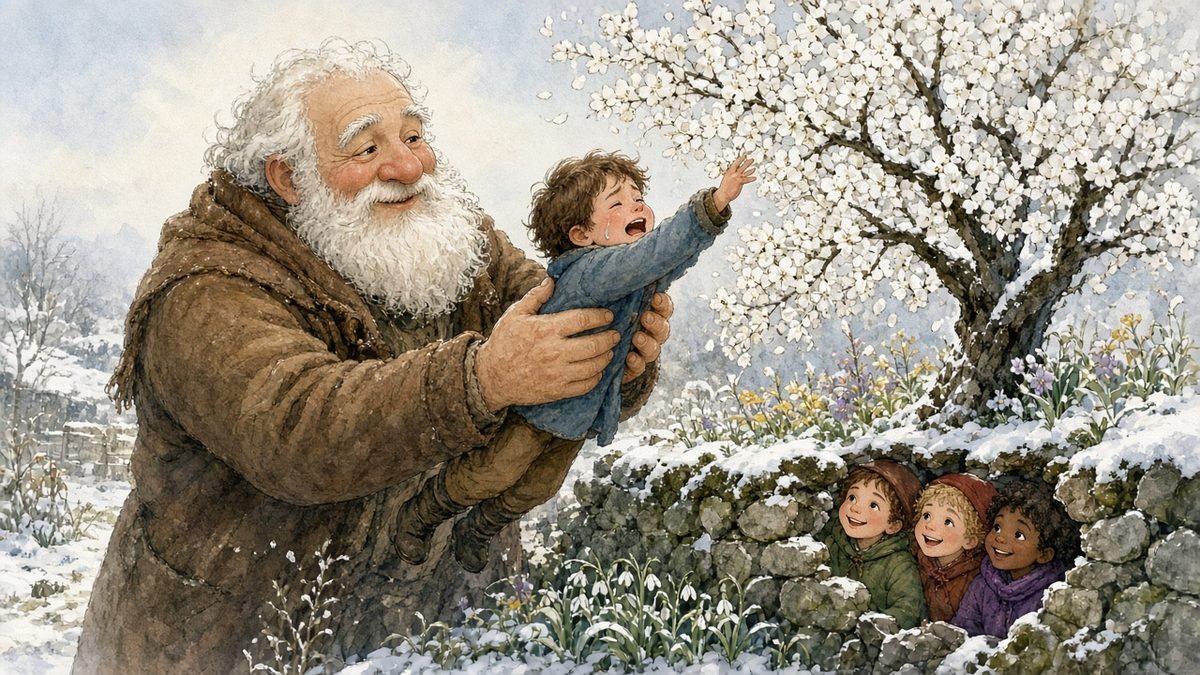
When the other children saw that the Giant wasn’t wicked anymore, they came running back, and spring came with them.
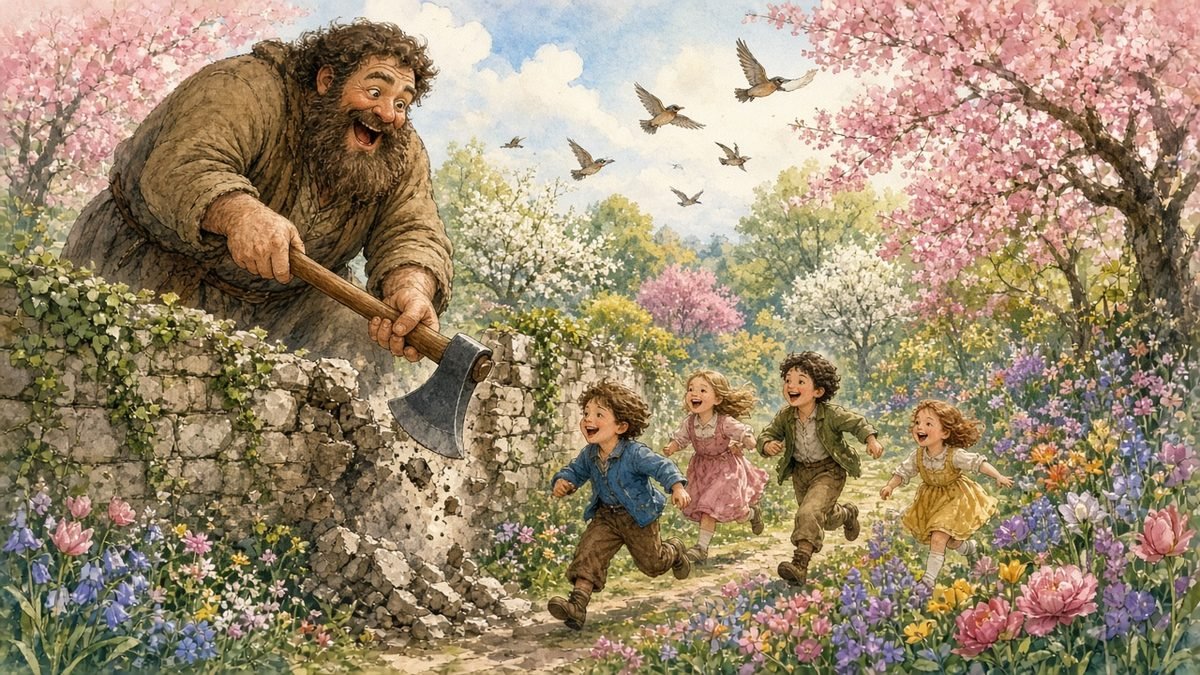
“It’s your garden now, little children,” said the Giant. He took a great axe and knocked down the wall.
Part 5: The little boy returns
All day long the children played, and in the evening they came to say goodbye.
“But where is your little friend?” asked the Giant. “The boy I put in the tree?” The Giant loved him best because he had kissed him.
“We don’t know,” said the children. “He’s gone away.”
The children came to play every afternoon after that, but the little boy was never seen again. The Giant missed him and often spoke of him.
Years went by, and the Giant grew very old and weak. He couldn’t play anymore, so he sat in a big armchair, watched the children at their games and admired his garden.
“I have many beautiful flowers,” he said, “but the children are the most beautiful flowers of all.”
One winter morning, he looked out of his window and rubbed his eyes in wonder. In the farthest corner of the garden was a tree covered with lovely white blossoms. Its branches were golden, silver fruit hung down from them, and underneath it stood the little boy he had loved.
The Giant ran downstairs with great joy and out into the garden. When he came close to the child, he saw that the boy had marks on his hands and on his feet.
“Who has hurt you?” cried the Giant.
“These are the wounds of love,” said the child gently. Then he smiled at the Giant. “You let me play once in your garden. Today you’ll come with me to my garden, which is Paradise.”
That afternoon, when the children ran in, they found the Giant lying peacefully under the tree, all covered with white blossoms. He had gone to the little boy’s garden, where it is always spring.
The End
A note for parents about the ending
Oscar Wilde’s ending is quietly religious. The little boy is meant to be the Christ child, and the marks on his hands and feet stand for the wounds of the crucifixion. The Giant dies peacefully and goes to Paradise. Wilde meant this as a happy ending, though some children find it sad. You can explain it simply: the Giant grew old, and because he learned to be kind, the little boy took him to a beautiful garden where it’s always spring. With younger kids, you can stop after Part 4 if you’d rather.
Moral of the story: Kindness and sharing bring happiness
As long as the Giant kept his garden to himself, it was frozen and empty. When he shared it, it came back to life, and so did he. Selfishness can make our lives cold and lonely, while kindness brings warmth and joy to everyone.
What kids can learn from The Selfish Giant
- Sharing makes things better, for others and for ourselves.
- People can change. The Giant went from selfish to kind.
- Small acts of kindness matter. Lifting one little boy changed everything.
- Notice who’s left out. The Giant saw the one boy who couldn’t reach the tree.
Questions to talk about with your child
- Why did the Giant build a wall around his garden?
- What made the Giant change his mind?
- Why was the little boy so special to the Giant?
- Is there something you could share that would make someone else happy?
Summary: The Selfish Giant
A Giant builds a wall to keep children out of his garden, and spring refuses to come. When the children sneak back in, spring returns everywhere except one corner where a little boy can’t climb a tree. The Giant lifts him into the tree, knocks down the wall and shares his garden. Years later, the little boy returns and takes the old Giant to his own garden, Paradise.
If you liked this story, read Wilde’s The Happy Prince, from the same 1888 book, and The Nightingale and the Rose.
Read More: Kindness Stories for Kids to Read
Frequently asked questions
Who wrote The Selfish Giant?
Oscar Wilde, the Irish writer, wrote it. It was published in 1888 in “The Happy Prince and Other Tales.”
What is the moral of the Selfish Giant story?
Selfishness makes life cold and empty, while kindness and sharing bring joy. It also teaches that people can change for the better.
Who is the little boy in The Selfish Giant?
He is meant to be the Christ child. See the note for parents above for a simple way to explain the ending.
What age is The Selfish Giant good for?
It’s often read with kids ages 6 to 12. Older children can talk about the deeper meaning of the ending.