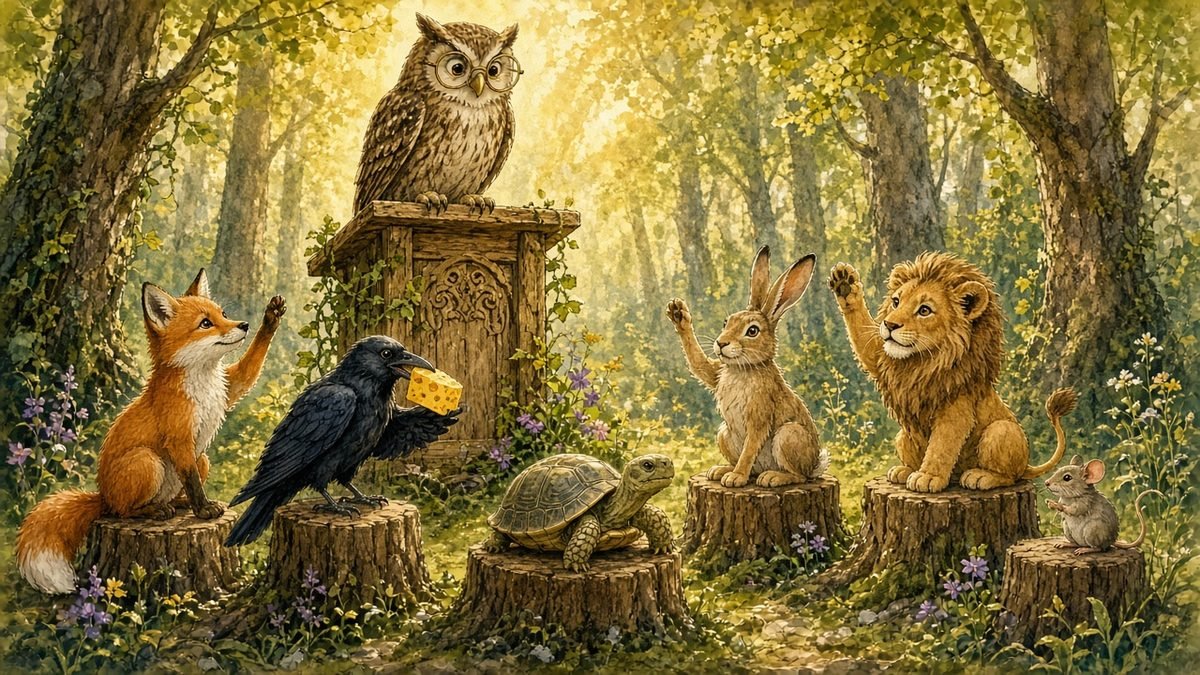
This Aesop’s fables quiz has 20 questions about the most famous fables, from The Tortoise and the Hare to The Milkmaid and Her Pail. Some questions ask what happened in the story. Others ask for the moral, the lesson the story teaches.
After each answer, kids see whether they got it right, a short explanation of the moral and a link to read the full story on Kidsgraphy. That makes the quiz useful for review after story time, or as a warm-up before a lesson on fables.
How to play Aesop’s Fables Quiz
- Choose how many questions you want: 5, 10 or all 20.
- Read the question and the three answer choices.
- Tap or click the answer you think is right.
- The right answer turns green. If you picked a different one, it turns red, and you’ll see the moral explained.
- Press Next question to keep going. At the end you’ll see your score out of the total.
What kids learn from this game
A quiz about morals asks kids to think beyond the plot. Knowing that the fox couldn’t reach the grapes is recall. Knowing why he said they were sour is understanding.
- Reading comprehension and recall
- Finding the main idea and the lesson of a story
- Vocabulary, including phrases like “sour grapes” and “slow and steady”
- Talking about choices, honesty, kindness and greed
Best age range
Ages 6 to 12. Children ages 6 to 12 can play. Younger kids may need a grown-up to read the questions aloud. If your child hasn’t heard many fables yet, start with 5 questions and read the stories you miss.
Tips for parents and teachers
- Read the question out loud together and talk about each choice before tapping.
- When your child gets one wrong, open the story link and read it together. The answer will make sense right away.
- Ask “Has anything like this ever happened to you?” after a moral about honesty or sharing.
- Teachers can use the 20-question version as a fun review at the end of a fables unit.
- Play again later in the week. The questions come in a different order each time.
Why fables still matter
Aesop’s fables are short, usually under a page, and each one ends with a clear lesson. That makes them a good first step into talking about right and wrong. Kids can laugh at the vain crow or the boastful hare and still see a bit of themselves in the story. Teachers often use fables to introduce the idea of a theme, the big message an author wants readers to take away. This quiz gives kids practice saying that message in plain words. If your child can explain why the boy who cried wolf wasn’t believed, they’re doing the same thinking they’ll later use on longer books.
Stories to read with this game
Every question links to its story, so kids can check the answer and read more. Three good ones to start with:
Frequently asked questions
Who was Aesop?
Aesop is the name linked to a collection of short animal stories from ancient Greece, told more than 2,000 years ago. Little is known about his life, and many of the fables were collected and retold by later writers.
What is a moral?
A moral is the lesson a story teaches. For example, the moral of The Tortoise and the Hare is often given as “slow and steady wins the race.”
Is the quiz the same every time?
No. The questions and the answer choices are shuffled each time you play.
Does the quiz work for a classroom?
Yes. It runs in a browser, so you can show it on a projector or smartboard and let students vote on each answer.
More free games for kids
Looking for something else to play? Try the Story Sequencing Game or the Fable Friends Memory Match, or see all of our free online games for kids. Every game is free, works on phones, tablets and computers, and needs no download.