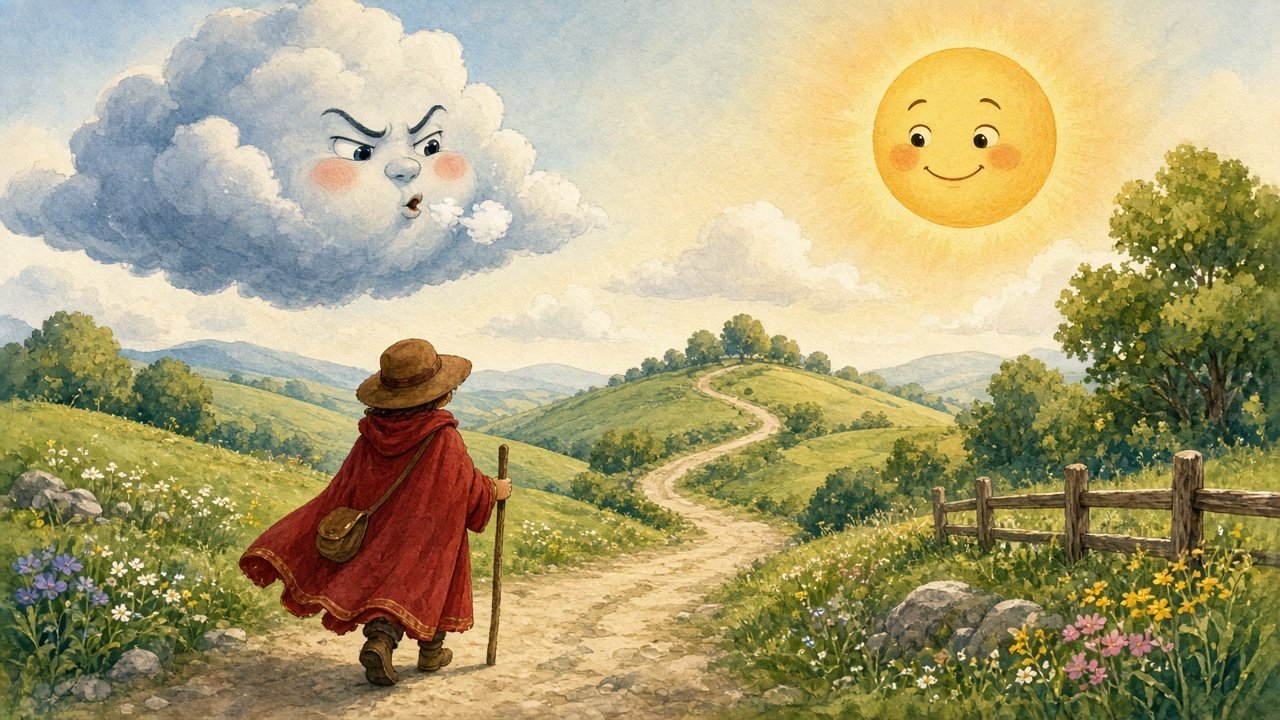
The North Wind and the Sun is one of Aesop’s best-loved fables, and one of the shortest. In the oldest version it takes only a few lines: the Wind and the Sun argue about who is stronger, and they settle it by seeing who can make a traveler take off his cloak. The answer surprises the Wind, and it often surprises children too.
This retelling stretches the fable into a full bedtime story for kids aged 5 to 12, with a boastful, puffy-cheeked Wind, a patient Sun and a young traveler who just wants to get to his grandmother’s house. After the story you’ll find the moral, a few questions to talk over together and a short FAQ.
Part 1: A Boastful Wind
High above the hills and valleys, where the clouds drift and the birds fly, the North Wind lived in a big gray cloud. He was loud. He was bouncy. And he liked very much to show off.
When the North Wind blew, the trees bent their heads. Leaves went spinning through the air, washing flapped on the lines, and the sea threw up great white waves. Children chased their hats down the street, and ships raced across the water with their sails stretched tight.
“Look at me!” the North Wind would roar. “Nobody in the whole sky is as strong as I am!”
Not far away, the Sun was shining in her quiet way. She did not roar. She did not push. Every morning she simply rose over the hills, warmed the fields, woke up the flowers and dried the dew from the grass.
One bright morning, the North Wind puffed himself up and drifted right next to her.
“Good morning, Sun,” he said, in a voice that was not very polite. “I have been thinking. Everybody says you are important. But I am much, much stronger than you.”
The Sun smiled. “Is that so?” she said.
“It is!” said the Wind. “I can knock down fences. I can blow the roofs off barns. I can push a ship across the whole ocean. All you do is sit there and glow.”
The Sun thought for a moment. She did not like arguing, but she could see the Wind was not going to stop.
“Very well,” she said. “Instead of arguing, let us have a friendly contest. Then we will see.”
Part 2: The Traveler and His Red Cloak
Down below, on a winding road between the green hills, a young traveler was walking along. He wore a long red cloak with a hood, a brown hat with a wide brim, and boots that were a little dusty. In one hand he held a walking stick. Over his shoulder hung a small leather bag with bread and cheese inside. He was on his way to visit his grandmother, who lived on the other side of the valley.
The Sun pointed down at him with one golden ray.
“Do you see that traveler?” she asked. “Whoever can make him take off his cloak will be the stronger one. Do you agree?”
The North Wind laughed so hard that a little gust ran across the hills and tickled the sheep.
“Take off his cloak? That’s easy!” he said. “I’ll have it off him in one puff. You might as well give up right now.”
“Then you may go first,” said the Sun kindly. And she slipped behind a cloud to watch.
Part 3: The North Wind Blows and Blows
The North Wind took a deep breath. His gray cheeks grew round and fat. Then he blew.
WHOOOOSH!
A cold gust raced down the hills and swept across the road. The traveler’s cloak flapped around his legs. His hat flew right off his head and went tumbling away into the grass.
“Oh!” said the traveler. He shivered. But instead of letting his cloak go, he grabbed the edges and pulled it tighter around himself.
“Hmph,” said the North Wind. “That was just a little puff. Watch this.”
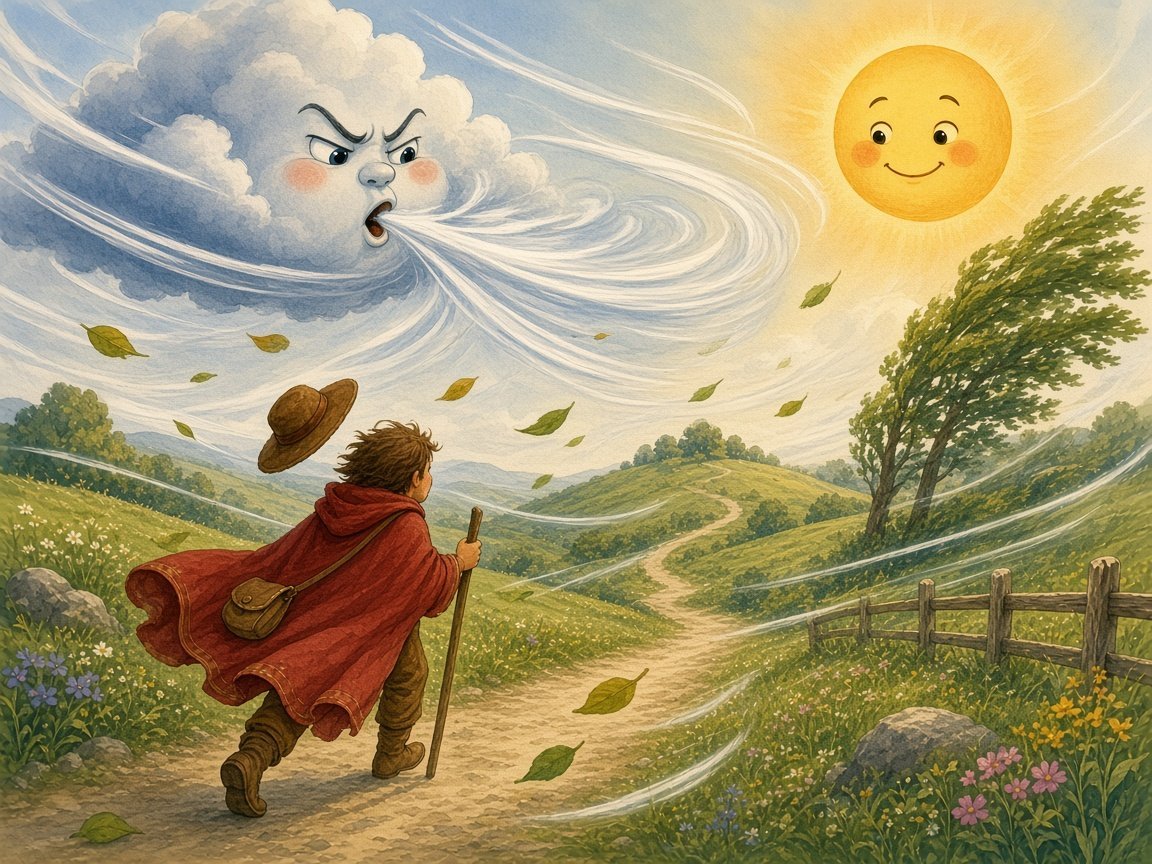
He blew harder.
WHOOOOOOOSH!
Now the trees bent low. Leaves whirled through the air like flocks of tiny green birds. Dust rose up from the road and stung the traveler’s eyes. The fence posts creaked. The cloak flapped and snapped like a flag in a storm.
But the traveler only bent his head, turned up his collar and wrapped his cloak around himself twice. “What a terrible wind,” he muttered. “I must hold on tight, or I’ll freeze.”
The North Wind grew cross. He was not used to losing. He blew harder than he had ever blown in his life, until he was huffing and puffing and his cloud was shaking.
WHOOOOOOOOOOOOSH!
The traveler sat down behind a big rock, pulled his knees up to his chin, and tucked every bit of his cloak around him so the wind couldn’t get in anywhere at all.
At last the North Wind ran out of breath. He drifted back up into the sky, panting and grumbling.
“It’s an impossible test,” he said. “Nobody could get that cloak off. He’s holding on far too tightly.”
“May I try?” asked the Sun.
The North Wind snorted. “Go ahead. If I couldn’t do it, you certainly can’t.”
Part 4: The Sun’s Gentle Warmth
The Sun came out from behind her cloud. She did not rush. She did not roar. She simply began to shine.
Her soft, warm rays spread across the hills. The cold air began to fade. The leaves settled back on their branches. The birds came out of their hiding places and began to sing again.
Down on the road, the traveler stood up from behind his rock. He looked around. “Well,” he said, “the wind has stopped at last.” He found his hat in the grass, brushed it off and put it back on. Then he picked up his walking stick and carried on along the road.
The Sun shone a little more brightly.
After a while, the traveler loosened the front of his cloak. Then he pushed back his hood. A little later, he wiped his forehead with the back of his hand. “My goodness,” he said. “It’s turned into a lovely warm day.”
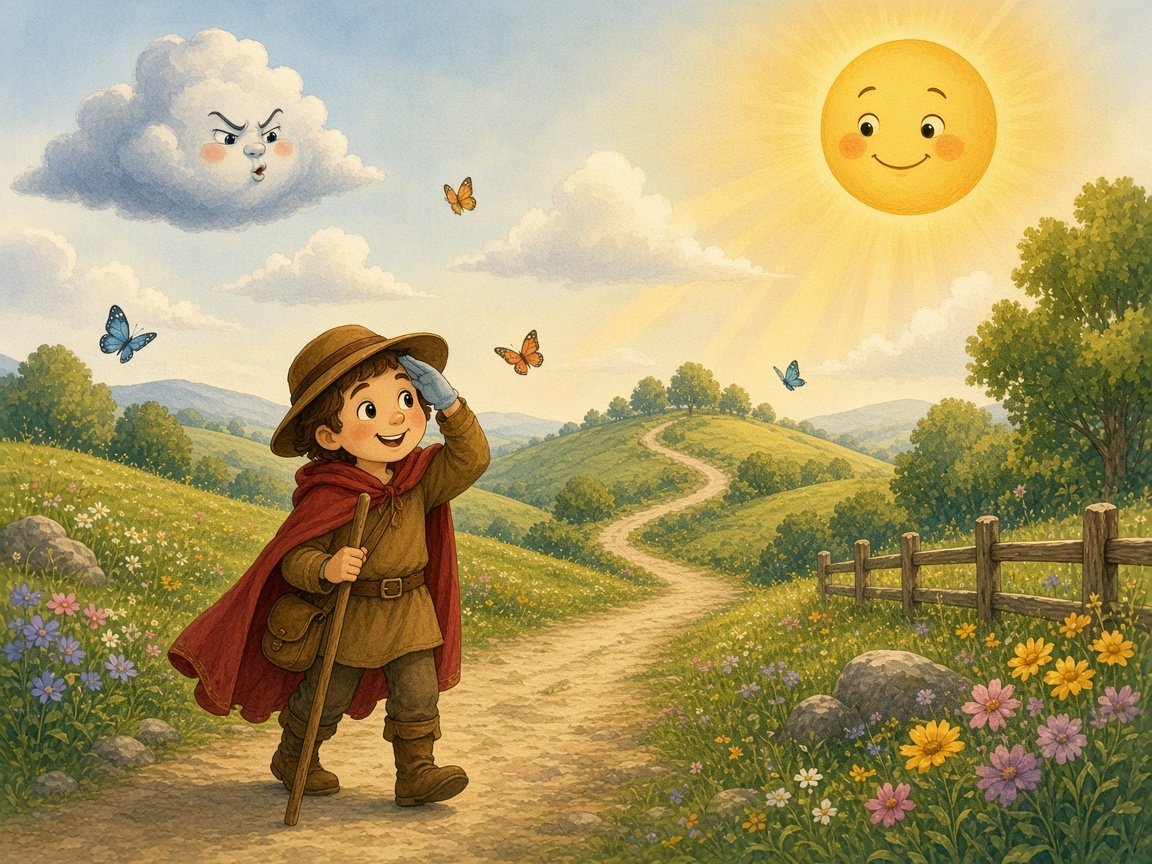
The Sun kept shining, steady and gentle, warming the road, the fields and the little stream that ran beside them.
The traveler slowed down. He was getting very warm indeed. Finally he stopped, untied the strings at his neck and took off his heavy red cloak. He folded it neatly over his arm.
“That’s much better,” he said with a happy sigh.
Up in the sky, the North Wind’s mouth fell open.
Part 5: What the North Wind Learned
The traveler walked until he came to a shady tree beside the stream. He laid his cloak on the grass, sat down, pulled off his dusty boots and dipped his feet into the cool water. Then he took out his bread and cheese and ate his lunch, humming a little tune.
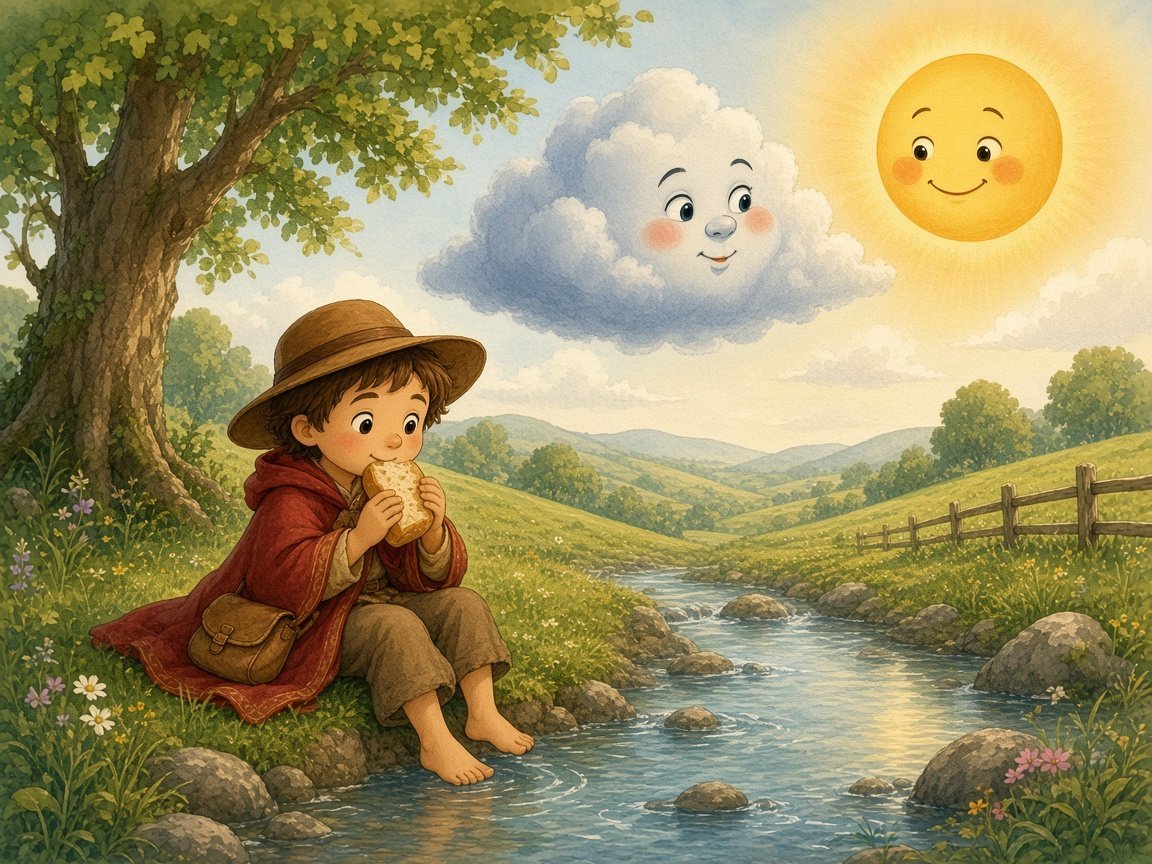
The North Wind drifted over to the Sun. He was much smaller and quieter now.
“I don’t understand,” he said. “I used all my strength. I pushed and pulled and huffed and puffed. And you barely did anything at all.”
The Sun laughed softly. “You tried to force him,” she said. “When someone pushes us, we push back. The harder you blew, the tighter he held on. I only made him warm and comfortable, and then he chose to take off his cloak himself.”
The North Wind was quiet for a long time. Then he gave a small, embarrassed sigh.
“I suppose being loud isn’t the same thing as being strong,” he said.
“No,” said the Sun. “But it’s a good thing to learn. And you are very strong, you know. The ships need you. The windmills need you. The kites need you. You don’t have to win every contest to be important.”
The North Wind thought about that. Then he blew the gentlest breeze he had ever made. It floated down to the stream and cooled the traveler’s face as he finished his lunch.
The traveler smiled up at the sky. “What a perfect day,” he said.
And the Sun and the North Wind, side by side, agreed that it was.
The End
Moral of the story: The North Wind and the Sun
Kindness and gentleness can do what force cannot. Aesop’s own moral is usually given as “persuasion is better than force.” When you are warm, patient and kind, people are much more willing to listen to you and to change their minds.
What kids can learn from this fable
- Shouting, pushing and bossing people around usually makes them hold on tighter to what they already think.
- Being loud doesn’t make you strong. The Sun never raised her voice, and she still won.
- Patience works. The Sun did not rush the traveler. She gave him time to decide for himself.
- Losing gracefully matters. The North Wind admitted he was wrong and then did something kind.
Questions to talk about with your child
- Why did the traveler hold his cloak tighter when the North Wind blew harder?
- What did the Sun do differently from the Wind? Why did it work?
- Can you think of a time when someone asked you kindly to do something, and you were happy to do it? What about a time someone was bossy?
- How do you think the North Wind felt at the end of the story? What did he do to show he had learned something?
Summary: The North Wind and the Sun
The North Wind boasts that he is stronger than the Sun. To settle it, the Sun suggests a contest: whoever can make a traveler take off his cloak wins. The Wind blows with all his might, but the colder it gets, the tighter the traveler wraps his cloak. Then the Sun shines gently, the day grows warm, and the traveler takes off his cloak on his own. The Wind learns that gentleness and kindness can succeed where force fails.
Read More: The Tortoise and the Hare: A Timeless Tale of Perseverance
Frequently asked questions
Who wrote The North Wind and the Sun?
The fable is credited to Aesop, a storyteller who is said to have lived in ancient Greece around 2,500 years ago. His fables were passed along by word of mouth for centuries before they were written down.
What is the moral of The North Wind and the Sun?
The traditional moral is “persuasion is better than force.” In simple words for kids: being kind and gentle gets better results than being rough or bossy.
Is this story good for bedtime?
Yes. It is calm, it has no scary parts, and the ending is peaceful. The “WHOOOOSH” sounds are fun for children to make along with you, so it also works for reading aloud in a classroom.