Ant Army Times Tables is one of the simplest multiplication games for kids who are learning their facts. Pick a single table, like the 3s or the 7s, or mix the facts from 2 to 10 or 2 to 12. Then see how many you can solve before the timer runs out.
Kids type answers with the on-screen number pad or a keyboard. For small facts up to 6 times 6, rows of ants show the problem as an array, so kids can count groups when they’re unsure. At the end, the game lists the facts that tripped your child up so you know what to practice next.
How to play Ant Army Times Tables
- Choose a table: one number, Mixed 2 to 10 or Mixed 2 to 12.
- Choose 1 minute, 2 minutes or No timer.
- Press Start and solve the problem on the screen. Type the answer with the number pad or your keyboard.
- Press the check button or Enter. If your answer is right, the next fact appears right away.
- When time runs out, you’ll see how many facts you solved and which ones to practice.
What kids learn from this game
Knowing multiplication facts by heart makes later math, like division, fractions and long multiplication, much easier.
- Fluency with times tables from 1 to 12
- Seeing multiplication as equal groups (the ant arrays)
- Mental math speed
- Noticing which facts still need work
Best age range
Ages 7 to 11. Most US students start multiplication in second or third grade. The Common Core standards used in many states expect kids to know all products of two one-digit numbers from memory by the end of third grade. Practicing a single table fits ages 7 to 8. Mixed facts and the 2-minute timer give fourth and fifth graders a good challenge.
Tips for parents and teachers
- Start with the easy tables: 2s, 5s and 10s. Move to 3s, 4s and 9s next.
- Use No timer for kids who feel nervous about speed.
- Look at the practice list at the end and work on those facts for a day.
- Point out patterns: every 5s answer ends in 0 or 5, and 9s digits add up to 9.
- Two minutes a day, most days, works better than one long session a week.
A simple plan for learning times tables
Many teachers suggest learning the facts in small groups instead of all at once. A good order is 2s, 10s and 5s first, then 3s and 4s, then 9s, and finally 6s, 7s and 8s. Spend a few days on one table using the single-table setting, then mix it with the ones your child already knows. Remember that every fact has a partner: if you know 3 times 7, you also know 7 times 3, so there are fewer facts to learn than it looks. The practice list at the end of each round tells you exactly where to start next time.
Stories to read with this game
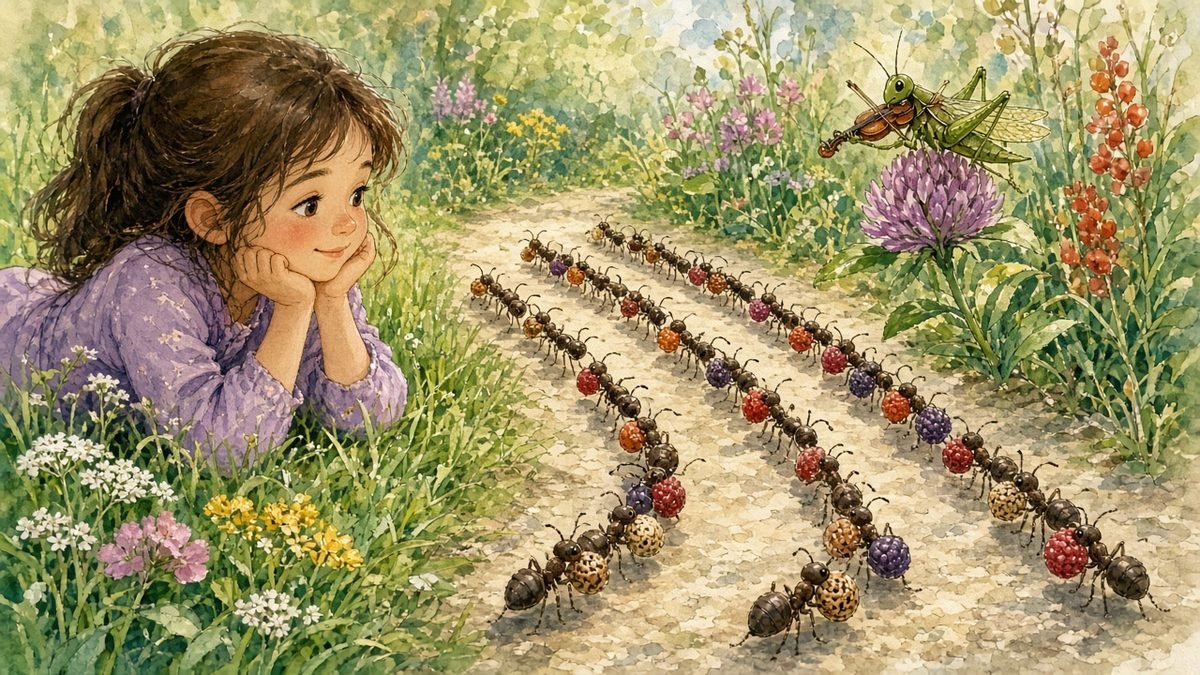
The ants in this game are a nod to Aesop’s hardworking ant, who practiced every day and was ready when winter came. That’s a pretty good plan for times tables too.
Frequently asked questions
Is this multiplication game free?
Yes. It’s free and runs in any modern browser on a phone, tablet or computer.
Can my child practice just one times table?
Yes. Choose a single number from the Table menu, like the 6s, and every question will use it.
What does the ant picture mean?
For facts up to 6 times 6, the ants are arranged in rows. Three rows of four ants shows 3 times 4. Kids can count them if they’re unsure.
Is there a version without a timer?
Yes. Choose No timer and press Finish whenever you want to see your results.
More free games for kids
Looking for something else to play? Try the Tortoise and Hare Addition Race or the Coin Counting Game, or see all of our free online games for kids. Every game is free, works on phones, tablets and computers, and needs no download.