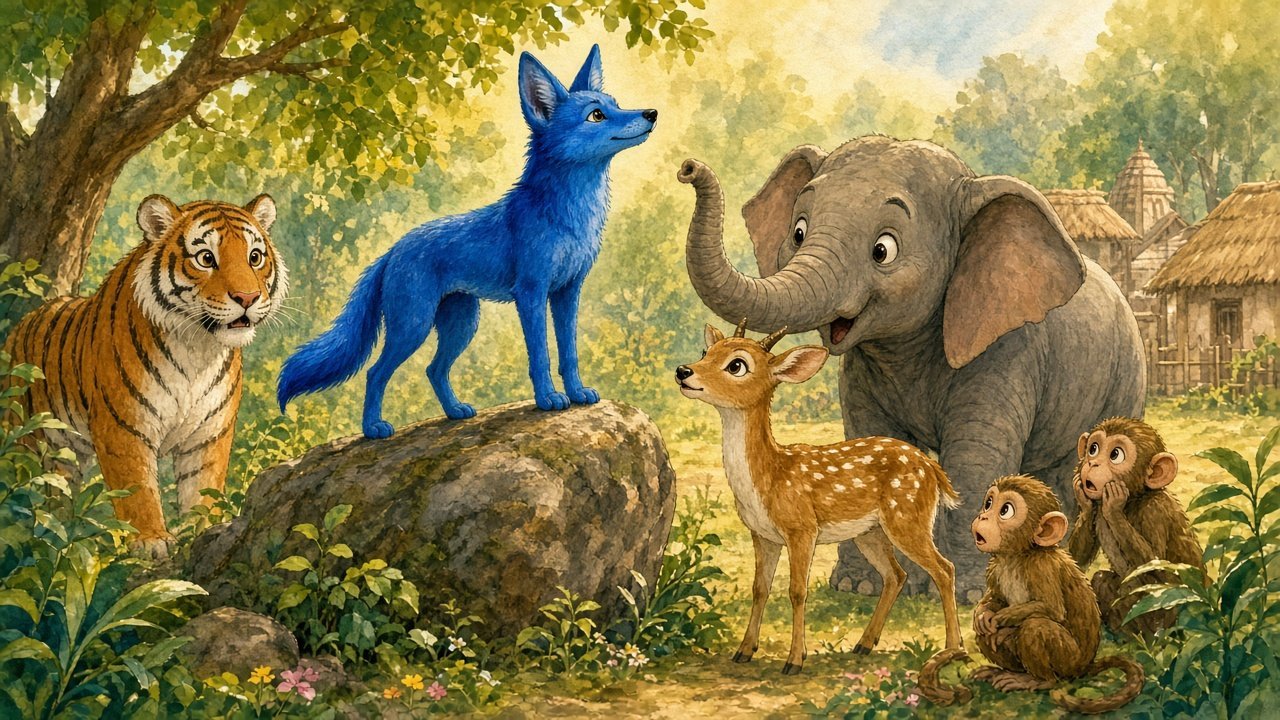
The Blue Jackal is one of the funniest and most famous stories from the Panchatantra, a collection of animal tales first told in India more than two thousand years ago. Wise teachers used these stories to help young princes learn about good sense, friendship and honesty. Children still love this one today, mostly because of its hero: a hungry, ordinary jackal who falls into a tub of blue dye and wakes up looking like nothing the jungle has ever seen.
It is a story about pretending to be someone you are not, and it takes about ten minutes to read aloud. The moral, questions to talk about and a short FAQ follow the story.
Part 1: A Hungry Jackal Wanders into the Village
Once upon a time, at the edge of a thick green jungle, there lived a jackal named Chandarava. He was thin and scruffy, with a bushy tail and sharp ears that turned at every sound. Chandarava was not the strongest animal in the jungle, and he was not the fastest. Most days, he was simply hungry.
One summer, food was very hard to find, and Chandarava’s tummy rumbled all day long.
“If I stay here, I will starve,” he said to himself one evening. “The village is close. Perhaps the people there have thrown away some scraps. Perhaps I can find a bone or a bit of bread.”
So when the moon came up, Chandarava crept into the village. Lamps flickered in a few windows as he sniffed his way past a well and a row of sleeping goats.
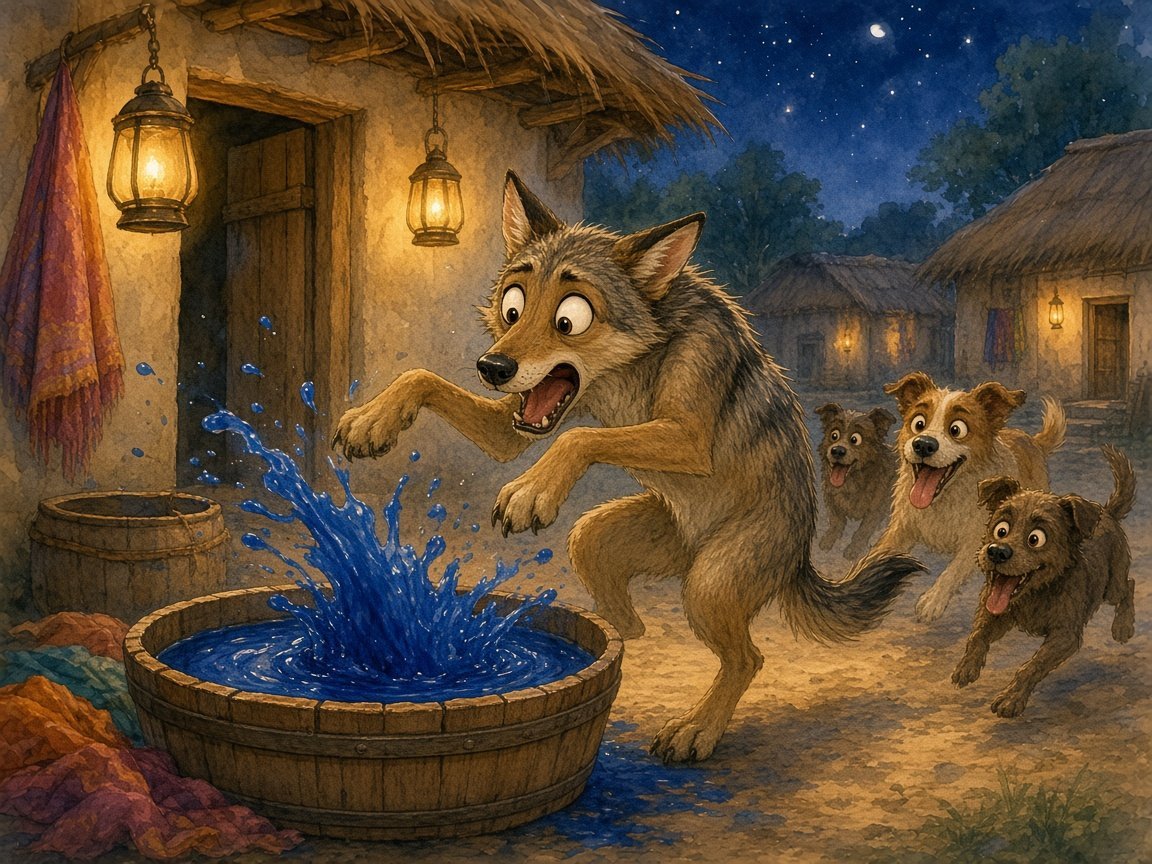
He had just found a crust of roti near a doorstep when the village dogs smelled him. “Woof! Woof! WOOF!” A whole pack came racing around the corner with their tails up and their teeth showing.
Chandarava dropped the roti and ran.
Part 2: Splash! Into the Indigo Tub
The dogs were getting closer and closer. Chandarava’s heart thumped so hard he thought it might burst.
Up ahead stood the house of a dyer, a man whose job was to color cloth. Outside his hut sat a huge wooden tub filled almost to the top with indigo dye, the deepest, brightest blue you can imagine. The dyer dipped his cloth in it every morning and hung it out to dry in long blue ribbons.
In the dark, Chandarava did not see the tub. He leaped.
SPLASH!
Down, down, down he went, right into the dye. It filled his ears and soaked his fur from the tip of his nose to the end of his tail. He held his breath and stayed very, very still.
The dogs skidded to a stop and sniffed around the hut, but all they could smell was dye. After a while they gave one last bark and trotted home to their beds.
When everything was quiet, Chandarava climbed out of the tub, dripping and shivering. He shook himself and ran as fast as he could, all the way back into the jungle.
Part 3: “Who Is That Strange Blue Creature?”
By the time the morning sun rose, Chandarava’s fur had dried. He stopped by a pond for a drink, looked down at the water, and nearly fell over in surprise.
Staring back at him was a bright blue animal. Its ears were blue. Its paws were blue. Even its whiskers were blue.
“Is that… me?” he whispered. He licked his paw and rubbed it. The blue did not come off. Indigo dye is very stubborn, and it was not going anywhere.
Just then, he heard footsteps. A deer stepped out from the bushes, saw him and froze. Her big eyes grew even bigger. Then she spun around and bounded away.
“There is a strange blue creature by the pond!” the parrots squawked, and soon the whole jungle knew.
Even the tiger came to look. Even the elephant. Even the lion, who was king of the jungle, stood at a distance and watched with a worried frown. None of them dared to come close, because none of them knew what this blue animal was or what it might do.
Chandarava noticed that they were all afraid of him. For the first time in his whole life, the big animals were the ones keeping their distance. A sly little idea began to grow in his head.
Part 4: King Chandarava Takes the Throne
Chandarava climbed onto a big flat rock where everyone could see him. He puffed out his chest and lifted his chin.
“Do not be afraid, creatures of the jungle!” he called in his deepest voice. “I have been sent down from the heavens by the gods themselves. They saw that this jungle had no proper ruler, so they made me in this special blue color and sent me to be your king. From this day on, you will all obey me, and I will protect you.”
The animals looked at one another. A blue animal sent from the sky? It sounded strange, but nobody had ever seen a blue animal before. Maybe it was true.
The lion bowed his head, the elephant lowered his trunk, and one by one every animal bowed.
“Your Majesty,” they said.
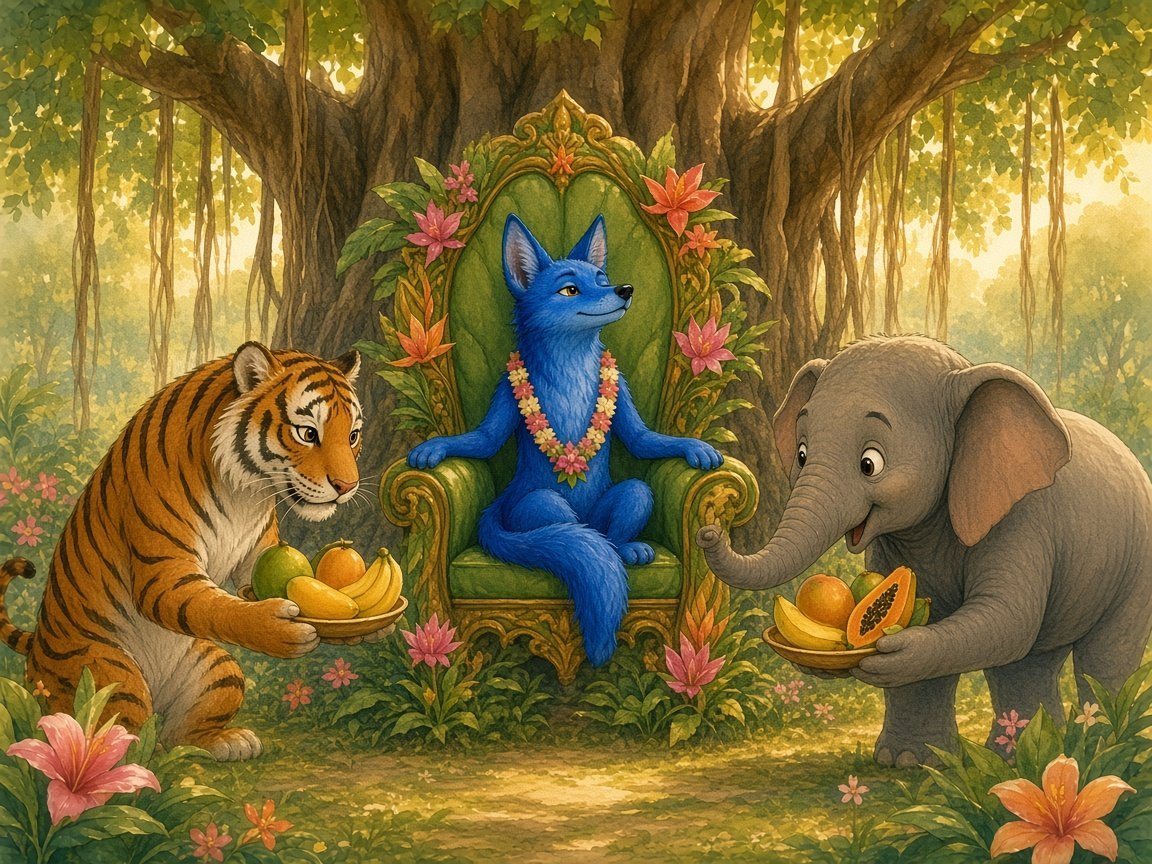
Chandarava could hardly believe it. He made the lion his chief minister and the elephant his doorkeeper. They built him a throne of leaves and flowers under the biggest banyan tree in the jungle. Every day the animals brought him the juiciest fruit and the best food they could find.
Whenever the new king saw other jackals, his own family and old friends, he chased them away.
“Get out of my kingdom!” he snapped. “I do not want you here.”
The other jackals were hurt and confused. They did not know that the blue king was really one of them. And Chandarava wanted to keep it that way. If they came too close, they might recognize him. If anyone found out he was only a jackal, he would lose everything.
So he sent them far off to the edge of the jungle, and he went back to eating mangoes on his flower throne.
Part 5: The Night of the Full Moon
Weeks went by. Chandarava grew round and comfortable, and he almost forgot that he had ever been a hungry, scruffy jackal running from village dogs.
Then came a night with a big, round, silver full moon.
The king was holding court under the banyan tree. The lion sat on one side of him, the tiger on the other. The elephant stood at the entrance, and all the smaller animals sat in a circle on the grass.
Far away, at the edge of the jungle, the other jackals lifted their noses to the moon and began to sing.
“Aoooooo! Aoooooo!”
Their howls floated through the trees. Chandarava’s ears twitched. Something deep inside him stirred. Every jackal in the world howls when it hears other jackals howling, and it is very, very hard not to join in. He tried to stay still. He tried to keep his royal face. But his nose tipped up all by itself, his mouth opened, and out came…
“AOOOOOOOO!”
The whole court went silent.
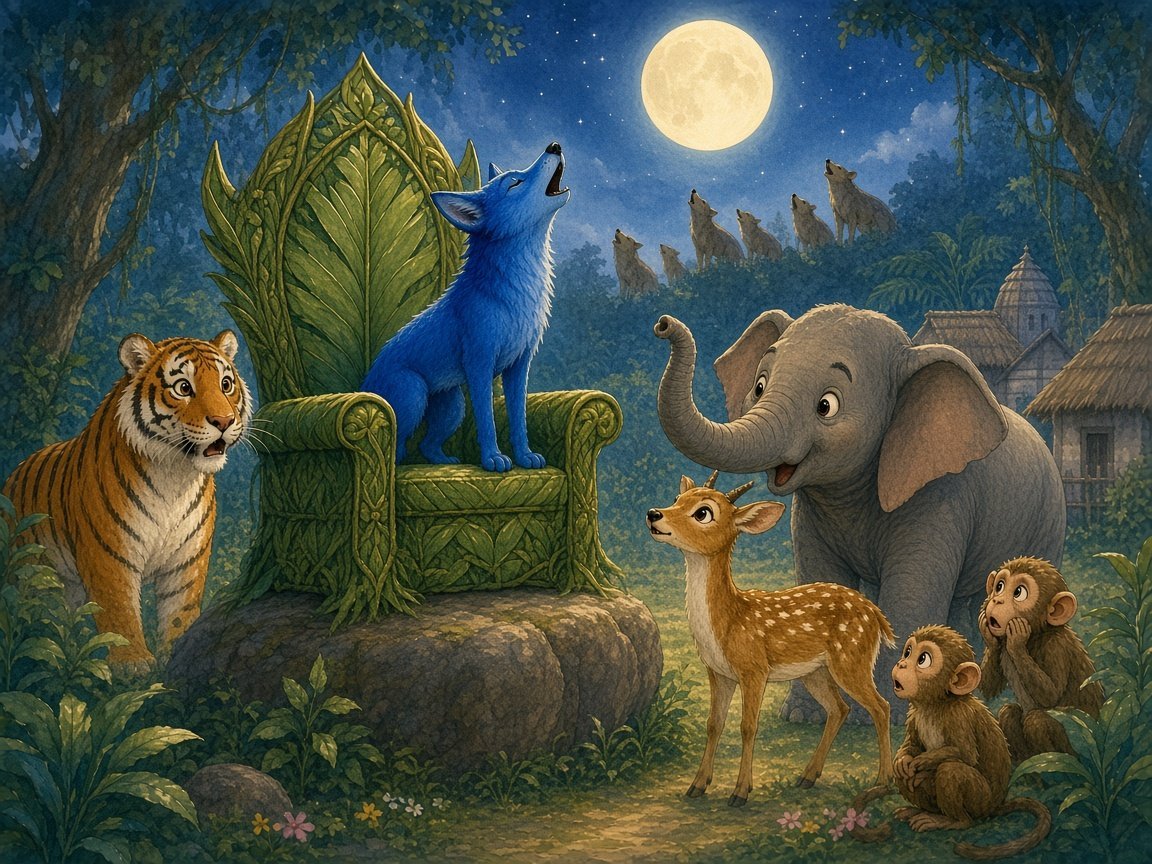
“That’s not the voice of a heavenly king,” said the lion slowly. “That is the howl of a jackal.”
“He is no messenger from the gods,” growled the tiger. “He is a jackal who fell into some dye!”
Part 6: The Truth Comes Out
Chandarava jumped off his throne. His blue fur stood on end. He did not wait to say sorry or explain. He ran as fast as his legs could carry him, out of the banyan grove, through the bushes and away into the night, with the angry roars of the lion and tiger chasing behind him.
He ran until he reached the edge of the jungle, where his family lived. But when the other jackals saw the blue king coming, they remembered how he had chased them away. They turned their backs on him too.
Chandarava sat alone under the moon. His fur was still blue, but now the color felt like a heavy coat he could not take off.
“I had a family,” he said softly. “I had friends who were just like me. I pushed them away so I could pretend to be something I wasn’t. And in the end, my own voice told the truth.”
Some tellers say the story ends there. But it is nice to imagine that Chandarava did not give up. Over many rainy days, the blue dye slowly washed out of his fur. Little by little he went back to his family, said sorry for being unkind, and asked if he could be just Chandarava again. And because families can be forgiving, they let him sit with them under the moon. That night, when they all lifted their noses and howled together, he sang the loudest of all.
The End
Moral of the story: The Blue Jackal
You can fool people for a while by pretending to be someone you are not, but the truth comes out sooner or later. It is better to be honest about who you are and to stay kind to the people who are like you and who care about you.
What kids can learn from The Blue Jackal
- Be yourself. Chandarava’s real self was a jackal, and when the other jackals howled he could not help howling too. Pretending takes a lot of work, and it rarely lasts.
- Lies grow. His first fib, “I was sent by the gods,” led to more and more pretending until he was scared all the time of being found out.
- Don’t forget your friends and family. When he felt important, he chased away the jackals who loved him. When things went wrong, they were the ones he needed.
Questions to talk about with your child
- Why do you think the jungle animals believed Chandarava when he said the gods had sent him?
- Why did Chandarava chase the other jackals away? Was that kind? What could he have done instead?
- Have you ever pretended to be someone or something you weren’t? How did it feel?
- If you were one of the jackals at the end, would you forgive Chandarava? Why or why not?
Summary: The Blue Jackal
A hungry jackal named Chandarava is chased by village dogs and hides in a dyer’s tub of indigo. He comes out bright blue and tells the jungle animals the gods sent him to be their king. He chases off the other jackals so they won’t recognize him, but on a full-moon night he hears them howl and can’t help howling back. His secret is out, and he learns that pretending to be someone else never lasts.
Read More: The Ass in the Lion’s Skin: The Donkey’s Big Pretend
Frequently asked questions
Where does the story of The Blue Jackal come from?
It comes from the Panchatantra, an ancient collection of Indian animal fables. The book is traditionally credited to a teacher named Vishnu Sharma, who told the stories to teach three young princes about wise living. The Blue Jackal appears in the first book of the collection.
What is the moral of The Blue Jackal?
The main lesson is that you cannot hide your true self forever. Pretending to be someone you are not may work for a short time, but the truth usually comes out. The story also teaches children not to turn their backs on family and friends.
What age is The Blue Jackal suitable for?
This version is written for children aged about 5 to 12. Younger children enjoy the funny parts, like the splash into the dye tub and the surprise howl. Older children can talk about why the jackal lied and what he could have done differently.
Is the jackal in the story punished?
In older versions the angry animals chase him away or catch him. In this gentle bedtime version he loses his throne and then slowly makes things right with his family.