The Talkative Tortoise is a much-loved fable from the Panchatantra, the old collection of Indian animal stories that also gives us The Monkey and the Crocodile. It tells of a tortoise who loves to chat, two kind geese who want to save him from a drying lake, and a clever plan that works perfectly, as long as the tortoise can keep his mouth shut. A very similar story appears in the Jataka tales too, which shows how long children in India have been laughing at this chatty fellow.
In the oldest versions the ending is sad. Ours is a gentle bedtime retelling for kids aged 5 to 12, so the tortoise gets a soft landing and a second chance. After the story you’ll find the moral, some questions to talk about and a short FAQ.
Part 1: Kambugriva and His Two Best Friends
Once upon a time, in a lake near a little village in India, there lived a tortoise named Kambugriva. He had a round green shell, bright eyes and a smile that hardly ever left his face.
Kambugriva had one great love in life, and that was talking. He talked when he woke up and he talked while he ate his breakfast of water weeds. He talked to the fish and the frogs, and he even chatted to the dragonflies as they zipped past. If nobody was around, he talked to himself.
His two best friends were a pair of white geese named Sankata and Vikata. Every evening, after a day of flying over the fields, they came down to the lake to sit with him on his favorite rock.
“And then,” Kambugriva would say, “the frog said to the fish, and the fish said to the snail, and then I said…”
The geese did not mind. They were patient and kind, and they liked their chatty friend very much. They would nod and listen and laugh at his stories until the stars came out.
Part 2: The Lake Begins to Dry
One year, the rains did not come.
Week after week, the sun beat down. The village wells grew low. The fields turned brown. And little by little, the lake began to shrink.
The water pulled back from the edges and left behind mud that baked and cracked in the heat. The lily pads drooped. The fish crowded into the middle where the water was still deep. Every evening, Kambugriva’s favorite rock stood a little further from the water’s edge.
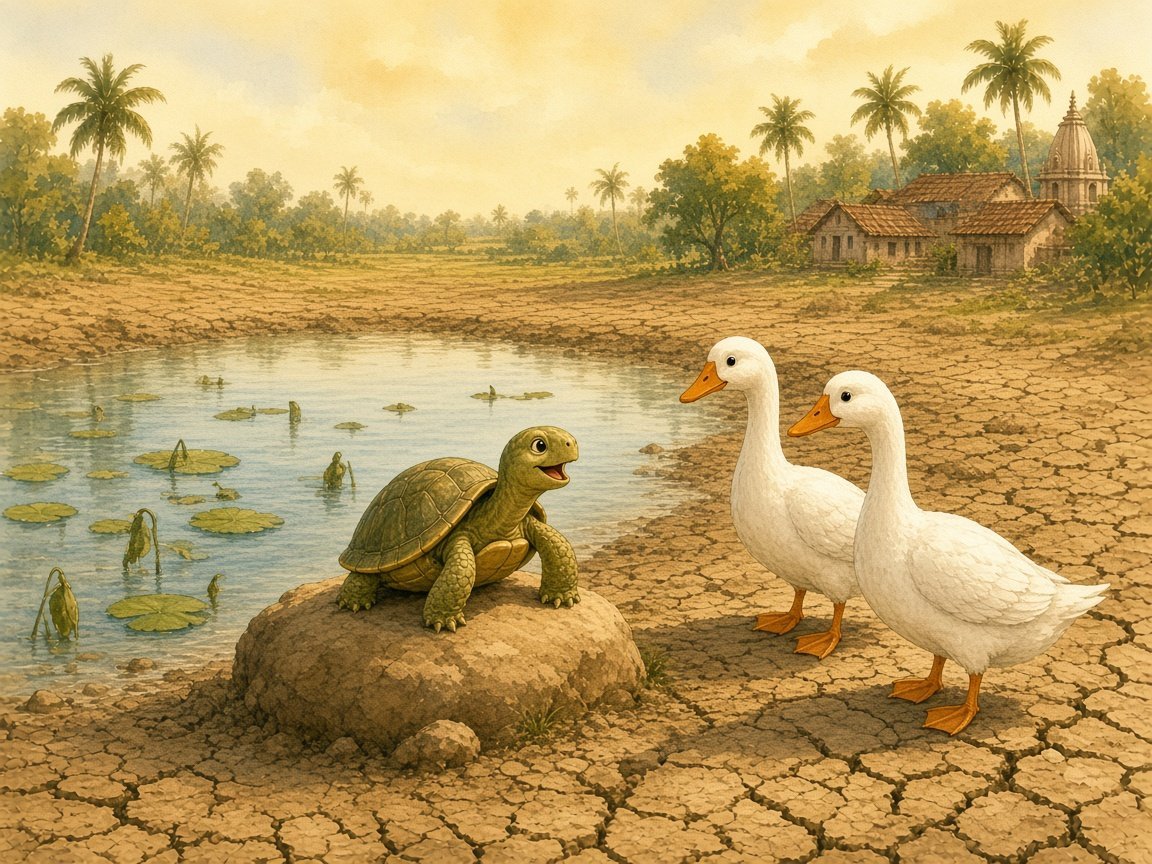
One evening, the geese came to visit with worried faces.
“Kambugriva,” said Sankata, “we have something to tell you. If the rain doesn’t come soon, this lake will dry up completely. We are going to fly away to another lake far from here, where the water is deep and cool all year round.”
Kambugriva stopped talking. For once in his life, he did not know what to say.
“You’re leaving?” he said at last in a small voice. “But you’re my best friends. And what will happen to me? You can fly away, but I can only walk, and I walk very, very slowly. I’d never reach another lake before the water here is gone.”
The geese looked at each other. They could not bear to leave their friend behind.
“We will think of something,” said Vikata. “We promise.”
Part 3: The Clever Plan
The geese thought all night. By morning, they had a plan.
They went to the edge of the forest and found a long, strong, straight stick. They carried it back and laid it on the ground in front of Kambugriva.
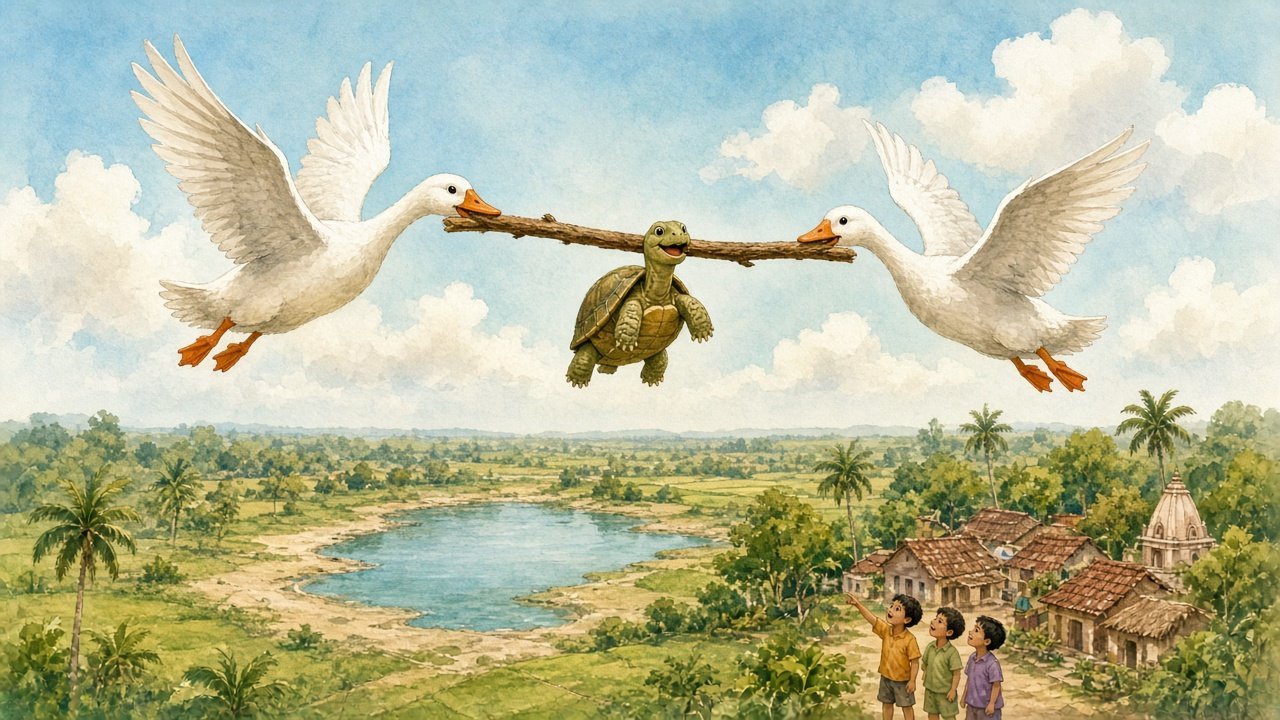
“Here is what we’ll do,” said Sankata. “Vikata and I will each hold one end of this stick in our beaks. You will bite onto the middle of it, and hold on tight. Then we will fly up into the sky and carry you all the way to the new lake.”
Kambugriva’s eyes lit up. “Fly? Me? A tortoise, flying through the sky? Oh, that’s wonderful! That’s marvelous! I can’t wait to tell the frogs, and the fish, and…”
“Wait,” said Vikata gently, holding up one white wing. “There is one very important rule. Once we are in the air, you must not open your mouth. Not even once. Not for a single word. If you open your mouth, you will let go of the stick, and you will fall.”
“Oh, that’s easy,” said Kambugriva. “I won’t say a thing. Not a peep. Not a whisper. My lips are sealed. You’ll see. I’ll be the quietest tortoise you’ve ever…”
The geese laughed. “Save your talking for when we land,” said Sankata. “Then you can tell us everything.”
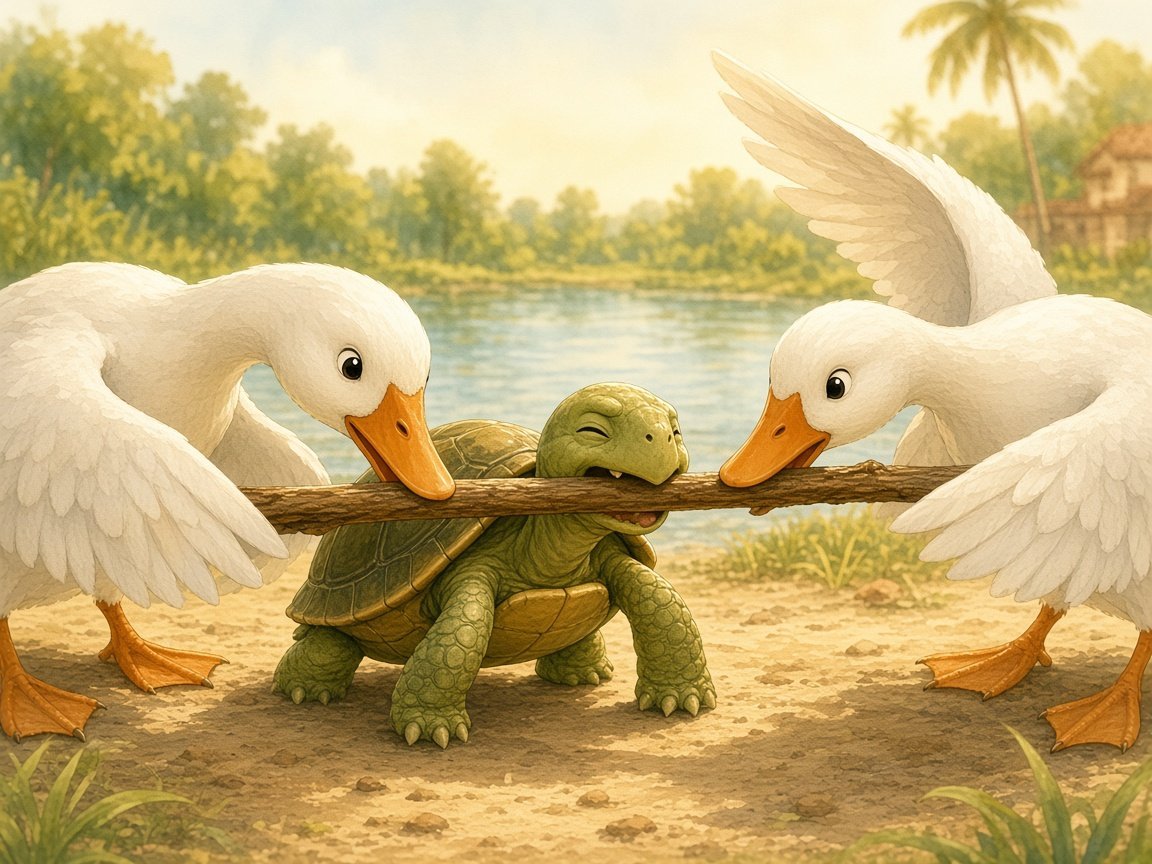
So Kambugriva took a deep breath, opened his mouth wide, and bit down hard on the middle of the stick. He squeezed his eyes shut. The geese took hold of the two ends, flapped their great white wings, and up, up, up they rose into the morning sky.
Part 4: Up, Up and Away
Kambugriva opened one eye. Then the other.
He was flying!
Below him, the cracked, dry lake grew smaller and smaller. He could see the brown fields and the palm trees and the winding river, which looked like a silver thread. The wind rushed past his face. The clouds floated by close enough to touch.
It was the most wonderful thing that had ever happened to him, and he wanted very badly to say so. He wanted to shout, “Look at me! Look how high I am!” But he remembered the rule and held on tight.
They flew over the hills. They flew over a forest. And then they flew over a busy village.
Down below, a group of children were playing in the dusty lane. One of them looked up and pointed.
“Look! Look up there!” he shouted. “Two geese are carrying a tortoise on a stick!”
Everyone in the village came running out to see. Mothers came out of their kitchens. Farmers dropped their tools. Old men looked up from their games under the banyan tree.
“How funny!” laughed one man. “Whoever heard of a flying tortoise?”
“What a silly sight!” giggled a little girl. “The geese have caught a tortoise. Maybe they’re going to eat him for dinner!”
Part 5: Just One Word
Up in the sky, Kambugriva heard every word.
His cheeks grew hot. They were laughing at him. They thought he was silly! They thought the geese were going to eat him! It wasn’t true at all. This was his idea, well, his friends’ idea, and it was brilliant, and they didn’t understand anything.
The more the people laughed, the crosser he became. He held on. He held on. He held on.
And then he couldn’t hold on any longer.
“Why don’t you mind your own…” he began.
But the moment he opened his mouth, the stick slipped away.
Down, down, down tumbled Kambugriva, spinning through the air with his little legs waving.
“Kambugriva!” cried the geese.
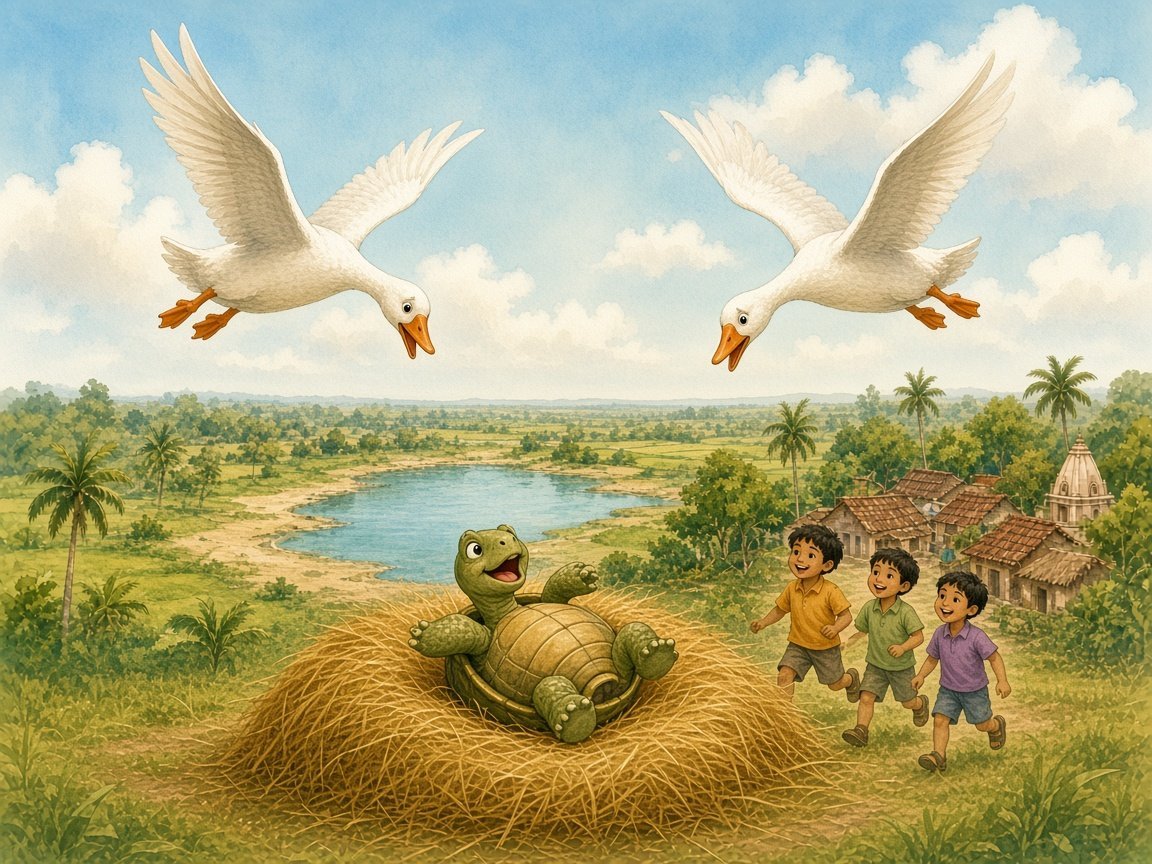
Luckily for the tortoise, a farmer at the edge of the village had just finished cutting his hay. A big, soft, golden haystack stood right in the middle of the field. And that is exactly where Kambugriva landed.
Fwump!
Part 6: A Lesson in a Haystack
Kambugriva lay on his back in the hay, blinking up at the sky. His head was spinning. His shell was covered in straw. But apart from that, he was perfectly fine.
The geese swooped down and landed beside him. The village children came running across the field too, and this time nobody was laughing. “Is he all right?” they asked.
“I’m all right,” said Kambugriva in a wobbly voice. He looked up at his friends. “I’m sorry. You told me to keep my mouth shut. It was the only rule, and I couldn’t even manage that.”
Sankata tucked a wing around him. “We were so frightened,” she said. “You could have been badly hurt.”
“I just couldn’t stand them laughing at me,” said Kambugriva. “I had to say something.”
“Did you, though?” asked Vikata gently. “Their words couldn’t hurt you up there. Opening your mouth is what made you fall.”
Kambugriva was quiet for a long while. It may have been the longest he had ever been quiet.
“You’re right,” he said finally. “Sometimes it’s better to stay quiet, especially when I’m cross. I’ll remember that.”
The children brought him a bowl of water. The farmer said he could rest in the shade of the haystack as long as he liked. And the next morning, the geese found a new, stronger stick.
“Shall we try again?” asked Sankata.
Kambugriva bit onto the stick and nodded. And this time, all the way to the beautiful new lake, he did not say a single word. Not even when a flock of parrots flew past and called him “Shell-on-a-Stick.”
When they landed by the deep, cool water, he finally let go of the stick, took a huge breath, and talked for three whole hours. And his friends listened to every word.
The End
Moral of the story: The Talkative Tortoise
Think before you speak. Sometimes keeping quiet is the wisest thing you can do, especially when you feel angry or embarrassed. Words spoken at the wrong moment can get us into a lot of trouble.
What kids can learn from this fable
- Listen to good advice. The geese gave Kambugriva one simple rule because they cared about him.
- You don’t have to answer every unkind comment. The villagers’ words could not hurt him, but his reply did.
- Self-control takes practice. It is hard to stay quiet when you’re upset, and it gets easier the more you try.
- Good friends help you, and they also forgive you. The geese gave Kambugriva a second chance.
Questions to talk about with your child
- Why did the geese tell Kambugriva not to open his mouth?
- How do you think Kambugriva felt when the villagers laughed at him?
- Have you ever said something when you were cross and wished you hadn’t? What happened?
- What could Kambugriva do next time someone teases him, instead of shouting back?
Read More: The Monkey and the Crocodile Story
Frequently asked questions
Where does The Talkative Tortoise come from?
It comes from the Panchatantra, an ancient Indian collection of animal fables traditionally credited to Vishnu Sharma. A similar tale also appears in the Buddhist Jataka tales, where it is called the Kacchapa Jataka.
Does the tortoise die in the original story?
Yes. In the traditional versions the tortoise falls to the ground and does not survive. This bedtime version gives him a soft landing in a haystack so younger children can enjoy the story and the lesson without a sad ending.
What is the moral of The Talkative Tortoise?
The main moral is to think before you speak, and that sometimes silence is wiser than words. It also reminds children to listen to friends who give them good advice.