The Twelve Dancing Princesses is a fairy tale collected by the Brothers Grimm, Jacob and Wilhelm, who published it in 1815. Its German title means “The Shoes That Were Danced to Pieces.” It’s a mystery story: twelve princesses are locked in their room every night, yet every morning their shoes are worn through. Where do they go?
This retelling is for children ages 5 to 12 and takes about 10 minutes to read aloud. The scary parts of the original have been softened, and the FAQ explains what changed.
Part 1: The mystery of the worn-out shoes
Once upon a time, a king had twelve daughters, each one more lively than the last. They slept in twelve beds in one long room at the top of the castle. Every night, the king locked their door himself and put the key in his pocket.
And every morning, when the door was unlocked, there was the same strange sight. Lined up at the foot of the twelve beds were twelve pairs of dancing shoes, and every single pair was worn through, with holes in the soles.
“Where have you been?” the king asked.
“Asleep, Father,” the princesses said, yawning. “Where else would we be?”
The king didn’t believe them.
So the king sent out a message to the whole kingdom. “Whoever can find out where my daughters go dancing each night may marry the princess of his choice and be king after me. He will have three nights to solve the mystery. If he can’t, he must go home and never try again.”
Prince after prince came to the castle. Each one was given a room next to the princesses’ bedroom, with the door left open so he could watch. And each one fell fast asleep. In the morning, the shoes had holes in them again, and the princes went home with red faces.

Part 2: A soldier and a magic cloak
One day, a soldier was walking home after many years in the army. His coat was patched and his boots were muddy, but he was kind and he had a sharp mind. On a quiet road he met an old woman carrying a heavy bundle of sticks, and he helped her carry it to her door.
“Where are you headed?” she asked.
“I’m not sure,” the soldier said with a laugh. “Maybe I’ll try to find out where the king’s daughters go dancing. Then one day I might be king.”
The old woman looked at him carefully. “That’s not hard if you listen to me,” she said. “When the princesses bring you a cup of wine at night, don’t drink it. Pretend to fall asleep.”
Then she gave him a soft gray cloak. “Wear this, and no one will be able to see you. Then you can follow them wherever they go.”
The soldier thanked her and went straight to the castle.
Part 3: Down the secret stairs
The king welcomed the soldier and gave him the room beside the princesses. That evening, the eldest princess came in with a golden cup.
“You must be thirsty after your long trip,” she said sweetly.
The soldier remembered the old woman’s words. He had tied a sponge under his chin, and while the princess wasn’t looking, he poured the drink into it instead of drinking it. Then he lay down and began to snore loudly.
The princesses giggled. “Another one asleep,” said the eldest.
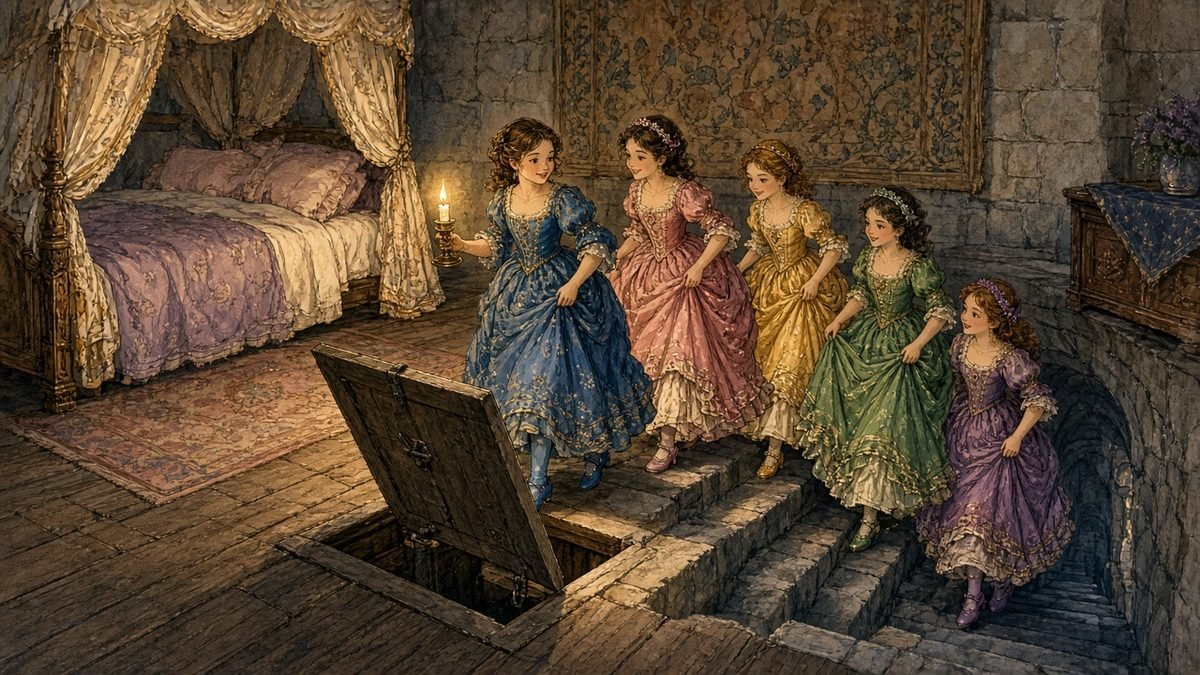
They jumped out of bed and opened their wardrobes. They put on their finest gowns, brushed their hair and slipped on brand-new dancing shoes. The youngest princess frowned.
“I don’t know why, but I have a strange feeling tonight,” she said. “Something’s going to go wrong.”
“You worry too much,” said the eldest. “Look, he’s snoring.”
The eldest princess knocked three times on her bed. With a creak, the bed sank into the floor, and a staircase appeared, leading down into the dark. One by one, the princesses hurried down the steps.
The soldier quickly threw on the magic cloak and followed. On the stairs, he accidentally stepped on the hem of the youngest princess’s gown.
“Who’s there?” she cried. “Someone stepped on my dress!”
“Don’t be silly,” said the eldest. “You caught it on a nail.”
Part 4: Silver trees, gold trees and diamond trees
At the bottom of the stairs was a wonderful avenue of trees. Their leaves were made of silver and they glittered in the dim light. The soldier thought, “I’ll need proof,” so he broke off a small twig. The tree gave a loud crack.
“Did you hear that?” said the youngest princess.
“It’s just our friends cheering because we’re coming,” said the eldest.
Next they walked through a grove of trees with golden leaves, and then a grove with leaves of sparkling diamonds. Each time, the soldier broke off a twig. Each time, the tree cracked, and the youngest princess jumped.
At last they came to a wide lake. Twelve little boats waited at the shore, and in each boat sat a prince with an oar. Each princess climbed into a boat. The soldier slipped into the boat with the youngest princess.
“This boat feels heavy tonight,” her prince said, puffing as he rowed.
“It must be the warm weather,” said the princess.
On the far side of the lake stood a castle glowing with lights. Music floated out over the water. The princes and princesses went inside and danced, and danced, and danced. They twirled until three o’clock in the morning, when their shoes were worn through and they had to stop.
The soldier, still invisible, danced along. When the youngest princess lifted her cup, he took a sip first, and she found it half empty.
Then everyone rowed back across the lake. This time the soldier sat in the boat with the eldest princess. He ran up the stairs ahead of them, threw off the cloak and jumped into bed. When the princesses came up, tired and happy, he was snoring again.
Part 5: The soldier tells the truth
The soldier followed them on the second night and the third night too. On the last night, he brought back a golden cup from the underground castle.
On the fourth morning, the king called him in. “Well? Where do my daughters dance at night?”
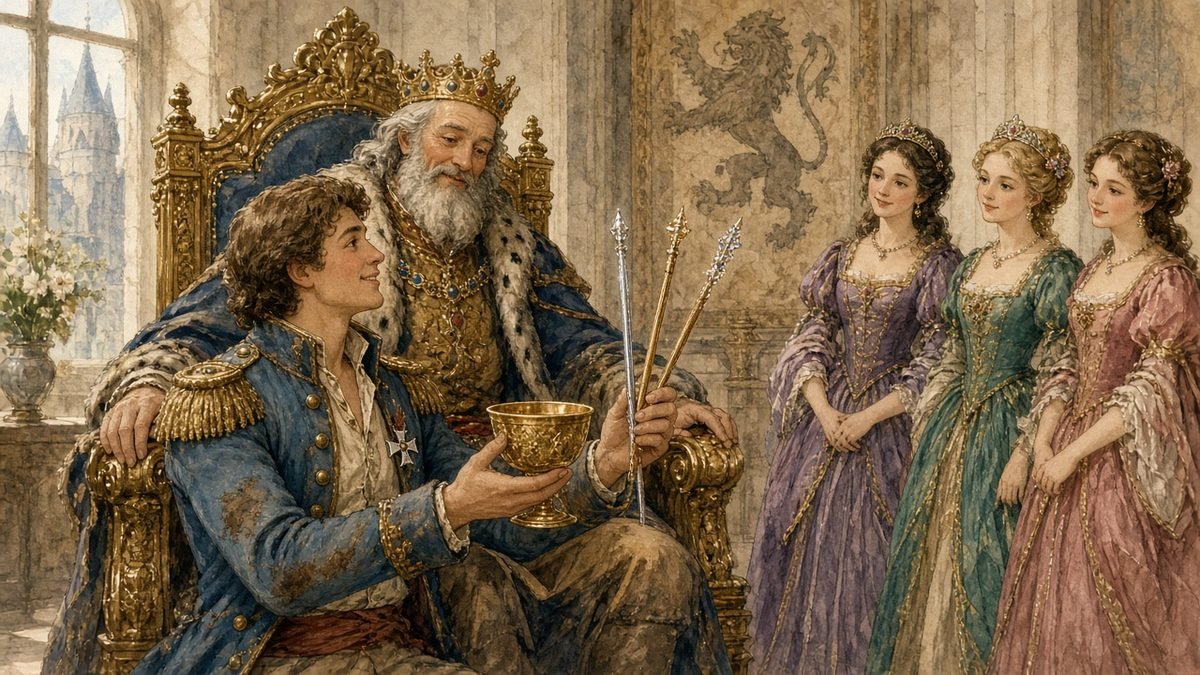
“Your Majesty,” said the soldier, “they dance with twelve princes in a castle under the ground.” He told the whole story and laid out the silver twig, the gold twig, the diamond twig and the golden cup.
The king called his daughters. They saw the twigs and the cup and knew the secret was out. So they told the truth.
The king kept his promise. “Which of my daughters would you like to marry?” he asked.
The soldier smiled. “I’m no longer young,” he said, “so I’ll choose the eldest.” The eldest princess, who had liked his clever thinking from the moment she heard the story, said yes. They were married that very day, and the soldier became the next king.
As for the dancing, the king decided his daughters could hold a grand ball in the castle once a month, with the doors wide open, so nobody would need to sneak away again.
The End
Moral of the story: Secrets don’t stay hidden forever
The princesses worked hard to keep their secret, but it came out in the end. The soldier won because he listened to good advice, kept his eyes open and told the truth with proof. The story also shows that being kind, like helping the old woman with her heavy load, can open doors you never expected.
What kids can learn from The Twelve Dancing Princesses
- The truth usually comes out. Even a well-kept secret is hard to hide.
- Kindness helps you too. The soldier’s help for the old woman led to the magic cloak.
- Listen to good advice. The soldier remembered not to drink the cup.
- Gather proof. The twigs and the cup showed the king the story was real.
- Trust your feelings. The youngest princess sensed something was wrong, and she was right.
Questions to talk about with your child
- Why were the princesses’ shoes worn out every morning?
- How did the soldier stay awake when the princes before him fell asleep?
- Why did the soldier break off twigs from the silver, gold and diamond trees?
- Which princess noticed that something was wrong? How did the others answer her?
- If you had a cloak that made you invisible, how would you use it kindly?
Summary: The Twelve Dancing Princesses
A king’s twelve daughters are locked in their room every night, but every morning their shoes are danced to pieces. Many princes try to solve the mystery and fall asleep. A kind soldier gets help from an old woman, who tells him not to drink the princesses’ wine and gives him an invisibility cloak. He follows the princesses through a secret door, past trees of silver, gold and diamonds, across a lake, to a castle where they dance with twelve princes. He brings back proof, tells the king and marries the eldest princess.
For another Brothers Grimm story with a clever hero, read The Brave Little Tailor or the magical night-time tale The Elves and the Shoemaker.
Read More: Rumpelstiltskin
Frequently asked questions
What is the Twelve Dancing Princesses story about?
It’s about twelve princesses who sneak out every night to dance in a secret underground castle, and a soldier who uses an invisibility cloak to follow them and solve the mystery.
Who wrote The Twelve Dancing Princesses?
The Brothers Grimm published it in 1815 in their collection of German folk tales. Its German title is “Die zertanzten Schuhe,” which means “The Shoes That Were Danced to Pieces.” Similar stories were told in other parts of Europe too.
How does the original story end?
In the Grimm version, the princes who fail to solve the mystery after three nights lose their lives, which has been left out here. In this retelling they simply go home. The original ends with the soldier marrying the eldest princess, and the underground princes are put under a spell for as many days as they had danced nights with the princesses. The idea of a monthly ball is added in this retelling.
Why did the soldier choose the eldest princess?
In the Grimm story, he says, “I am no longer young,” so he picks the eldest.
What age is this story good for?
It works for ages 5 to 12. Younger kids love the magic cloak and the glittering trees, and older kids enjoy the mystery and spotting the clues.