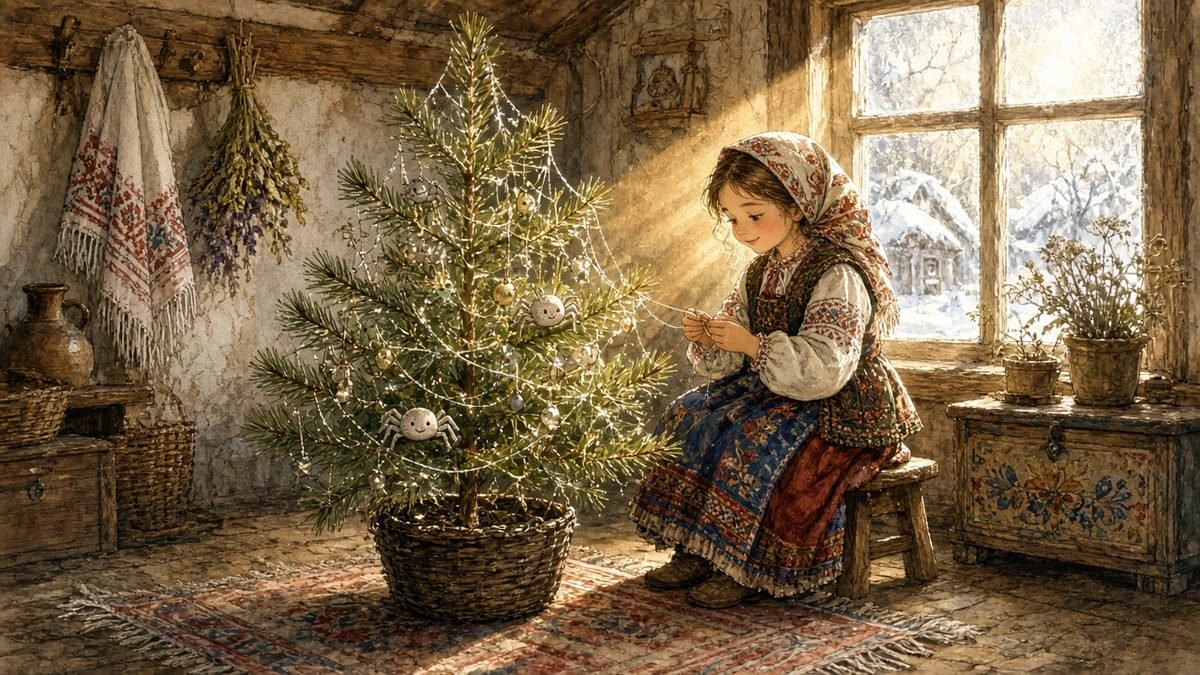
The Legend of the Christmas Spider is an old folk tale from Ukraine. It tells how a poor family’s bare Christmas tree ended up shining with silver and gold, all thanks to a few busy spiders. Many people say the story is where the idea of hanging shiny tinsel on Christmas trees comes from. Similar versions are told in Germany and other parts of Eastern Europe.
This retelling is for children ages 5 to 12 and takes about 9 minutes to read aloud. It’s a gentle story for the start of the holiday season, especially for kids who think spiders are scary. By the end, they might see those eight-legged weavers a little differently.
Part 1: A pine cone by the door
Long ago, in a small village in the hills of Ukraine, there lived a widow and her children in a tiny wooden cottage. They had a goat, a little garden and a stove that kept them warm in winter. They didn’t have much money at all.
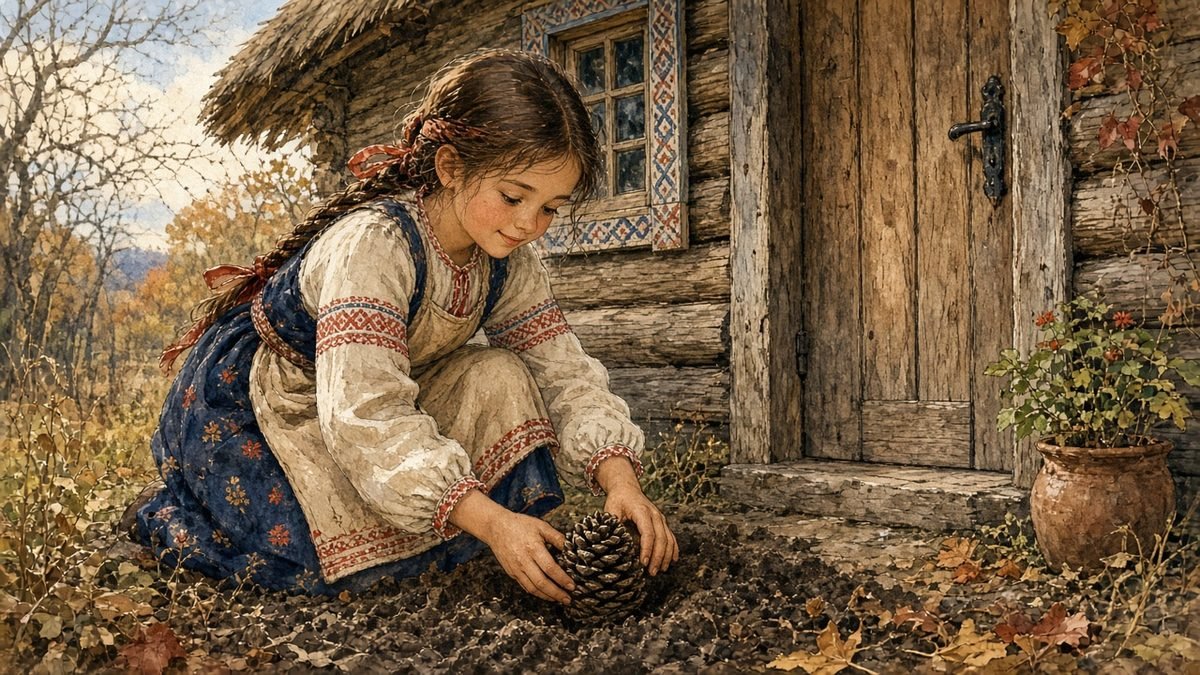
One autumn day, the youngest child, a girl named Oksana, found a pine cone on the path. She carried it home in her apron.
“Can we plant it?” she asked her mother.
Her mother smiled. “We can try. Who knows what it might become?”
So Oksana pressed the pine cone into the soft ground right beside the cottage door. She watered it. She talked to it. When snow came, she brushed it off. And in the spring, a tiny green shoot poked out of the earth.
Year after year, the little tree grew. The children measured themselves against it. First it came up to their knees, then their waists, then their shoulders. By the time Oksana was eight, the tree was just the right size to bring inside for Christmas.
“This will be our Christmas tree,” her mother said. “We’ve watched it grow from a pine cone. It’s part of our family.”
Part 2: A tree with nothing on it
A few days before Christmas, the family dug up the little tree and carried it into the cottage. They set it in a bucket of soil by the window. The whole room smelled like pine.
The children danced around it. Then Oksana’s big brother asked the question everyone was thinking.
“What will we put on it?”
The cottage went quiet. Other families in the village decorated their trees with painted wooden toys, ribbons and candles. Some had glass beads that sparkled in the firelight. But this family had no money for decorations that year. Every coin had gone to flour, firewood and warm boots.
“We could hang some straw,” the brother said.
“Or a few dried apples,” said the middle child.
They tried. They made a few stars out of straw and tied on some little red apples. Then they stepped back to look. The tree still looked plain and a bit lonely.
Their mother hugged them all. “It’s a beautiful tree,” she said. “And we’re together. That’s the best part of Christmas.”
The children nodded, but on Christmas Eve, they went to bed feeling a little sad. Oksana looked at the bare branches one last time before she closed her eyes.
“Goodnight, little tree,” she whispered. “I’m sorry we don’t have anything shiny for you.”
Part 3: The spiders get to work
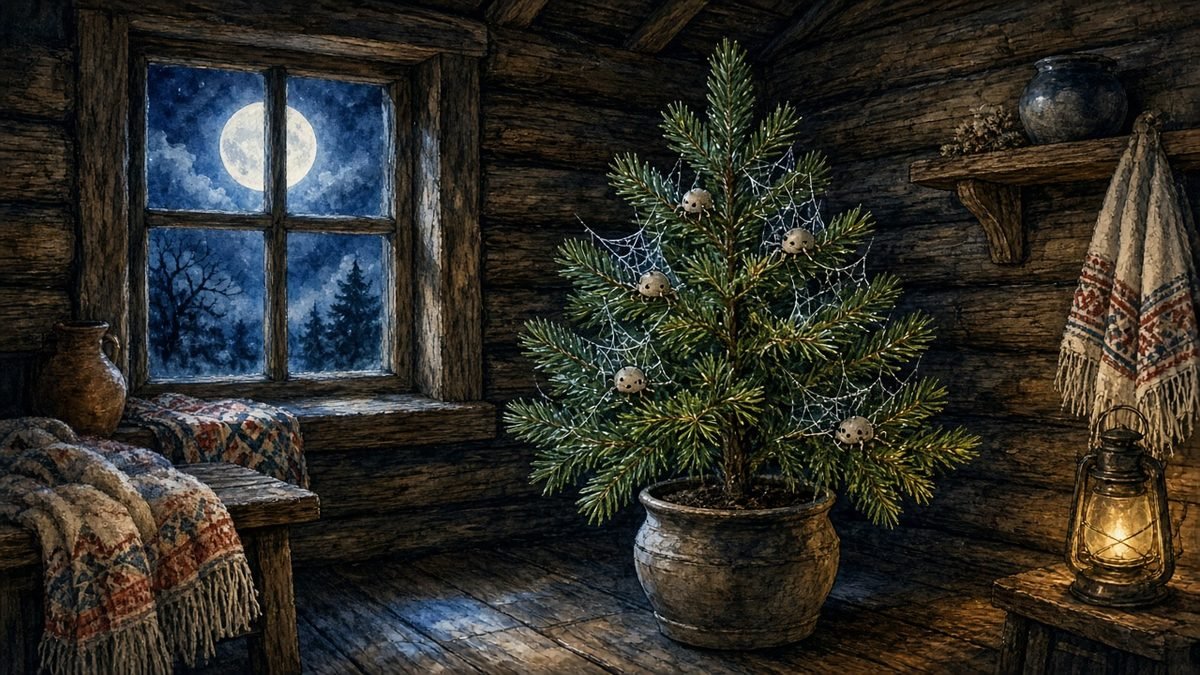
The cottage grew dark and still. The fire burned down to a soft red glow.
Up in the corners of the ceiling, behind the woodpile and under the old wooden bench, lived a family of spiders. They had been there all winter, keeping out of the cold. They had heard everything the children said.
The oldest spider crept out and looked at the tree.
“Those children were so sad,” she said. “And this family has never once swept us out into the snow. They let us stay all winter.”
“We can’t buy them anything,” said a small spider.
“No,” said the oldest spider. “But we can make something. Spinning is what we do best.”
So the spiders went to work. One by one, they climbed up the trunk of the little pine tree. They crawled out along every branch. They spun thread after thread, from needle to needle and branch to branch, until the whole tree was wrapped in delicate webs.
They worked all night long. When the spiders finally crept back to their corners, the tree was covered from top to bottom in fine gray lace.
Part 4: Christmas morning
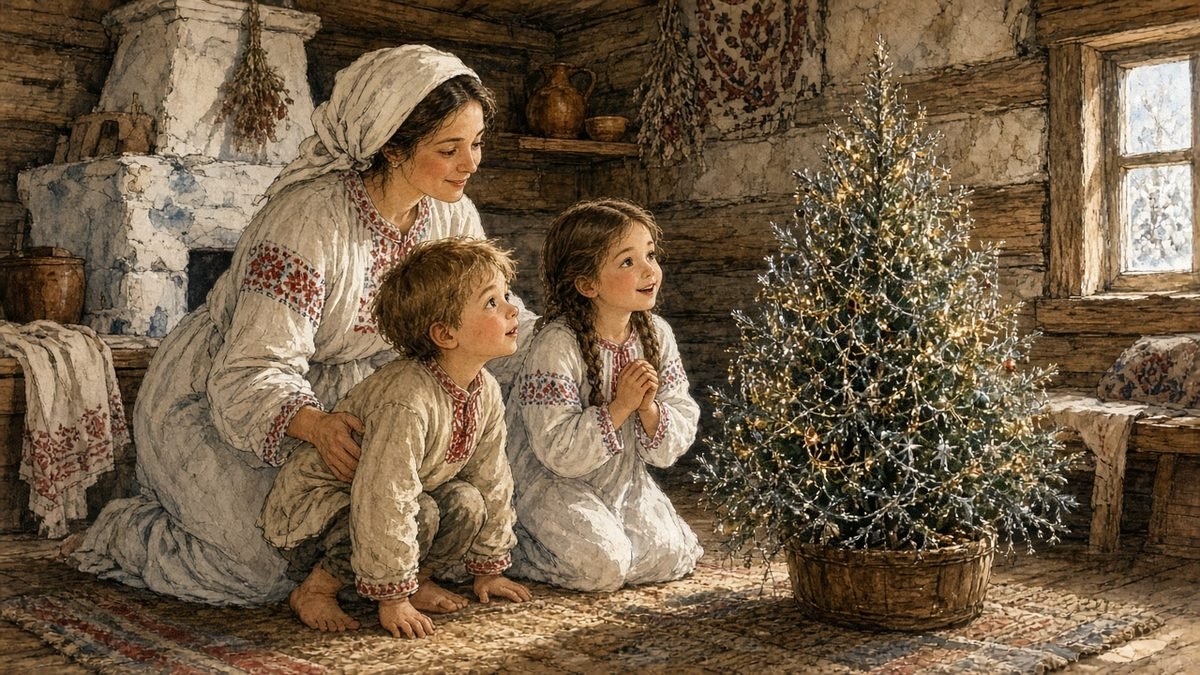
Early on Christmas morning, Oksana woke up first. She tiptoed into the main room, rubbing her eyes. The sun was just rising, and the first beam of light came through the little window and landed right on the tree.
Oksana gasped.
The spiderwebs were glowing. In the morning light, every thread had turned to shining silver and gold. The whole tree sparkled from the bottom branches to the very top. It shimmered every time a breath of air moved through the room.
“Mama! Everyone! Wake up!” she shouted. “Come and see!”
Her mother and her brothers and sisters came running. They stood in their nightclothes and stared at the glittering tree.
“Where did it come from?” her brother whispered.
Oksana looked closely at one branch. In a tiny corner, a small spider was sitting very still, as if it was trying to look like it had nothing to do with anything.
“I think,” Oksana said with a big smile, “we had some helpers.”
Her mother laughed and wiped a happy tear from her eye. “Then this is the most beautiful tree in the whole village,” she said. “And it was made with love.”
That Christmas, the family ate their simple supper of soup and bread beside the sparkling tree. They sang songs. They told stories. And every so often, Oksana looked up at the corners of the ceiling and whispered, “Thank you.”
From then on, the family never swept away the spiders’ webs at Christmastime. And they always left a quiet corner of the cottage for their small, clever neighbors.
The End
Moral of the story: Kindness comes back to you
The family let the spiders stay warm all winter. They didn’t expect anything back. When the family had nothing, the spiders gave them the best gift they could make. The story also reminds us that the most precious gifts are the ones made with care, and that even the smallest creatures can do something wonderful.
What kids can learn from the Legend of the Christmas Spider
- Kindness is never wasted. Letting the spiders stay was a small act, and it came back in a big way.
- Christmas isn’t about money. The family’s best moments came from being together.
- Use the gifts you have. The spiders couldn’t buy anything, so they used what they were good at.
- Don’t judge by looks. Spiders can seem scary, but in this story they’re the heroes.
- Say thank you. Oksana remembered to thank her helpers, even tiny ones.
Questions to talk about with your child
- Why was the family sad on Christmas Eve?
- Why did the spiders want to help the family?
- What happened to the spiderwebs when the sun came up?
- Have you ever made a gift for someone instead of buying one? What was it?
- How do you feel about spiders? Did the story change your mind at all?
Try it at home: make a sparkly spiderweb ornament
Bend a pipe cleaner into a circle, or use a small embroidery hoop. Tie a piece of silver yarn or thin ribbon to one side and wind it back and forth across the circle to make a web. Add a pom-pom or a bead for the spider, glue on eight little legs cut from black pipe cleaner, and hang it on your tree. Some Ukrainian families hang spider and spiderweb ornaments on their trees as a reminder of this story, and some say spotting a web on Christmas morning brings good luck.
Summary: The Legend of the Christmas Spider
A poor widow and her children grow a pine tree from a pine cone and bring it inside for Christmas. They can’t afford decorations, so the tree stays bare, and the children go to bed sad. The spiders who live in the cottage spin webs all over the tree during the night. On Christmas morning, sunlight turns the webs into shining silver and gold, and the family has the most beautiful tree in the village.
For another cozy winter tale, read The Mitten, a Ukrainian folk tale, or meet a very different spider in the Arachne myth for kids.
Read More: The Smallest Reindeer
Frequently asked questions
What is the Legend of the Christmas Spider?
It’s a Ukrainian folk tale about a poor family that can’t afford to decorate their Christmas tree. Spiders spin webs on it overnight, and on Christmas morning the webs turn to silver and gold.
Is the Christmas spider legend where tinsel comes from?
That’s how the legend is often explained. Many people link the shiny strands of tinsel on Christmas trees to the glittering webs in this story. It’s a lovely tradition, but it’s a folk story, so it isn’t a history lesson about who invented tinsel.
How does the original story end?
The ending is already happy in most versions, with the family waking to a sparkling tree. In some tellings the sunlight turns the webs to silver and gold. In others, a Christmas visitor such as Saint Nicholas or the Christ Child changes them. A German version starts with a mother sweeping every spider out of the house before Christmas, and the spiders sneak back in to see the tree. This retelling keeps the Ukrainian version and lets the sunrise do the magic.
What is the moral of the Christmas spider story?
Kindness comes back to you, and gifts made with love are worth more than expensive ones.
What age is this story good for?
It works for ages 5 to 12. Younger children love the sparkling tree, and older kids can talk about generosity and why the family’s kindness mattered.