Akbar and Birbal stories are some of the best-loved folk tales in India. Akbar was a real Mughal emperor who ruled in the 1500s, and Birbal was one of his trusted courtiers. Over hundreds of years, people have told funny stories about how Birbal’s quick wit got him out of tricky questions. The stories are folk tales, and the Akbar Birbal crow story, where the emperor asks how many crows live in his city, is one of the most famous.
This retelling is for children ages 5 to 12 and takes about 8 minutes to read aloud. It’s a short, funny story, so it’s also a good one for reluctant readers.
Part 1: A walk in the royal garden
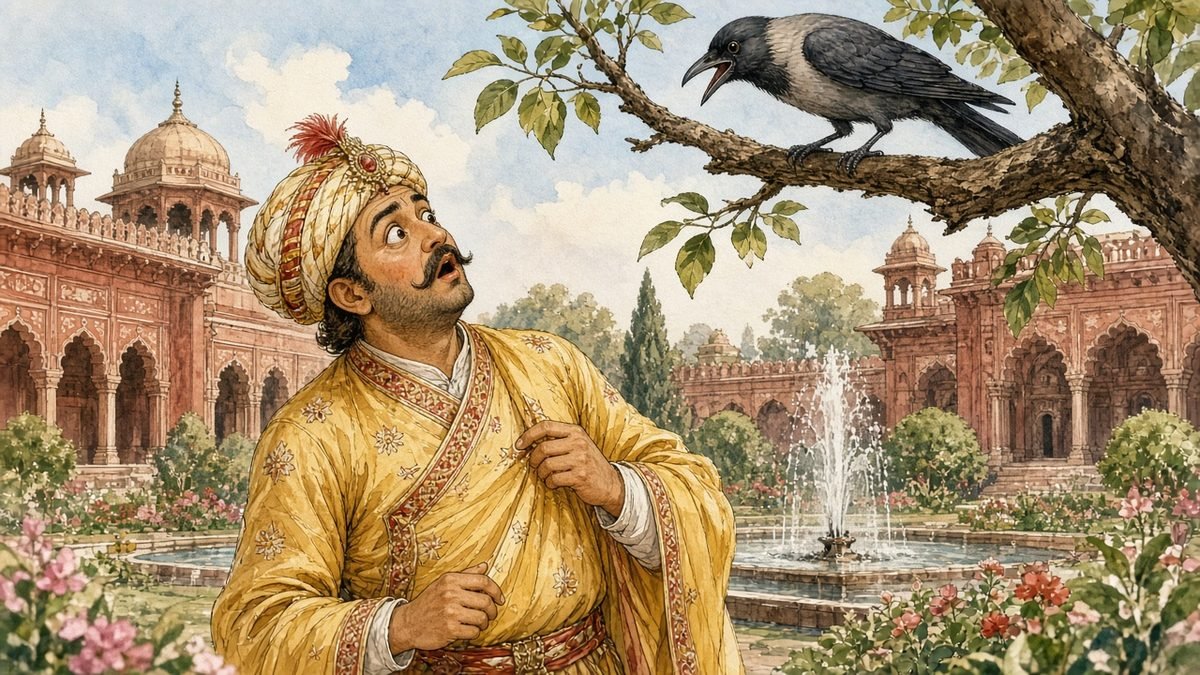
One bright morning, Emperor Akbar was walking in the palace gardens with his courtiers. The fountains were splashing, the roses were blooming and the sky was clear and blue.
But it was not quiet.
“Caw! Caw! Caw!”
Crows were everywhere. They sat on the garden walls. They hopped along the paths. They perched on the fountains and the rooftops and even on the tops of the palace domes. A big black crow landed on a branch right above the emperor’s head and cawed so loudly that Akbar jumped.
The courtiers tried not to laugh.
Akbar looked up at the crow and then out over the city. He could see black birds on every roof and tree.
“There are so many crows in this city,” he said. “I wonder exactly how many there are.”
A sly look came over his face. Akbar loved to test his courtiers with puzzles, and he especially loved to test Birbal.
Part 2: An impossible question
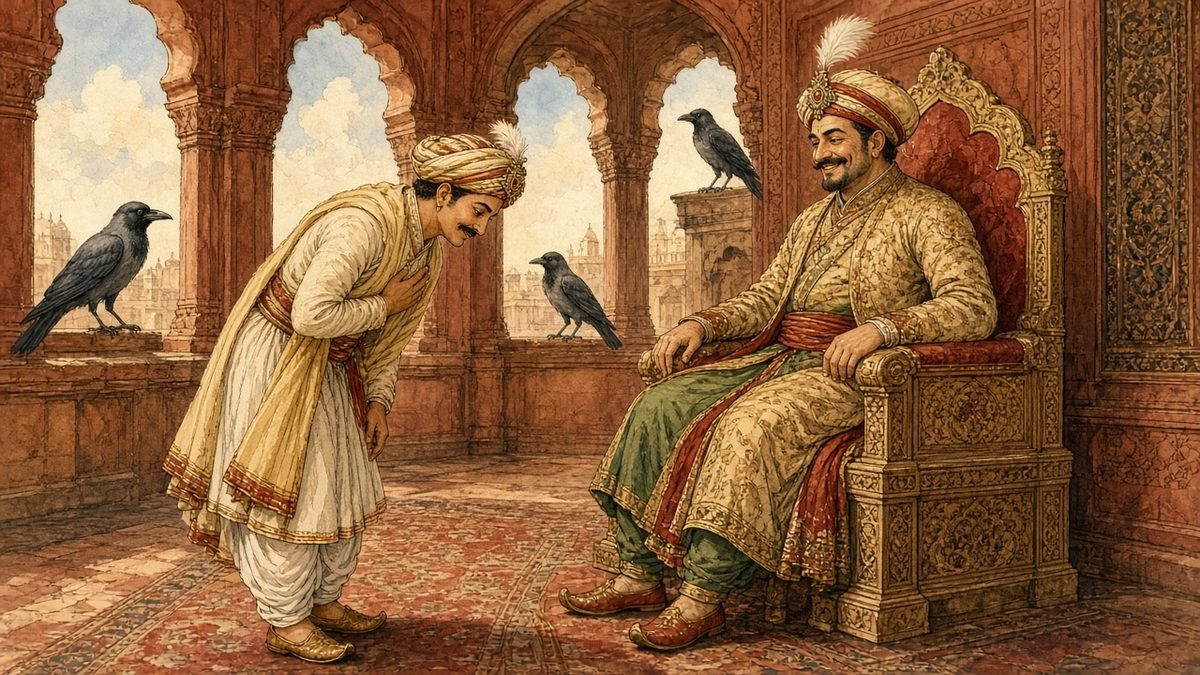
The next day, the emperor sat on his throne in the great hall. All the courtiers were there, and so was Birbal.
“I have a question for my wise men,” Akbar announced. “How many crows are there in our city?”
The courtiers looked at each other. Nobody said a word.
One courtier scratched his head. “Your Majesty, crows fly here and there all day long. Nobody could count them all.”
“It would take a hundred years,” said another.
Some of the courtiers were a little jealous of Birbal, because the emperor liked him so much. They smiled at each other. “This time,” they thought, “Birbal will have to admit he doesn’t know.”
Akbar turned to Birbal. “Well, Birbal? Can you tell me how many crows there are in the city?”
Birbal stroked his chin and thought for a moment. Then he bowed.
“Your Majesty,” he said, “please give me one day. I’ll come back tomorrow with the answer.”
The courtiers grinned. They were sure he was just buying time.
Part 3: Birbal’s answer
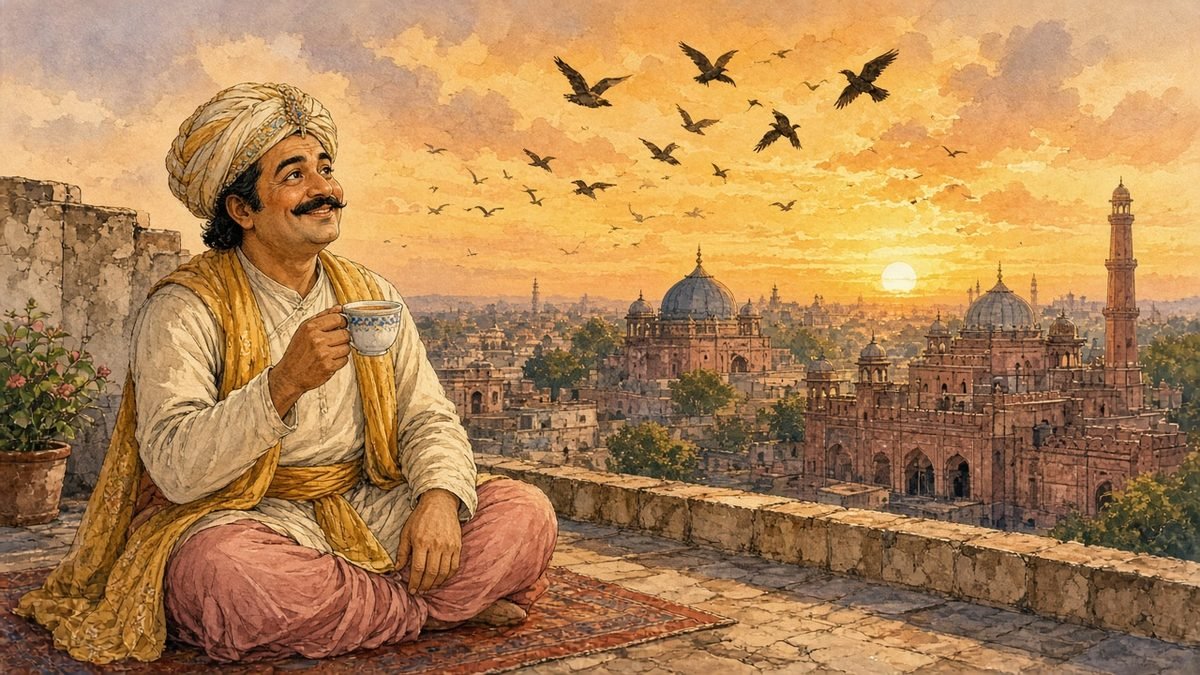
That evening, Birbal sat on his rooftop with a cup of tea and watched the crows fly home to their trees as the sun went down. He smiled to himself. He already knew exactly what he would say.
The next morning, the hall was packed. Word had spread that Birbal would answer the crow question, and everyone wanted to hear.
“Well, Birbal?” said Akbar. “How many crows are there in my city?”
Birbal stepped forward and bowed. “Your Majesty, there are exactly ninety-five thousand, four hundred and sixty-three crows in the city.”
The hall went silent. Then everyone started whispering at once.
Akbar leaned forward. “Exactly ninety-five thousand, four hundred and sixty-three? Are you sure, Birbal?”
“Quite sure, Your Majesty,” said Birbal calmly. “If you don’t believe me, you’re welcome to have them counted.”
Part 4: “What if there are more?”
Akbar narrowed his eyes. He wanted to catch Birbal this time.
“And what if we count them,” the emperor said, “and find there are more crows than that?”
Birbal didn’t even blink. “Then, Your Majesty, it means some crows have relatives visiting from other cities. Crows love visiting their cousins, just like people do.”
A few courtiers giggled before they could stop themselves.
“Hmm,” said Akbar. “And what if we count them and find there are fewer crows than you say?”
“Then,” said Birbal with a little smile, “some of our crows have gone away to visit their relatives in other cities. It is the wedding season, after all.”
For a moment, nobody made a sound. Then Akbar threw back his head and laughed so loudly that the crows on the windowsill flapped away in surprise.
“Birbal, you rascal!” the emperor said, wiping his eyes. “You’ve answered a question that has no answer, and nobody can prove you wrong!”
Part 5: The emperor’s reward
The courtiers who had hoped to see Birbal fail looked at their feet. They had to admit that he had been very clever.
Akbar clapped his hands. “A question with no true answer deserves a clever reply,” he said. “And Birbal has given us the cleverest one I’ve ever heard.”
He called a servant and gave Birbal a fine silk shawl and a bag of gold coins as a reward.
Birbal bowed. “Thank you, Your Majesty. But I must give some credit to the crows. They gave me the idea.”
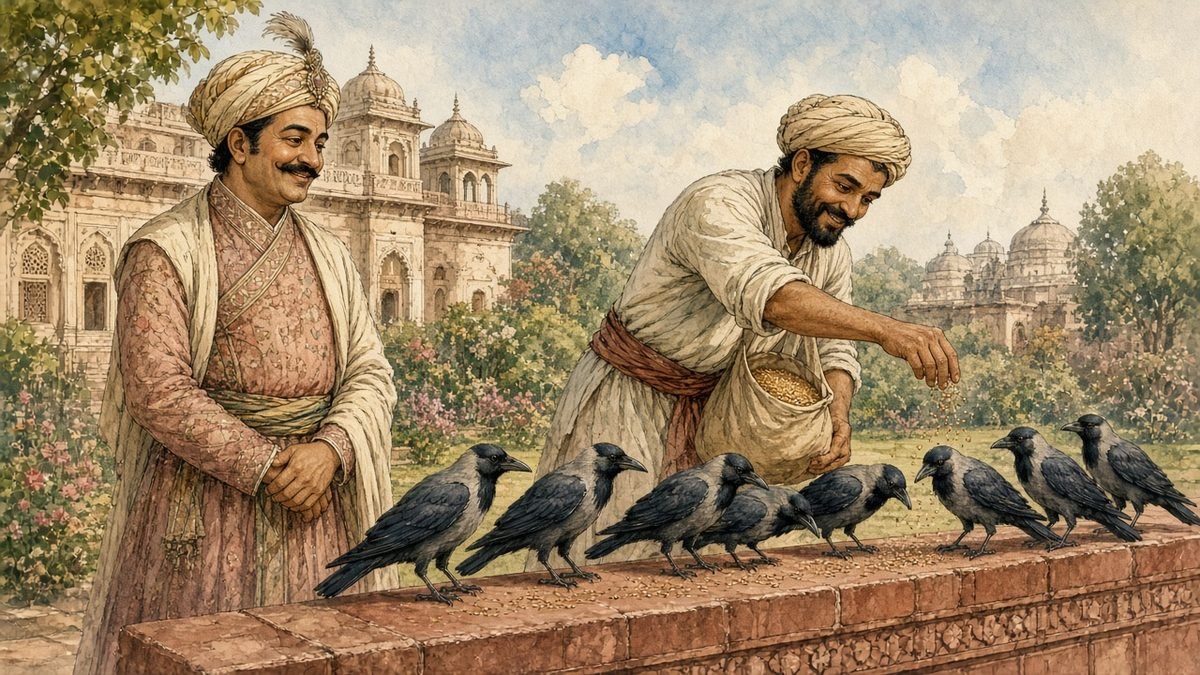
“Then let them have a reward too,” Akbar laughed. And from that day on, the palace gardeners scattered a little extra grain on the garden wall every morning for the crows of the city, however many of them there were.
As for Akbar, every time he heard a crow cawing in the garden after that, he couldn’t help smiling. “That one must be a cousin visiting from out of town,” he would say.
The End
Moral of the story: Keep calm and think cleverly
Birbal faced a question that nobody could truly answer. Instead of panicking or giving up, he stayed calm, used his imagination and gave an answer nobody could disprove. When facts can’t settle a problem, a bit of imagination and a good joke can still get you through.
What kids can learn from the Akbar Birbal crow story
- Stay calm under pressure. Birbal didn’t panic when everyone was watching.
- Take time to think. Asking for one day helped Birbal plan his answer.
- Humor can help. Birbal made the emperor laugh instead of making him angry.
- Some questions have no exact answer. The crows kept flying around, so no one could count them.
- Don’t wish for others to fail. The jealous courtiers ended up looking silly.
Questions to talk about with your child
- Why did Akbar ask how many crows were in the city?
- Why was it impossible to give an exact answer?
- How did Birbal explain it if there were more crows, or fewer?
- Why were some courtiers hoping Birbal would fail?
- If someone asked you how many ants live in your backyard, what clever answer would you give?
Try it at home: a counting challenge
Go outside or sit by a window for five minutes and count every bird you see. Then do it again at a different time of day. Did you get the same number? Talk about why counting birds is so hard, and why Birbal’s answer was so clever.
Summary: The Akbar Birbal crow story
While walking in his garden, Emperor Akbar notices crows everywhere and asks his court how many crows live in the city. Nobody can answer. Birbal asks for a day, then announces an exact number. When Akbar asks what happens if there are more or fewer crows, Birbal says that means some crows have relatives visiting or have gone visiting themselves. The emperor laughs and rewards Birbal for his wit.
For another story about Birbal’s clever thinking, read Birbal’s Khichdi. For a different kind of puzzle from India, try The Blind Men and the Elephant.
Read More: The Foolish Lion and the Clever Rabbit
Frequently asked questions
What is the moral of the Akbar Birbal crow story?
Stay calm and use your wits. A clever, cheerful answer can solve a problem that facts alone can’t.
How many crows did Birbal say were in the city?
The number changes from one telling to another. Many versions use ninety-five thousand, four hundred and sixty-three, which is the number used here. The exact figure doesn’t matter. The fun is in Birbal’s explanation.
Were Akbar and Birbal real people?
Yes. Akbar was a Mughal emperor of India who ruled from 1556 to 1605, and Birbal was a real member of his court. The funny stories about them, though, are folk tales that grew up over many years. They aren’t historical records.
How does the original story end?
Most versions end with Akbar laughing and rewarding Birbal, so this retelling keeps that ending. The extra grain for the crows and Akbar’s joke about visiting cousins were added here for fun.
What age is this story good for?
It works for ages 5 to 12. Younger kids love the noisy crows and the silly answer, and older kids enjoy figuring out why nobody could prove Birbal wrong.