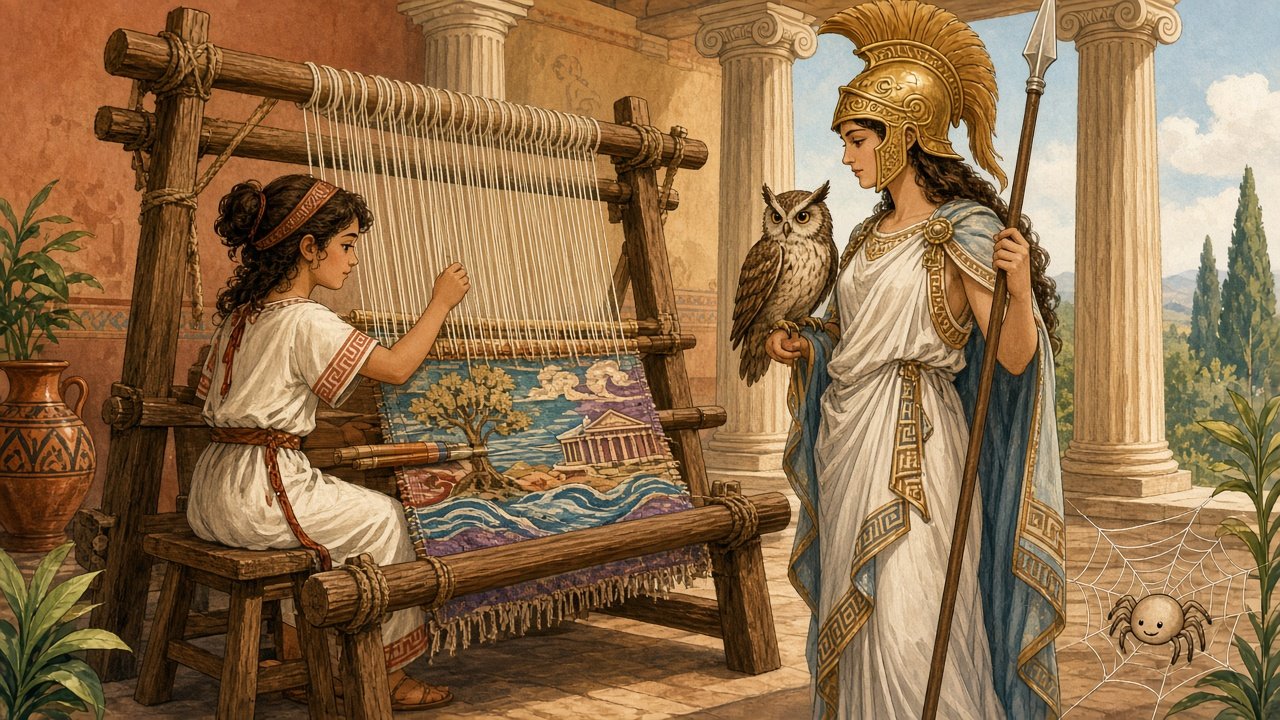
Have you ever watched a spider spin a web and wondered why it works so hard? The ancient Greeks had a story for that. The Arachne myth for kids tells how a talented young weaver challenged a goddess and ended up as the world’s first spider. It’s a short, memorable tale about skill, pride, and respect, and it explains where the word “arachnid” comes from.
Reading time: about 6 minutes | Best for ages: 6–12 | Source: Ovid’s Metamorphoses, Book 6 (public domain)
The Arachne Myth for Kids: The Story
In the land of Lydia, in a small town in what is now Turkey, there lived a young woman named Arachne. Her family was not rich or famous. Her father was a dyer who soaked wool in pots of purple dye until it gleamed. But Arachne had a gift that made her known far and wide. She could weave.
Arachne’s fingers flew over her loom. She spun wool so fine it looked like mist, and she wove pictures so lifelike that people swore the painted birds might fly away. Nymphs, the spirits of the forests and rivers, left their homes just to watch her work. “Surely,” they whispered, “the goddess Athena herself taught her.”
Athena was the goddess of wisdom and of crafts, especially weaving. Any other weaver would have been proud to hear such a thing. But Arachne tossed her head.
“Nobody taught me,” she said. “Not even Athena. My skill is my own. In fact, I’m better than Athena. Let her come and compete with me, and if I lose, I’ll accept any punishment.”
Far away on Mount Olympus, Athena heard these words. She did not rush down in a fury. Instead, she disguised herself as a bent old woman with gray hair and a walking stick, and she hobbled to Arachne’s door.
“Child,” the old woman said gently, “listen to someone who has lived a long time. Be proud that you’re the best weaver among people. But give the gods their due respect. Ask Athena to forgive your boast, and she will.”
Arachne frowned and stopped her shuttle. “Keep your advice for your own daughters, old woman. I can think for myself. If Athena is so great, why doesn’t she come here herself?”
“She has,” said the old woman. In a flash, the gray hair and walking stick vanished. There stood Athena, tall and shining, with a helmet on her head. The nymphs bowed to the ground. The townswomen gasped. Arachne’s cheeks went red for a moment, then pale, but she didn’t back down. She was too stubborn for that.
So the contest began.
Two looms were set up side by side. Athena and Arachne tied up their skirts and set to work. The shuttles darted in and out. Threads of purple, gold, and every shade of color flowed together.
Athena wove the hill of Athens and the twelve great gods sitting on their thrones. In the center, she showed the day she won the city: Poseidon striking a rock with his trident, and Athena giving the people the very first olive tree. In the four corners, she wove small scenes of mortals who had challenged the gods and been punished. It was a warning, woven in thread, for Arachne to see.
Arachne did not take the hint. She wove pictures of the gods behaving badly. She showed Zeus turning himself into a bull to trick a princess, and other gods playing tricks on mortals. Her pictures were perfect. Every wave of the sea looked wet. Every face looked alive. Around the edges, she wove a border of flowers and ivy.
Athena looked at Arachne’s tapestry for a long time. Even she could find no mistake in it. The weaving was flawless. But the pictures mocked the gods, and that made Athena furious. She tore the cloth from the loom and struck Arachne with her wooden shuttle.
Then Athena’s anger cooled into something sterner. She sprinkled Arachne with the juice of a magic herb. “Since you love to weave so much,” she said, “you shall weave forever. And so shall your children and their children after them.”
At once, Arachne began to change. Her hair fell away. Her head shrank tiny. Her arms and legs grew long and thin, and more legs sprouted from her sides until she had eight. Her body became small and round. Arachne had become a spider.
But she still had her gift. From her own body, she drew out a silky thread, and she began, as she always had, to weave.
And to this day, when you see a spider spinning a delicate web in the corner of a window or between two branches, sparkling with morning dew, you are watching Arachne’s family still at work.
Moral of the Story
Talent is wonderful, but it doesn’t make us better than everyone else. Arachne was truly gifted, and she could have been admired forever. Her pride and her refusal to listen to kind advice cost her everything. Being humble, and showing respect even when we’re good at something, is part of real greatness.
Questions to Talk About After Reading
- Arachne was truly the best weaver. Was it wrong for her to be proud of her work? Where is the line between being proud and bragging?
- The old woman gave Arachne advice. Why didn’t she listen? How do you feel when someone gives you advice you didn’t ask for?
- Athena couldn’t find a single mistake in Arachne’s tapestry. Was Athena fair? Why or why not?
- What would you weave into a tapestry if you could show any story?
- The next time you see a spider web, what will you think of?
Where the Word “Arachnid” Comes From
In Greek, arachne means “spider.” That’s why scientists group spiders, scorpions, mites, and ticks together as arachnids. All arachnids have eight legs, which is one way to tell them apart from insects, which have six. A fear of spiders even has a name from the same word: arachnophobia.
A garden spider can spin a whole new orb web in about an hour, and many rebuild theirs every day. Arachne would be proud.
More Greek Myths for Kids
Athena shows up in lots of other stories. Find her helping heroes in Perseus and the Gorgon, read about another punishment from the gods in Prometheus for kids, or explore the whole collection of Greek mythology for kids.
Frequently Asked Questions
What is the Arachne myth about?
Arachne was a young woman in ancient Lydia who was the best weaver in the land. She boasted that she was better than Athena, goddess of weaving, and challenged her to a contest. Athena turned her into a spider, so she could weave forever.
Where does the Arachne myth come from?
The best-known version comes from the Roman poet Ovid, who told it in his long poem Metamorphoses around 8 CE. He drew on older Greek stories about Athena, whom the Romans called Minerva.
Why are spiders called arachnids?
Scientists named the group after Arachne. Arachne is the Greek word for spider, so spiders, scorpions, ticks, and mites are all called arachnids.
What is the moral of the Arachne myth?
Talent is a gift, but pride and disrespect can spoil it. The story also shows that being skillful doesn’t give us the right to mock others.
Is the Arachne myth appropriate for young kids?
Yes, in this retelling. Ovid’s original has a sad, darker moment before the transformation, which we’ve left out. This version suits ages 6 to 12 and takes about 6 minutes to read.