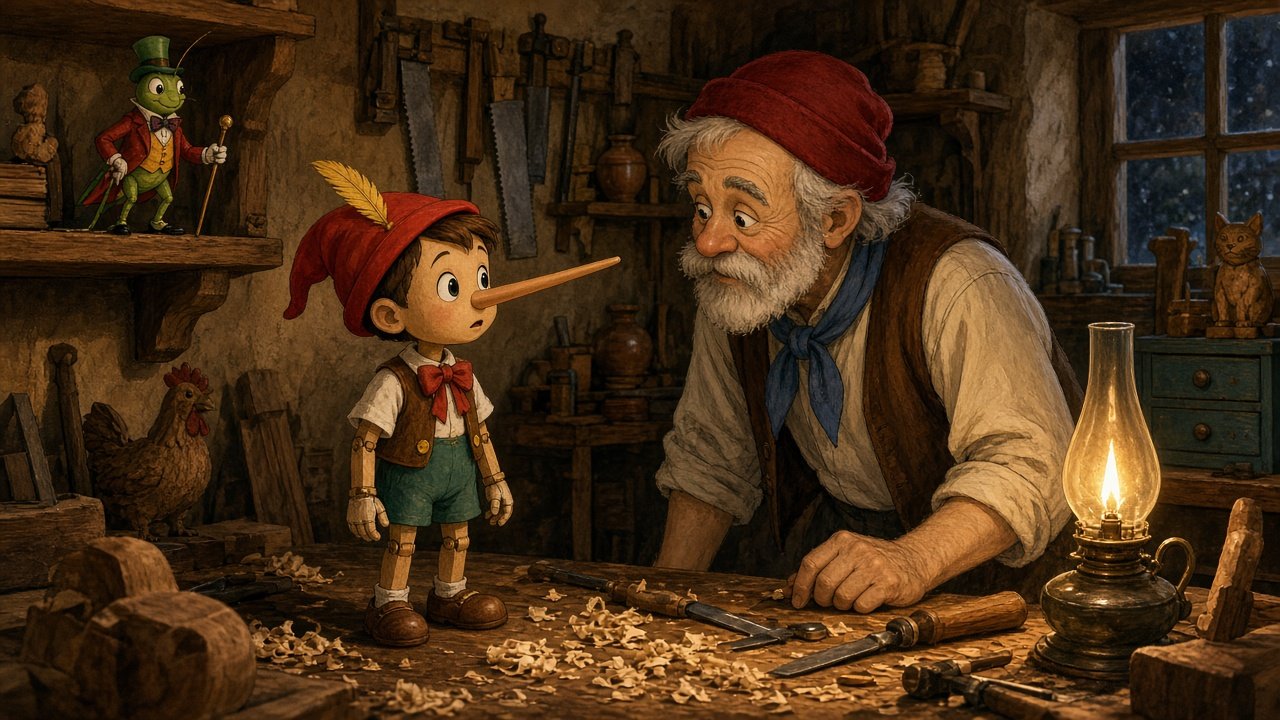
A puppet that talks, a nose that grows with every fib, and a boy who learns the hard way what it means to be good. The Pinocchio story for kids has been making children giggle and think for more than 140 years. This short retelling follows Carlo Collodi’s original Italian book from 1883, trimmed to a single bedtime and gentle enough for young listeners.
Reading time: about 7 minutes | Best for ages: 5-10 | Original author: Carlo Collodi (public domain)
The Pinocchio Story for Kids
In a small Italian village, there lived a poor old woodcarver named Geppetto. He had a white wig the color of cornmeal, a tiny workshop, and almost nothing to eat. One day a friend gave him a log of wood, and Geppetto had an idea. “I’ll carve a puppet,” he said, “a wonderful puppet that can dance and fence and turn somersaults. Then I’ll travel the world with him and earn my bread.”
He began to carve. First the hair, then the forehead, then the eyes. The eyes moved and stared at him. Geppetto blinked. He carved the nose, and it began to grow, longer and longer, no matter how much he trimmed it. He carved the mouth, and it laughed at him. He carved the hands, and they snatched off his wig.
“You naughty thing!” cried Geppetto. “I haven’t even finished you, and you’re already being rude to your father!”
He named the puppet Pinocchio. As soon as Pinocchio’s legs were done, he leaped off the table, ran out the door, and raced down the street. It took a police officer to catch him.
Geppetto loved Pinocchio anyway. That winter, he sold his only coat to buy Pinocchio a spelling book so he could go to school like a real boy. “Thank you, Father!” Pinocchio said, hugging him. “I’ll learn to read and write and earn money, and I’ll buy you a beautiful new coat.”
He meant it. But on the way to school, Pinocchio heard music from a puppet theater. “I’ll go to school tomorrow,” he thought. He sold his spelling book for a ticket and ran inside.
In Geppetto’s workshop lived a Talking Cricket who had seen it all. “Pinocchio,” the cricket had warned, “children who disobey their parents and run away from school come to no good.” Pinocchio didn’t listen. He seldom did.
At the theater, the puppet master, a huge man named Fire-Eater, at first wanted to throw Pinocchio in the fire to cook his supper. But when Pinocchio cried about his poor father, Fire-Eater sneezed (which, for him, meant he felt sorry) and gave Pinocchio five gold coins to take home.
Pinocchio skipped along, jingling his coins, until he met a sly Fox and a sneaky Cat. “Why bring home only five coins,” purred the Fox, “when you could plant them in the Field of Miracles and grow a tree full of gold?”
Pinocchio believed them. Of course, the Fox and the Cat were tricksters, and they ended up with his coins.
Lost and in trouble, Pinocchio was rescued by a kind Fairy with blue hair. She tucked him into bed and asked him what happened to his money.
“I lost it,” Pinocchio lied. His nose grew two inches.
“Where did you lose it?” asked the Fairy.
“In the woods,” said Pinocchio. His nose grew longer.
“Then we’ll find it,” she said.
“Oh, no, I remember now, I swallowed it with my medicine!” At that, his nose grew so long he couldn’t turn around without bumping the walls.
The Fairy laughed. “Lies, my boy, are easy to see. Some have short legs, and some have long noses. Yours is the long-nosed kind.” Then she called a flock of woodpeckers, who pecked his nose back to its normal size.
Pinocchio promised to be good. For a while he even went to school and did well. But then his friend Lampwick told him about Toyland, a place with no school, no books, and no bedtime, where every day was play. Pinocchio couldn’t resist. He climbed onto a wagon pulled by donkeys and rode off.
Toyland was fun for five whole months. Then one morning Pinocchio woke up with long, furry ears. By evening he had a tail, and soon he was braying “Hee-haw!” He and Lampwick had turned into donkeys. Pinocchio was sold to a circus, where he hurt his leg, and then thrown into the sea.
In the water, fish nibbled away the donkey skin, and Pinocchio became a wooden puppet again. He swam happily, until an enormous shark opened its mouth and swallowed him whole.
Inside the dark belly of the shark, Pinocchio saw a tiny light flickering far away. He walked toward it. There, at a little table with a candle, sat an old man.
“Father!” cried Pinocchio.
It was Geppetto! He had built a boat to search for Pinocchio, and the shark had swallowed him two years before. Pinocchio thought of Geppetto first. “Climb on my shoulders, Father. I’m a good swimmer.””
While the shark slept with its mouth open, Pinocchio carried Geppetto out past its teeth and swam through the night toward shore. They found a little farm, and Pinocchio went to work. He turned a heavy water wheel every day to earn milk for his weak father. At night, he wove baskets and studied by candlelight. He even saved his pennies to buy himself new clothes, then gave them to help the Fairy when he heard she was sick.
One night, he dreamed of the Blue Fairy. “Well done, Pinocchio,” she said. “You have a good heart.”
When he woke up, Pinocchio was no longer made of wood. He looked in the mirror and saw a real boy with brown hair and blue eyes. And in the corner, Geppetto was well again, back at his carving table, smiling the biggest smile of his life.
Moral of the Story
What made Pinocchio “real” was how he lived, not what he was made of. He told lies, skipped school, and chased easy fun, and each choice got him into deeper trouble. What finally changed him was telling the truth, working hard, and caring about someone else more than himself.
Questions to Talk About After Reading
- What happened every time Pinocchio told a lie? What do you think the long nose stands for?
- Why did Pinocchio keep listening to the Fox, the Cat, and Lampwick instead of the Talking Cricket?
- Toyland sounded perfect. What went wrong? Would you want to live there?
- What did Pinocchio do inside the shark that showed he had changed?
- Geppetto sold his coat to buy a spelling book. What do the grown-ups in your life give up for you?
About the Original Book
Collodi’s The Adventures of Pinocchio was first published in a children’s magazine starting in 1881 and became a book in 1883. In the original, the giant sea creature is a “terrible Dogfish,” a kind of shark, and the story is packed with funny, odd side adventures we couldn’t fit here. If your child loves learning lessons through classic tales, try The Boy Who Cried Wolf, another story about what happens to fibbers, or The Emperor’s New Clothes. Find more in our classic stories collection.
Frequently Asked Questions
Who wrote Pinocchio?
Italian writer Carlo Collodi (the pen name of Carlo Lorenzini) wrote The Adventures of Pinocchio. It first appeared as a magazine serial in 1881 to 1882 and was published as a book in 1883.
Why does Pinocchio’s nose grow?
In the story, Pinocchio’s nose grows every time he tells a lie. The Blue Fairy uses it to teach him that lies are easy to spot and only make things worse.
What is the moral of the Pinocchio story?
Honesty, hard work, and caring for the people who love you are what make you truly ‘real.’ Pinocchio becomes a real boy only after he stops thinking about himself and works to save his father.
Is the original Pinocchio different from the movie?
Yes. Collodi’s book is longer and sometimes darker and funnier than the film versions. The Talking Cricket, the Fox and the Cat, Toyland, and the giant fish are all in the original, though details differ.
What age is this Pinocchio story good for?
This retelling suits ages 5 to 10 and takes about 7 minutes to read aloud. The scary parts are brief and end happily.