The Akbar Birbal line story is one of the most-told tales about the emperor and his clever adviser. One morning, Emperor Akbar draws a line on a slate and gives his court a puzzle: make it shorter, without erasing it and without touching it. Every wise man in the room gets stuck. Then Birbal walks in and solves it in a few seconds.
Akbar was a real Mughal emperor who ruled much of India from 1556 to 1605, and Birbal was a real adviser at his court, born with the name Mahesh Das. The clever-answer stories about the two of them are folk tales that people have told and retold for centuries, so they’re best read as fun stories rather than history. This version is for kids ages 5 to 12 and takes about 7 minutes to read aloud.
Part 1: A puzzle for the court
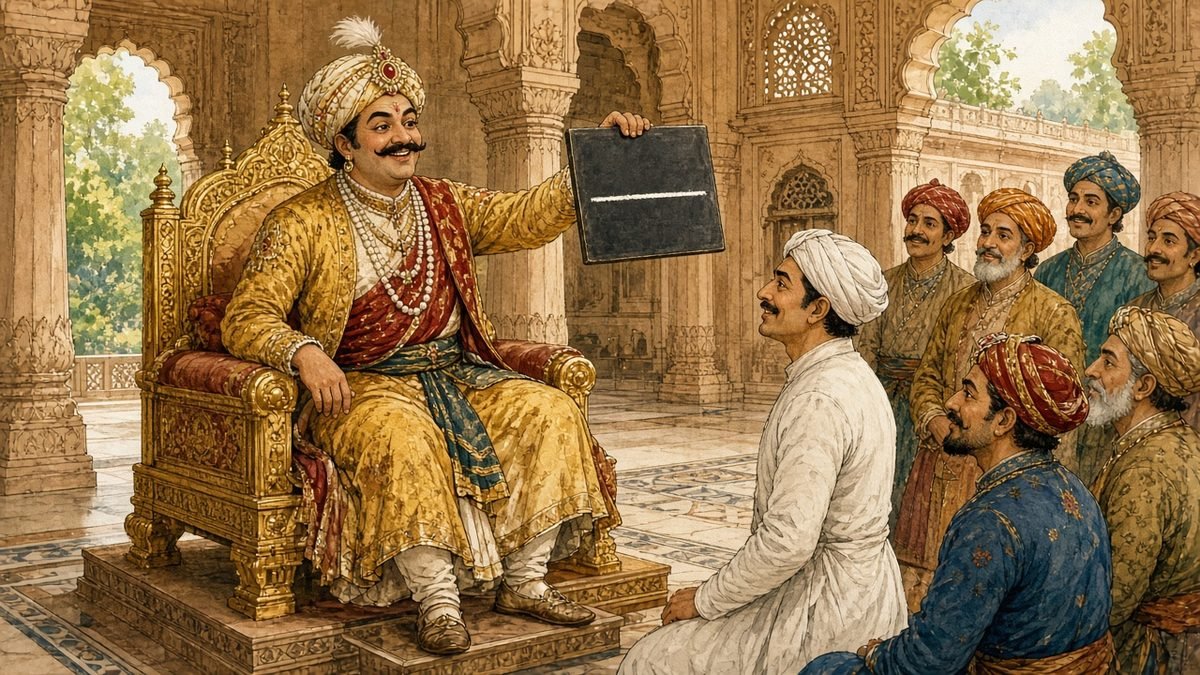
Long ago, Emperor Akbar sat on his throne in a grand hall with tall pillars and a marble floor. Sunlight came in through carved windows and made patterns on the walls. Every morning, advisers, poets and scholars gathered there to talk with the emperor.
Akbar loved riddles. Whenever he had a quiet moment, he thought up a new one and tried it on the people around him. Some mornings he asked questions about numbers, and others he asked about animals or about the stars.
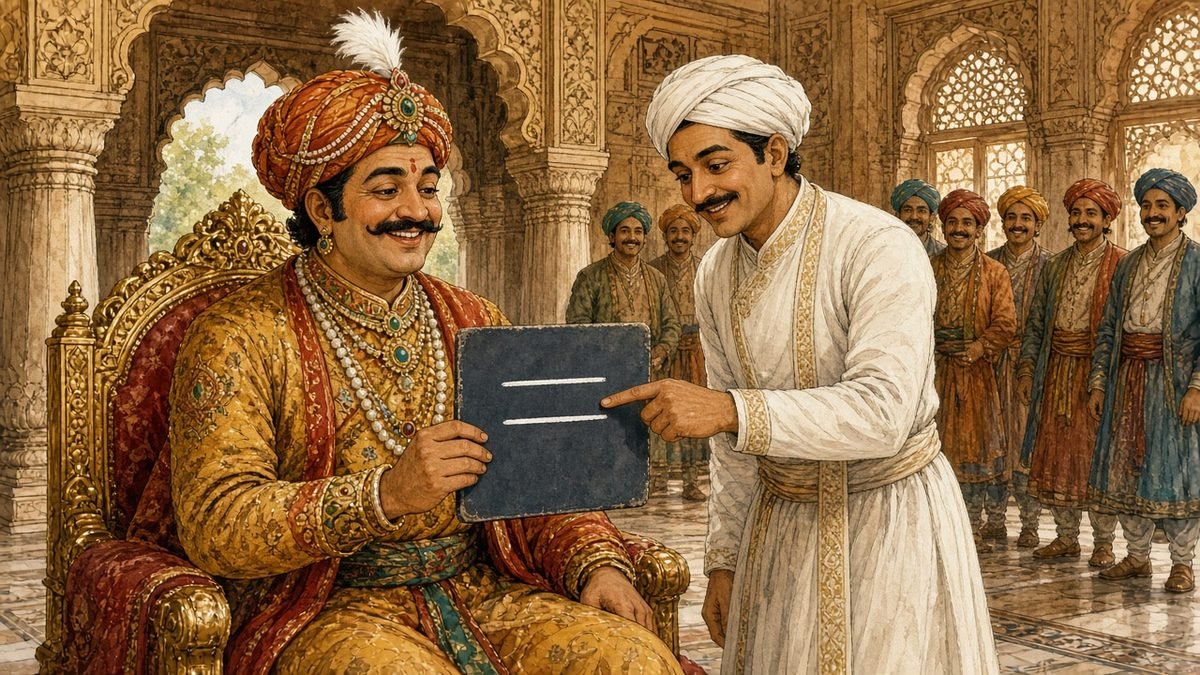
On this particular morning, he was in an especially playful mood. He picked up a small slate and a piece of chalk, walked to the middle of the room and drew a long, straight line across the slate. He held it up so everyone could see.
“Here is a challenge for you,” he said, smiling. “I’d like somebody to make this line shorter. But there are rules. You can’t rub out any part of it, and you can’t touch it at all.”
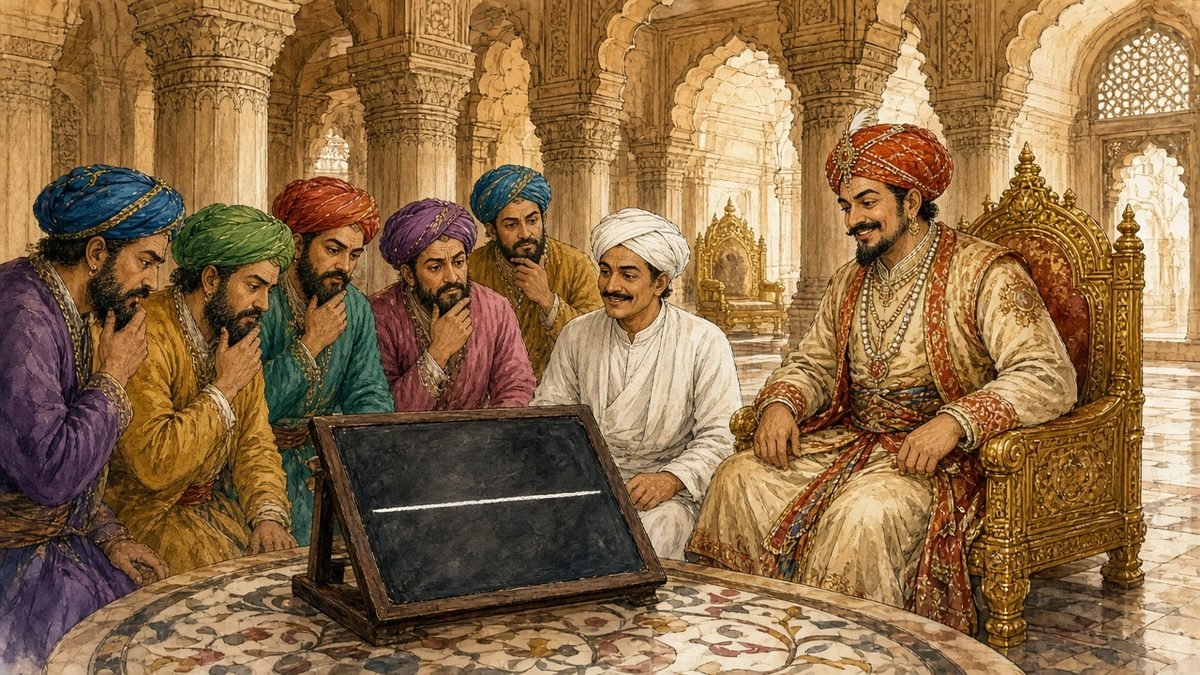
The courtiers looked at each other. One of them scratched his beard, and another rubbed his chin.
“Make it shorter,” murmured one. “Without touching it.”
“Impossible,” whispered another.
Part 2: Everybody tries
A tall scholar in a green turban was the first to step forward. He studied the slate for a long time and tapped his foot. “Your Majesty,” he said at last, “perhaps if I cover one end of the line with my hand…”
“That’s touching it,” said Akbar, with a twinkle in his eye.
The scholar’s face turned red, and he stepped back.
A young poet came next. He suggested folding the slate in half so that the line looked shorter. But folding the slate was touching it, too, and slates don’t fold, anyway. Everybody laughed, including the poet.
Then a nobleman offered to hold the slate very far away, so the line would look small. “That makes the line look farther off,” said Akbar. “It doesn’t make it shorter. Anybody can see that.”
One after another, the courtiers tried their best. They talked about shadows and mirrors and magic. A few of them whispered to each other and shook their heads. But every idea broke one of the rules, and none of them worked.
Finally, the whole room fell quiet. The emperor leaned back on his throne, looking a little disappointed. “Is there really nobody here who can solve a little line?” he asked.
Just then, the doors at the far end of the hall swung open.
Part 3: Birbal arrives
It was Birbal. He had been away on an errand for the emperor, and he came walking down the long hall, still dusty from the road. The courtiers stood up a little straighter. A few of them gave each other sideways looks, because they knew how this usually went.
“You’re just in time, Birbal,” said Akbar, waving him over. “We have a puzzle. See this line on the slate? I want it made shorter, but nobody may rub it out, and nobody may touch it.”
Birbal bowed. “May I have a look, Your Majesty?”
The emperor handed him the slate. Birbal looked at the line for a moment, with his head tilted to one side. Then he smiled very slightly.
“Would you let me borrow your chalk, please?” he asked.
“Of course,” said Akbar. He was curious now, and so was everybody else. People leaned forward to see better, and a few at the back stood on tiptoe.
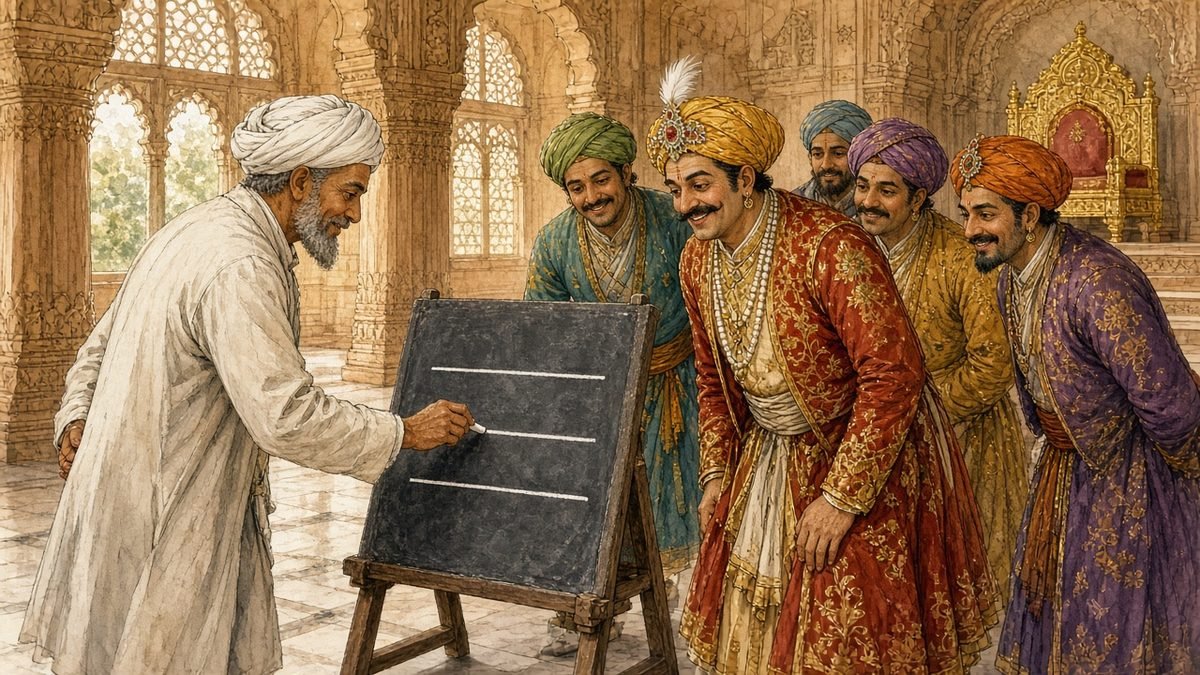
Birbal set the slate down on a low table. Then, right beside the emperor’s line, he drew a second line. And this one was much, much longer.
He put the chalk down and stepped back. “There, Your Majesty,” he said. “Now the first line is shorter.”
Part 4: Why it worked
For a moment, nobody said anything. Then Akbar looked at the slate and began to laugh. It was a big, happy laugh that echoed off the marble pillars.
“Wonderful!” he cried. “You haven’t touched my line at all. You haven’t rubbed out one tiny piece of it. And yet, next to your line, mine really is shorter!”
“Yes, Your Majesty,” said Birbal. “A line looks long or short depending on what’s beside it. I didn’t have to change your line. All I had to do was draw a longer one.”
The courtiers began to clap. The scholar in the green turban clapped, too, though his cheeks were still a bit pink. He bowed to Birbal, and Birbal bowed back and gave him a friendly nod.
Akbar held up the slate for everyone to see. “Do you understand what Birbal has taught us today?” he said. “When we try to make someone else smaller, we only get tangled up. But when we do something great ourselves, the others don’t need to be brought down at all.”
“Hear, hear!” said an old minister, and the whole hall cheered.
Part 5: A gift for Birbal
The emperor was so pleased that he took a ring from his finger and handed it to Birbal. “For your quick thinking,” he said. “Keep it, my friend.”
Birbal thanked him and slipped it on. Then he turned to the court with a smile. “I’m glad the puzzle has an answer,” he said. “I’d much rather borrow a bit of chalk than take anything away from someone.”
That afternoon, the slate with the two lines was hung on the wall of the hall, right above the throne. Whenever anybody came to the court feeling jealous of somebody else’s success, they were taken to look at it.
“Don’t try to make their line shorter,” the courtiers would say. “Just draw a longer one.”
And ever after, that was one of the favorite sayings in the emperor’s court.
The End
Moral of the story: Grow your own line
You don’t need to put another person down to look good. Birbal shows that the best way to stand out is to build your own skills and kindness, and to let your own work speak for itself. The same idea works for friends, classmates and teammates: when somebody else succeeds, it doesn’t take anything away from you. It’s a good reminder to work on your own line and let other people have theirs.
What kids can learn from the Akbar Birbal line story
- Pulling someone down doesn’t make you any taller. Improving yourself does.
- Sometimes the answer to a puzzle comes from looking at it in a new way.
- Being clever and being kind can go together.
- It’s okay to be stuck. Everybody in the court was, until Birbal came along.
Questions to talk about with your child
- What were the two rules Akbar gave for the puzzle?
- Why did the courtiers’ ideas break the rules?
- How did Birbal make the first line shorter without touching it?
- What does “draw a longer line” mean for how we treat other people?
- Can you think of a time when someone else’s success made you feel jealous? What could you do instead?
Summary: The Akbar Birbal line story
In the Akbar Birbal line story, Emperor Akbar draws a line on a slate and asks his court to make it shorter without touching or erasing it. None of the courtiers can do it. Birbal draws a longer line next to Akbar’s, which makes the first line look shorter. The emperor praises him, and the court learns not to tear others down but to improve themselves.
For more tales of the emperor and his adviser, read Birbal’s Khichdi and How Many Crows? The Akbar Birbal Crow Story.
Read More: The Foolish Lion and the Clever Rabbit
Frequently asked questions
What is the moral of the Akbar Birbal line story?
Don’t try to bring other people down to look better. Do your own best work instead, and your achievements will stand out on their own.
Were Akbar and Birbal real people?
Yes. Akbar was a Mughal emperor who ruled from 1556 to 1605, and Birbal was one of his advisers at court. Birbal was born Mahesh Das and is remembered by the name Birbal. The stories about their clever back-and-forth are folk tales told long afterward, so there’s no record that any single story, including this one, really happened.
Does the story end differently in other versions?
There’s nothing to soften here, because nobody is punished or hurt. Tellings differ on small details, such as whether the line is drawn on a slate, the floor or paper. The courtiers’ failed attempts, the emperor’s ring and the saying on the wall are our additions, added to fill out a very short tale for read-aloud time.
How is this different from the other Akbar Birbal stories on Kidsgraphy?
In How Many Crows?, Birbal answers a numbers question with a clever trick, and in Birbal’s Khichdi, he shows the emperor an unfair decision. This story is about jealousy and how to handle it.
What age is this story good for?
Ages 5 to 12. Even young children enjoy the surprise of the longer line, and older kids can talk about jealousy, fairness and different ways to solve a problem.