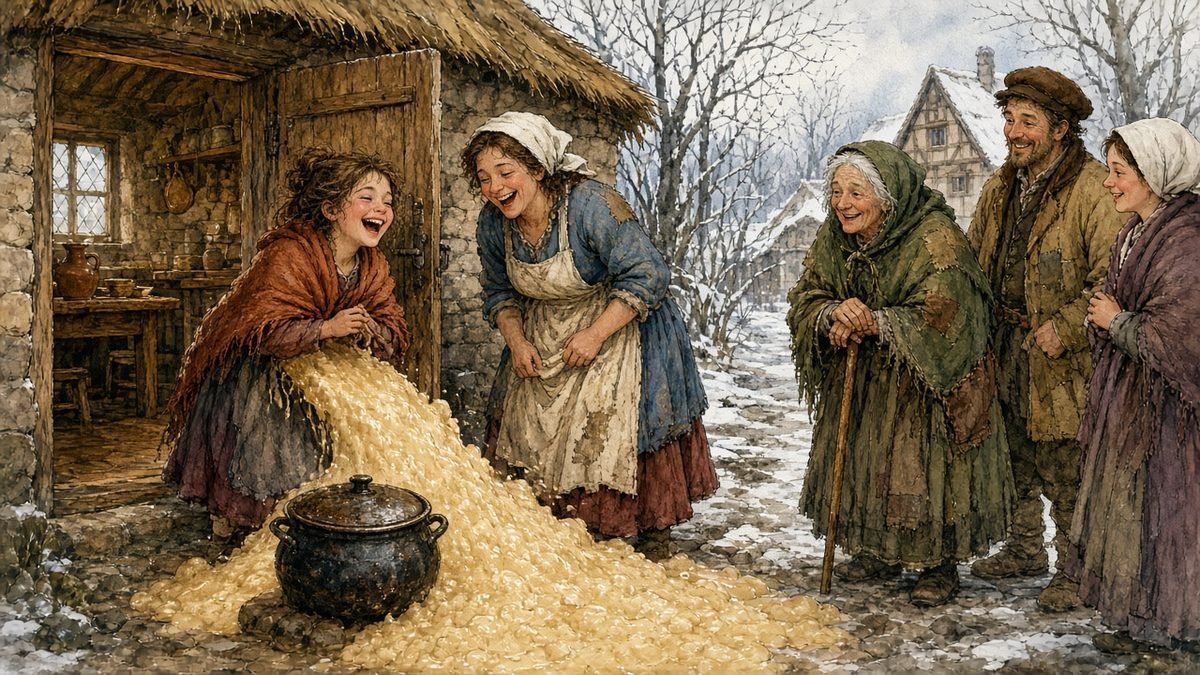
The Magic Porridge Pot story is a folk tale collected by the Brothers Grimm, who called it “Sweet Porridge.” A poor girl and her mother have nothing left to eat, until an old woman gives the girl a little black pot that cooks porridge whenever she asks. It’s a funny, cozy story about a kitchen, a village and a word that someone forgot.
The story has been retold in many picture books under the title The Magic Porridge Pot. This version is for kids ages 5 to 12 and takes about 7 minutes to read aloud. The ending in the original is already gentle, and the FAQ explains how it goes.
Part 1: Nothing left to eat
Once upon a time, a girl named Greta lived with her mother in a small house at the edge of a village. They were very poor. Their cupboard was empty, their garden had stopped growing anything, and they hadn’t had a real meal in days.
One cold morning, Greta’s stomach growled so loudly that her mother laughed in spite of herself. “I’m sorry, my dear,” she said. “I wish I had something to give you.”
“I’ll go to the forest,” said Greta. “Maybe I can find some berries.”
She put on her warm shawl and walked through the village and along the path into the woods. The trees were bare, and the ground was crunchy with frost. She looked under every bush, but there wasn’t a single berry anywhere.
After a long time, Greta sat down on a mossy log, feeling very tired. She was so hungry that she was almost ready to cry.

Part 2: The old woman and the little pot
“Why, hello there, child,” said a gentle voice.
Greta looked up. An old woman was standing beside the log. She had a kind, wrinkled face and a patched green cloak, and she carried a basket on her arm.
“Hello,” said Greta, wiping her eyes. “I’m sorry. I was only looking for something to eat.”
The old woman nodded as if she knew all about it. “I can tell that you’re hungry,” she said, “and you’re a good girl. I have something for you.”
She reached into her basket and took out a small black pot. It wasn’t much to look at. It had a round belly and a little lid.
“This is a very special pot,” said the old woman. “Whenever you want porridge, put it on the table and say, ‘Cook, little pot, cook!’ It will fill up with the sweetest porridge you’ve ever tasted. When you’ve had enough, say, ‘Stop, little pot, stop!’ And it will stop.”
Greta stared at her. “Really?”
“Really,” said the old woman, smiling. “Take it home to your mother.”
Greta thanked her over and over. Then she hugged the pot to her chest and hurried back through the woods.
Part 3: A feast at home
When Greta got home, her mother was sitting by the cold stove with her hands folded. Greta put the pot on the kitchen table and told her about the old woman.
“Oh, Greta,” said her mother gently. “I don’t know if it’s true.”
“Let’s try,” said Greta. She put her hands on either side of the pot and said, as clearly as she could, “Cook, little pot, cook!”
At once, the pot began to bubble. A sweet, warm smell drifted through the kitchen. The porridge rose to the top of the pot, thick and creamy, with a little steam curling off it.
“Stop, little pot, stop!” said Greta.
The bubbling stopped. The pot sat there, perfectly full, and not a drop spilled over the rim.
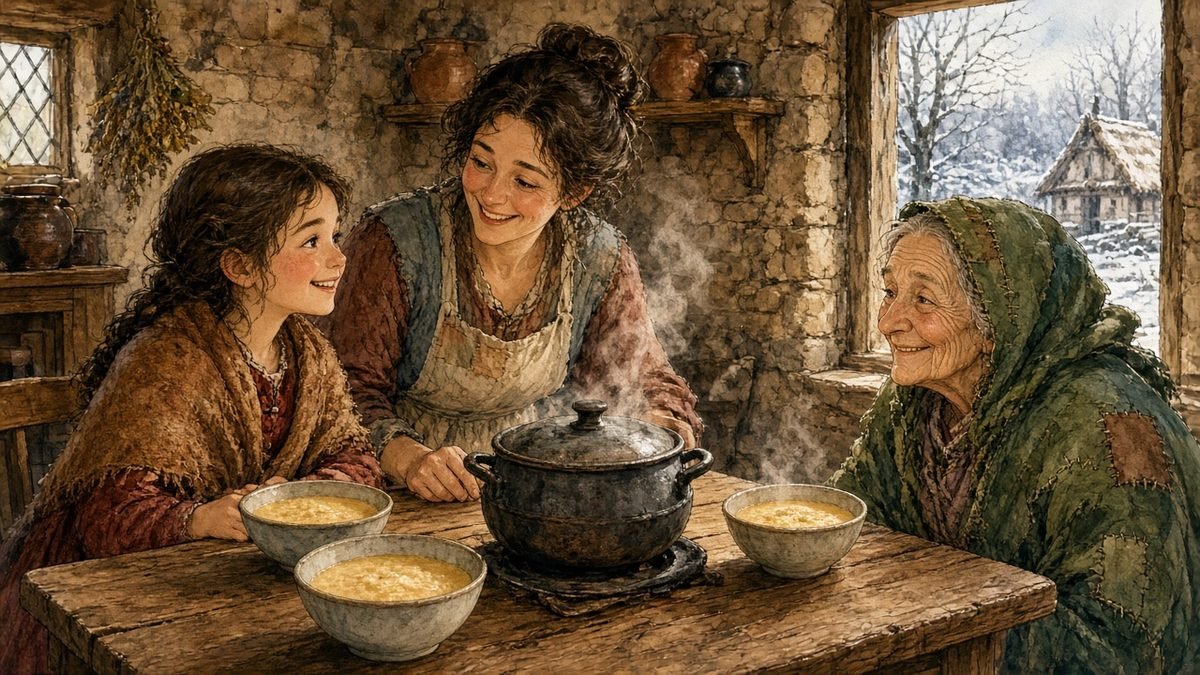
Her mother’s mouth fell open. Then she started to laugh, and Greta laughed with her. They found two spoons and two bowls, and they ate until they were full. It was the best porridge they had ever had in their lives.
After that, Greta and her mother never went hungry again. Whenever they wanted a meal, they only had to say the magic words.
Part 4: The day Mother forgot
One afternoon, Greta went out to visit her friend down the road. Her mother stayed home to tidy the kitchen. After a while, she began to feel a little peckish.
“I’ll have a small bowl of porridge,” she said to herself. She set the pot on the table. “Cook, little pot, cook!”
The pot began to bubble. The porridge came up to the brim, and her mother ate a bowlful. It was delicious.
“That’s enough now,” she said, and she reached for her cup of tea. But the pot kept bubbling. Porridge slid over the rim and onto the table, and then it slid down onto the floor.
Her mother frowned. “Little pot,” she said, “I’ve had enough.” The pot didn’t stop. “Stop!” she said. “Quiet!” The porridge kept coming.
She tried to remember the magic words, but all she could think of was the words for starting the pot. The harder she tried, the more muddled her mind got.
The porridge was ankle-deep, then knee-deep. Her mother climbed onto a chair, then onto the table, and finally she opened the window and scrambled out onto the grass. Behind her, the porridge poured out the door and down the path.
Part 5: Porridge in the village
The porridge didn’t stop at the house. It slid through the garden and out the gate, and it flowed down the road toward the village.
The neighbors came out to see what was going on. “Porridge!” shouted the baker. “It’s coming down the street!”
It filled up the dog’s kennel and the baker’s front steps. It gurgled around the well and flowed under the doors of the shops. A little boy walked out in his boots and stood in a warm puddle of porridge, laughing so hard he could barely breathe.
“Where is it coming from?” said the baker’s wife.
“From the little house at the end of the lane!” yelled somebody. “Look! It’s up to the roof!”
It seemed like the whole village would be buried before the afternoon was over. Everyone who lived there could do nothing but watch the porridge come.
Part 6: The magic words
Meanwhile, Greta was walking home, humming a tune. She turned the corner of the lane and stopped.
The street was full of porridge, and so were the gardens. People were standing on their roofs. In the middle of it all, her mother was sitting on top of the garden gate, waving her arms.
“Greta!” she called. “The pot won’t stop! I forgot the words!”
Greta ran as fast as she could, wading through porridge up to her knees. She pushed open the door and splashed into the kitchen, where the little black pot was bubbling away on the table.
“Stop, little pot, stop!” she said.
The pot gave one last little bubble, and then it was quiet.
Everybody cheered. But there was one more problem. The porridge that had spilled into the village was still there, piled up on the roads and in the squares. Anyone who wanted to get from one end of the village to the other had to eat their way through it.
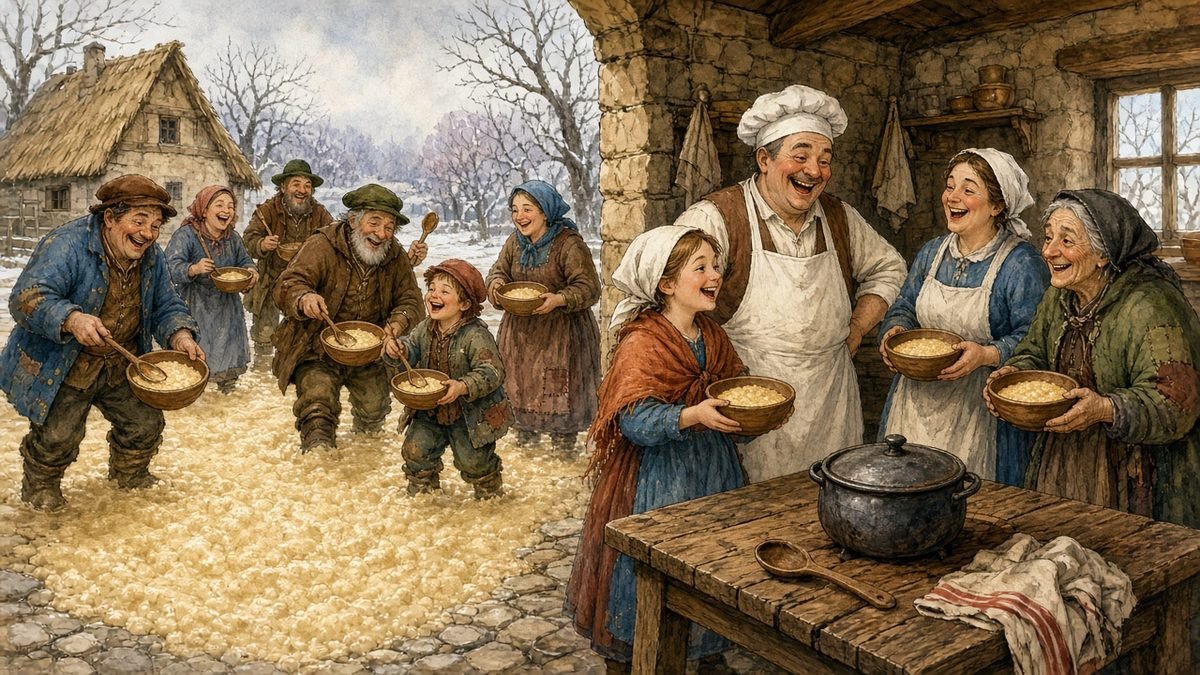
So Greta and her mother, and all the neighbors, grabbed their spoons and their bowls and their ladles. They ate porridge all day long. The baker made porridge buns, and the children made porridge castles, and they all agreed they’d never forget the day.
The End
Moral of the story: Know how to stop
Knowing how to start something isn’t enough. You need to know how to stop it, too. Greta’s mother had the pot but forgot the second half of the instructions, and a good thing turned into a big mess. The story also reminds us that kind gifts, like the old woman’s, are best used with care, and that it’s smart to listen closely and remember what you’re told.
What kids can learn from the Magic Porridge Pot story
- Pay attention to instructions all the way to the end.
- Too much of a good thing can turn into a problem.
- When something goes wrong, tell someone and get help quickly.
- Neighbors can work together to fix a mess, even a very sticky one.
Questions to talk about with your child
- Why did the old woman give Greta the pot?
- What were the two magic phrases, and why do both matter?
- Why couldn’t Greta’s mother make the pot stop?
- How would you have felt if porridge was coming down your street?
- What’s something at home that you need to know how to turn off as well as on?
Summary: The Magic Porridge Pot
In the Magic Porridge Pot story, a poor girl named Greta is given a little pot by an old woman. When she says “Cook, little pot, cook!” the pot makes porridge, and “Stop, little pot, stop!” turns it off. One day, Greta’s mother forgets the stopping words, and the porridge floods the house and the village until Greta comes back and says them. The story teaches us to remember the whole set of instructions.
For more stories about food and neighbors, read Stone Soup and Grandma’s Pancakes That Flew Away.
Read More: The Enormous Turnip
Frequently asked questions
What is the moral of The Magic Porridge Pot?
Know how to stop what you start, and remember all of the instructions. The pot is a gift, but it only works well if you know when to say “stop.”
Is The Magic Porridge Pot a Brothers Grimm story?
Yes. The Brothers Grimm collected it in their Children’s and Household Tales under the title “Sweet Porridge” (in German, “Der süße Brei”). Picture-book versions, including the popular British ones, usually call it The Magic Porridge Pot. Similar tales about magic cooking pots are told in other parts of Europe, too.
How does the original story end?
The ending is already kid-friendly. In the Grimms’ tale, the girl comes home just in time to say the stopping words, but the porridge has filled the whole village. Anyone who wants to go back into town has to eat their way through it. Nobody is hurt, so this retelling keeps that ending and adds names for the girl and her mother, along with the baker and the neighbors, and a bit more fun with the porridge buns.
What kind of porridge is it?
In the Grimms’ version, it’s a sweet porridge made from millet, a small grain. Many picture books just say porridge, so you can imagine whatever kind your family likes best.
What age is this story good for?
Ages 5 to 12. Younger children love chanting the magic words and the sticky mess in the village, and older children can talk about why instructions matter.