Turkeys get a lot of attention in November, most of it about the dinner table. Out in the woods, they are fast, clever, colorful birds. These turkey facts for kids cover how turkeys gobble, run, fly, and see the world, along with some history and a few surprises. You can use them on a Thanksgiving placemat, in a school report, or as a fun-fact challenge while the pie bakes.
Turkey Facts for Kids: The Basics
- Turkeys are birds native to North America. Wild turkeys lived here long before Europeans arrived. Mexico, the United States, and southern Canada are their original home.
- There are two kinds of turkeys. The wild turkey lives across North America, and the ocellated turkey lives in Mexico’s Yucatán Peninsula and parts of Central America. The ocellated turkey has bright blue skin and shimmery feathers with eye-like spots.
- Male turkeys have three names. Adult males are called toms or gobblers. Young males are called jakes.
- Females are hens, and babies are poults. Young females are called jennies.
- A group of turkeys is called a flock, or sometimes a rafter.
- Wild turkeys are big birds. An adult tom usually weighs about 16 to 24 pounds, and hens about 8 to 12 pounds.
- Wild turkeys almost disappeared. By the early 1900s, overhunting and loss of forests had made them rare in many states. Thanks to conservation work, there are now millions of wild turkeys across the U.S.
Gobbles, Clucks, and Purrs
- Only males really gobble. Toms gobble to attract hens and to tell other males, “This is my turf.”
- A gobble can travel about a mile. On a still spring morning, you can hear one from far away.
- Turkeys “talk” in lots of ways. Scientists have counted more than two dozen different turkey calls, including clucks, purrs, yelps, cackles, and alarm “putts.”
- Hens yelp to call their poults. It’s like a turkey mom calling her kids in for dinner.
- Turkeys gobble back at loud noises. Thunder, slammed car doors, and even owl hoots can set off a “shock gobble.”
Feathers, Snoods, and Wattles
- Turkeys have about 5,000 to 6,000 feathers. That’s a lot of preening.
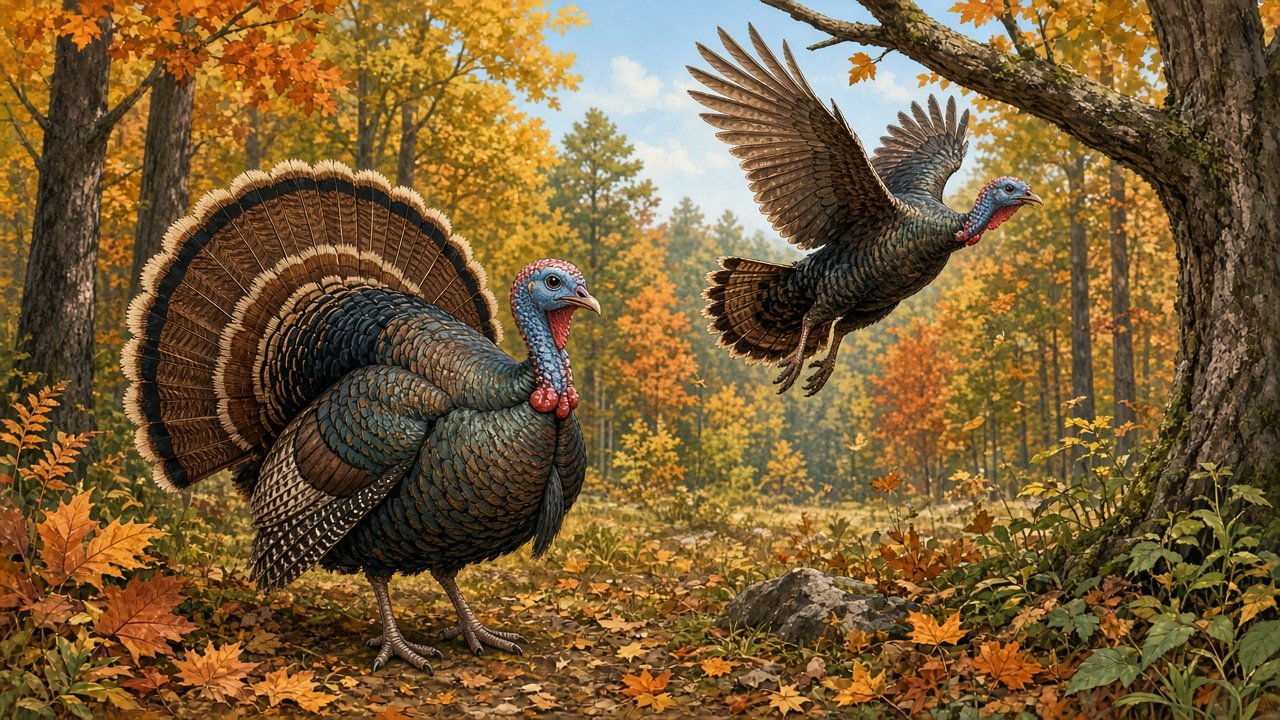
- The tail fan has about 18 feathers. When a tom spreads them out, it’s called strutting or displaying.
- Turkey feathers aren’t just brown. In sunlight, wild turkey feathers shimmer bronze, copper, green, and gold.
- The snood is the floppy flap over the beak. When a tom is excited, it can stretch and hang down past his beak. Scientists have found hens seem to prefer toms with longer snoods.
- The wattle hangs under the chin. It’s a flap of bare skin.
- Their heads change color. A turkey’s bare head and neck can turn red, white, or blue depending on its mood. Red usually means excited or ready to show off.
- Toms have a “beard.” It’s a tuft of thin, hair-like feathers that sticks out from the chest. Some hens have small beards too.
- Males have spurs. These sharp points on the back of their legs are used when toms spar with each other.
Turkey Superpowers
- Wild turkeys can fly. They can burst into the air and fly up to about 55 miles per hour for short distances.
- They sleep in trees. At sunset, wild turkeys fly up into tree branches to roost, where they’re safer from foxes and coyotes.
- They’re fast runners. Wild turkeys can run around 20 to 25 miles per hour. That’s faster than most people can sprint.
- They can swim. It doesn’t happen often, but turkeys can tuck their wings, spread their tails, and paddle.
- They see in color. Turkeys have excellent color vision, better than ours in some ways, and they notice movement quickly.
- They have a huge field of view. Because their eyes are on the sides of their heads, turkeys can see nearly all the way around themselves without turning.
- They eat almost anything. Wild turkeys eat acorns, seeds, berries, insects, and even small salamanders.
Farm Turkeys vs. Wild Turkeys
- Farm turkeys are much heavier. Most turkeys raised for food are a breed called the Broad Breasted White. They grow so big that most can’t fly.
- Farm turkeys are white. White feathers don’t leave dark spots on the skin, which is why farmers chose them.
- Minnesota raises the most turkeys. It’s the top turkey-producing state in the U.S., followed by North Carolina and Arkansas.
Turkey History Facts
- People in Mexico raised turkeys long ago. Turkeys were domesticated in Mexico more than 2,000 years ago.
- Turkeys took a round trip. Spanish explorers carried domestic turkeys from Mexico to Europe in the 1500s. Later, English colonists brought some back to North America.
- Ben Franklin teased the eagle. In a 1784 letter to his daughter, Benjamin Franklin called the turkey “a much more respectable bird” than the bald eagle. But he never actually proposed it as the national bird.
- Presidents “pardon” turkeys. Each year, the President of the United States spares one or two turkeys in a lighthearted White House ceremony. The pardoned birds go to live on a farm.
- We don’t know if turkey was at the first Thanksgiving. A colonist’s letter mentions wild birds and deer, but not turkey by name. Read more in our first Thanksgiving story for kids.
Turkey Myths Kids Might Hear (and the Truth)
“Turkeys are dumb.”
Not true. Wild turkeys are wary and alert, and hunters will tell you they’re very hard to sneak up on. They remember the layout of their home range, recognize members of their flock, and quickly learn which spots are dangerous. The “dumb turkey” idea mostly comes from heavy farm birds, which were bred for size, not survival skills.
“Turkeys drown by looking up at the rain.”
This is an old story, but there’s no good evidence for it. Some young farm turkeys have a genetic condition that can make them stare upward and lose balance, which may be where the rumor started. Healthy turkeys know to get out of the rain.
“Eating turkey makes you sleepy.”
Turkey contains tryptophan, a building block your body uses to make sleep chemicals. But chicken, cheese, and many other foods contain similar amounts. The post-dinner yawns probably come from eating a huge meal, sitting on a warm couch, and a long, busy day.
“All turkeys gobble.”
Only the males make the famous gobble. Hens make softer yelps, clucks, and purrs, and poults peep like little chicks.
“Turkeys can’t fly.”
Farm turkeys mostly can’t, but wild turkeys are strong fliers over short distances, and they roost high in trees every night.
Turkey Activities for Kids
Handprint Turkey
Trace your child’s hand on paper. The thumb becomes the head and the fingers become tail feathers. Add a snood and a wattle now that they know what those are!
Feather Fact Fan
Cut out paper feathers and write one turkey fact on each. Glue them in a fan behind a paper-plate turkey body. Hang it on the door.
Turkey Call Contest
Have everyone try a gobble, a cluck, and a purr. Vote on the most realistic, or the silliest. Then read The Little Red Hen aloud and let the kids do all the barnyard voices.
Bird Watching Walk
Wild turkeys live in all U.S. states except Alaska. Walk through a park or forest edge early in the morning, and look for scratch marks in the leaves, three-toed tracks in mud, or feathers.
Pair These Facts with More Thanksgiving Fun
Kids who like animal facts may enjoy our fun facts about dolphins next. For something quiet to print, try our turkey coloring pages. And if you’re planning more autumn fun, our fall activities for kids list has easy indoor and outdoor ideas.
Frequently Asked Questions
Can turkeys fly?
Wild turkeys can fly. They usually fly short bursts at up to about 55 miles per hour and roost in trees at night. Farm-raised domestic turkeys are bred to be so heavy that most can’t fly.
Why do turkeys gobble?
Male turkeys, called toms or gobblers, gobble to attract females and to announce themselves to other males, especially in spring. A gobble can be heard up to about a mile away.
What is the red thing on a turkey’s face?
The fleshy flap that hangs over the beak is the snood, and the dangly skin under the chin is the wattle. Both can turn bright red when a turkey is excited or showing off.
What is a baby turkey called?
A baby turkey is called a poult. Female turkeys are hens, males are toms or gobblers, and young males are called jakes.
Did Benjamin Franklin want the turkey as the national bird?
Not exactly. In a 1784 letter to his daughter, Franklin joked that the turkey was ‘a much more respectable bird’ than the bald eagle, but he never formally proposed it as the national symbol.
How many feathers does a turkey have?
An adult wild turkey has roughly 5,000 to 6,000 feathers, including about 18 long feathers in its fan-shaped tail.