The Foolish Lion and the Clever Rabbit is one of the best-known stories from the Panchatantra, a collection of animal fables from ancient India. Parents and teachers still reach for it when they want a tale about brains beating brute strength. A hungry lion rules a forest by fear, until a small rabbit shows up late for dinner with a plan that saves everyone.
This kid-friendly version is written for ages 5 to 12. It takes about ten to twelve minutes to read aloud. The sharp parts of the old tale are softened so bedtime stays calm. After the story you’ll find the moral, talking points, a short summary and a FAQ.
Part 1: The Lion Who Would Not Wait
Once upon a time, in a wide green forest of mango trees and bamboo, there lived a lion. He was big. He was strong. He had a golden mane that shone in the sun, and a roar that made the leaves shake on the highest branches.
Every morning he woke up hungry. Every morning he chased whatever animal he saw first: a deer by the stream, a buffalo in the tall grass, a boar in the thickets. He did not hunt only when he needed food. He hunted because he could, and because nobody had ever told him no.
The other animals grew tired and scared. Mothers hid their little ones in hollow logs. Birds stopped singing when the lion walked by. Even the monkeys, who usually chattered from dawn to dusk, held still in the canopy. The forest that used to buzz with life went quiet, the way a playground goes quiet when a storm rolls in.
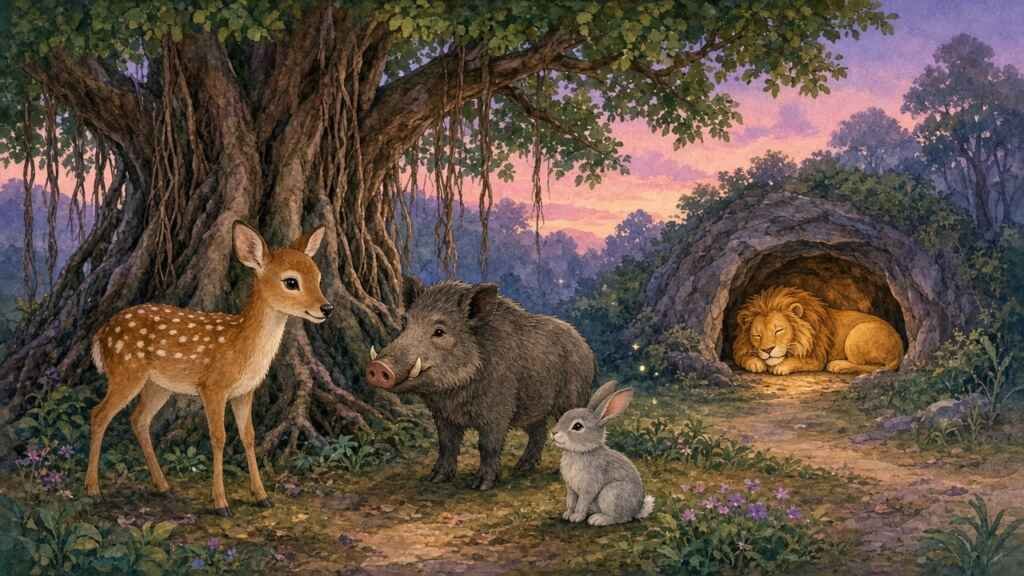
One evening the animals held a secret meeting under a huge banyan tree, while the lion slept off a heavy lunch.
“If this keeps up,” whispered an old deer, “none of us will be left by the rainy season.”
“We can’t fight him,” said a wild boar, scraping a hoof in the dirt. “He’s too strong. One swipe of his paw and it’s over.”
“Then we have to think,” said a small gray rabbit, thumping one soft foot. “Strong isn’t the same as smart. There has to be another way.”
They talked until the fireflies came out. At last they agreed on a plan that felt unfair and necessary at the same time.
Part 2: A Deal With the King
The next morning the animals walked together to the lion’s den. Their knees knocked, but they stood in a polite line outside the rocky cave.
The lion blinked awake and licked his chops. “Breakfast has delivered itself,” he said. “How thoughtful of you.”
The old deer stepped forward and bowed. “Your Majesty, we have a proposal. Every day we will send one animal to you for your meal. You will not have to hunt. You will not have to chase through thorns. Your food will arrive on time, and the rest of us can live in peace.”
The lion tilted his heavy head. No more running in the midday heat? No more sweaty chases that left burrs in his mane?
“Hmm,” he said. “And if you miss a day?”
“Then you may hunt again as you please,” said the deer. “But we won’t miss. You have our word.”
The lion agreed with a lazy yawn. From that day on, each morning one animal walked slowly along the path to the den. The lion ate, stretched in a patch of sun and took long naps. For a while, the forest breathed again. Birds sang. Little ones played near the stream. It was not a perfect deal, but it was quieter than before.
Part 3: The Rabbit’s Turn
Days passed. Weeks passed. Names were drawn. Then it was the small rabbit’s turn.
His friends hugged him goodbye near the berry bushes. His mother pressed her nose to his and tucked a clover behind his ear. “Be brave,” she whispered. “And be careful.”
The rabbit set off along the path, but he did not hurry. He hopped a few steps. He paused to nibble a leaf. He watched a line of ants carry a crumb. He counted clouds shaped like carrots. The sun climbed high over the mango trees, and still he was not at the den.
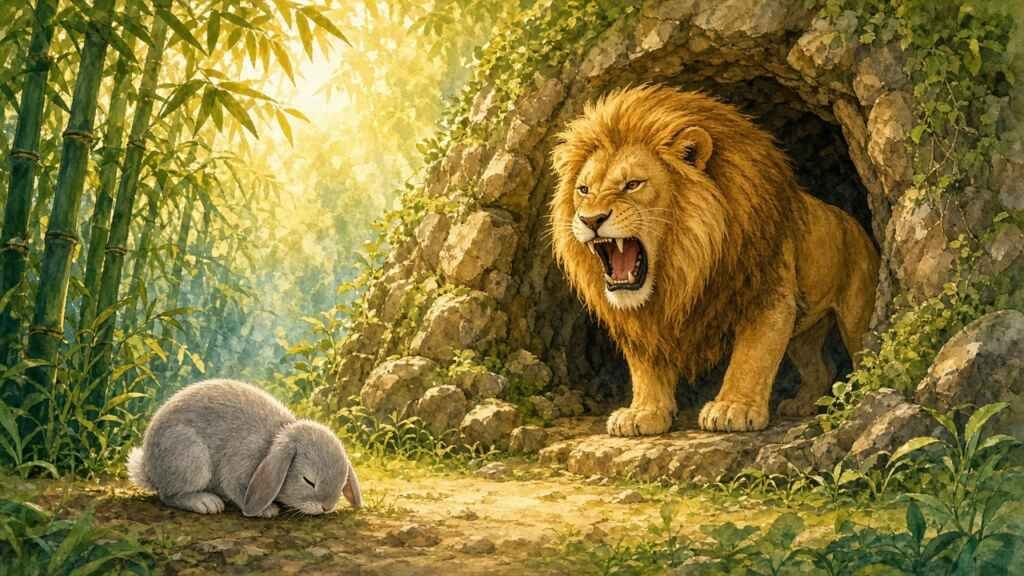
By the time he arrived, the lion was pacing in front of the cave, furious and empty-bellied.
“You are LATE!” the lion roared. Dust puffed from the rocks. “I have been waiting for hours. I should eat you in one gulp and then hunt the rest of your family for dessert!”
The rabbit bowed so low his whiskers brushed the ground. His ears shook, but his voice stayed steady.
“Forgive me, Your Majesty. I was coming to you on time. Truly I was. But on the way I met another lion, and he stopped me cold.”
The lion froze mid-pace. “Another lion? In MY forest?”
“Yes,” said the rabbit. “A huge lion. Bigger than you, if you can believe it. He said this forest belongs to him now. He said he would eat any animal on its way to your den. He even said… well, I shouldn’t repeat it. It was very rude.”
“Repeat it,” growled the lion, and a fleck of spit hit a fern.
The rabbit gulped. “He said you are a lazy old cat who makes rabbits bring him lunch because he is too soft to hunt.”
Part 4: The Well in the Clearing
The lion’s mane bristled like a brush on fire. Nobody called him a lazy old cat. Nobody claimed his forest. Nobody, in all his years as king, had dared to talk that way.
“Show me this lion!” he bellowed. “I’ll teach him whose trees these are!”
“Follow me,” said the rabbit, already turning. “I’ll take you right to him. He is not far.”
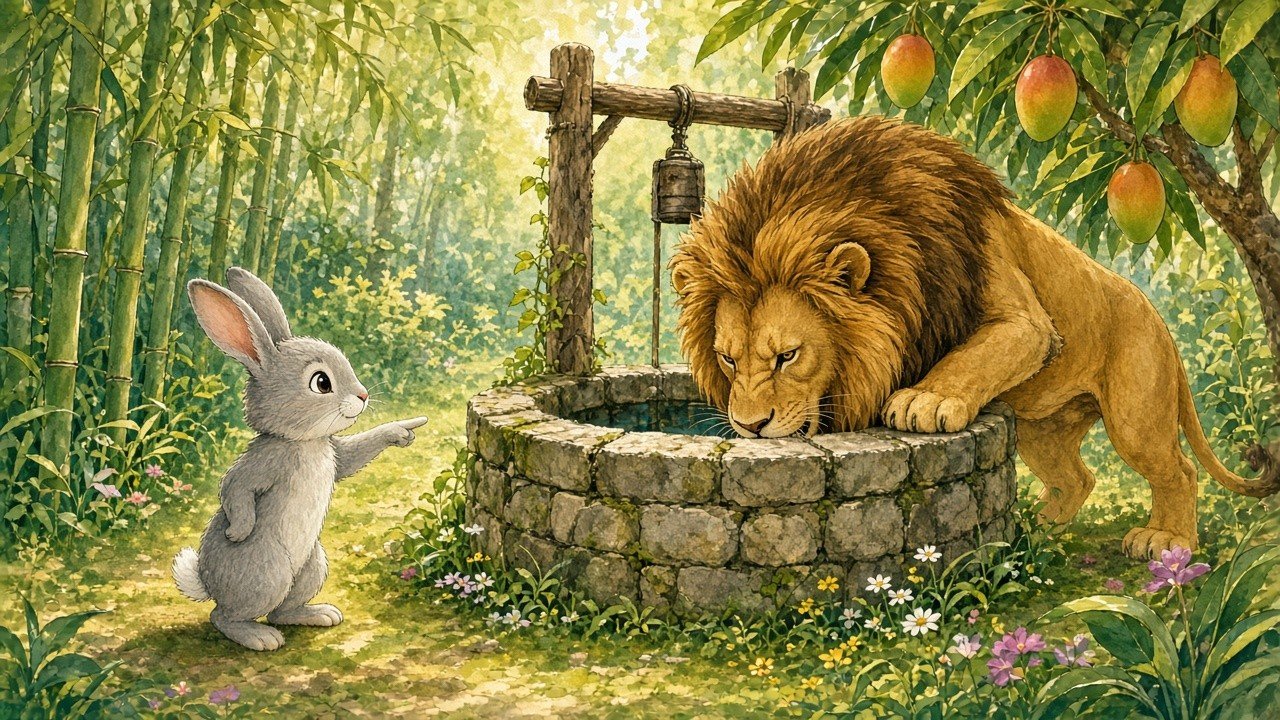
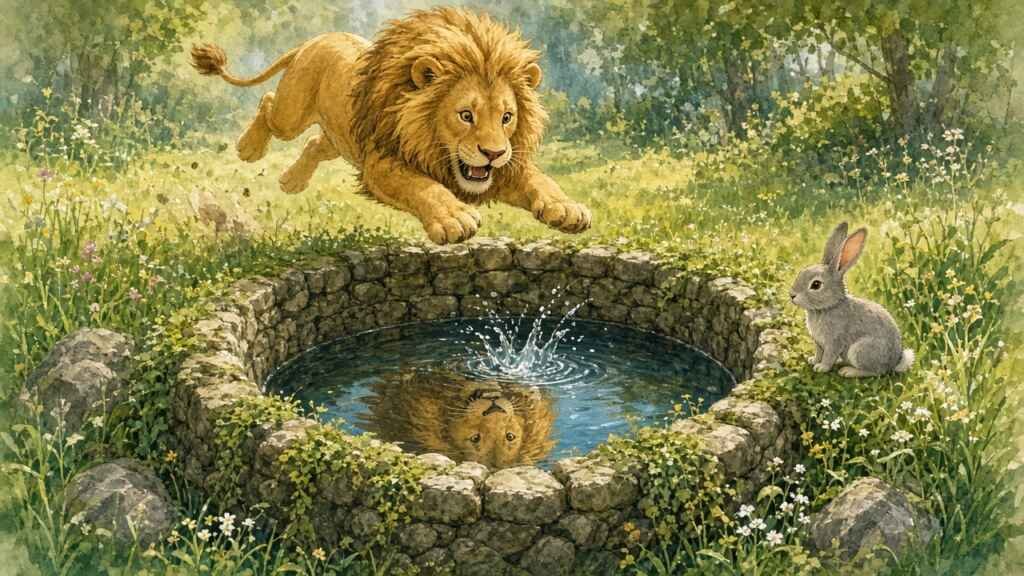
They ran through the trees, the lion crashing ahead through bamboo, the rabbit hopping just fast enough to stay a few bounds in front. Birds scattered. Leaves flew. At last they came to a sunny clearing with an old stone well at its center. The well was deep, and the water at the bottom was still and clear, like a dark mirror held flat to the sky.
“He lives down there,” whispered the rabbit, pointing with a trembling paw. “He told me this well is his palace. Look over the edge, Your Majesty, but be careful. He is fierce, and he does not like visitors.”
The lion stormed to the rim and peered down.
From the water, another lion glared back: same golden mane, same angry eyes, same open mouth full of teeth.
“THERE you are!” roared the lion at the top.
The lion in the water roared too, mouth for mouth, eyes for eyes.
“This is MY forest!”
The reflection mouthed the same words without a sound anyone could hear above the echo.
The lion at the top grew wild with rage. He did not stop to think. He did not ask the rabbit a single question. He did not notice how still the clearing was, or how the rabbit had hopped three steps back from the edge. He sprang at the enemy in the water with all four paws outstretched.
Splash!
Part 5: Ripples and Quiet
Water sprayed up in a glittering arc and spotted the rabbit’s fur. The well was deep, the walls were slick with moss, and the lion could not find a paw-hold. He thrashed and roared, and the sound bounced off the stones until it faded into a wet, tired growl.
The rabbit peered over the edge once. Then he hopped back three careful steps and shook the water from his ears.
“I’m sorry it came to this,” he said softly toward the well. “But the forest needed peace, and you would not listen any other way.”
He turned and ran all the way home, clover still tucked behind one ear.
When he told the others what had happened, nobody cheered at first. They were quiet, the way people are quiet after a storm passes. Then the old deer let out a long breath. A peacock spread his feathers like a painted fan. The little ones tumbled into the open grass and laughed for the first time in weeks.
From that day on, the animals shared the forest without a king who ate out of turn. They still told the story of the small rabbit who was late on purpose, and of the lion who jumped at his own reflection. Parents used it when a child needed reminding that a sharp mind can protect a whole family. Travelers who stopped by the clearing tossed a pebble into the well and listened to the plink, just to be sure the water still answered only with sky.
And if you walk past a still well in a quiet clearing, you might see only clouds looking back. That is usually enough.
The End
Moral of the story: The Foolish Lion and the Clever Rabbit
Intelligence can overcome strength. The lion had power, teeth and a roar that shook the trees, but he did not stop to think. The rabbit was small, yet he used a calm plan, a sharp story and the lion’s own pride to protect the whole forest.
What kids can learn from this fable
- Being strong is not the same as being wise. The lion lost because he rushed.
- A good plan can protect people who cannot win a fair fight.
- Anger makes it hard to see clearly. The lion attacked a reflection.
- Even a small person can help a whole group when they keep their head.
- Pride can be a trap. The insult about a “lazy old cat” mattered more to the lion than the truth.
Questions to talk about with your child
- Why did the animals offer the lion one animal a day? Was that fair, or only the best they could do at the time?
- Was the rabbit’s trick brave, sneaky or both? Would you have done the same?
- What should the lion have done when he saw the “other lion” in the well?
- Have you ever solved a problem with a smart idea instead of force? What happened?
- How do you think the forest felt the morning after the lion was gone?
Summary: The Foolish Lion and the Clever Rabbit
A fierce lion hunts so often that the forest animals fear for their lives. They make a deal to send him one animal each day so he will stop chasing everyone. When a small rabbit’s turn comes, the rabbit arrives late and tells the lion another lion has claimed the forest. He leads the angry king to a well. The lion sees his own reflection, leaps at it and falls in. The forest is peaceful again, thanks to a clever plan and a cool head.
Read More: The Blue Jackal
Frequently asked questions
Who wrote The Foolish Lion and the Clever Rabbit?
It comes from the Panchatantra, a Sanskrit collection of fables traditionally linked to the teacher Vishnu Sharma. Versions of the tale have been retold across Asia and beyond for centuries.
Is this the same as The Lion and the Mouse?
No. The Lion and the Mouse is an Aesop fable about kindness repaid. This Panchatantra story is about a rabbit who outsmarts a greedy lion with a well and a reflection.
What is the moral of The Foolish Lion and the Clever Rabbit?
Wisdom is stronger than muscle. Pride and anger can make even a mighty person fall for a simple trick.
Is this a good bedtime story?
Yes, in a gentle retelling. This version keeps the lesson and leaves out gory details, so kids can talk about cleverness without scary images sticking at lights-out.
Why does the rabbit arrive late on purpose?
The delay makes the lion angry enough to listen to a wild story. If the rabbit had arrived on time and told the same tale, the lion might have eaten him first and asked questions never.