Akbar and Birbal stories are some of the most loved folk tales in India. Akbar was a real Mughal emperor who ruled in the 1500s, and Birbal was one of his trusted courtiers. Over hundreds of years, people have told funny stories about how Birbal’s quick wit helped the emperor see what was fair. Most of these stories are folk tales rather than history, but they’ve been passed down for generations. The Birbal’s Khichdi story is one of the most famous.
Khichdi (say “KITCH-ree”) is a simple, comforting dish of rice and lentils cooked together. This retelling is for children ages 5 to 12 and takes about 9 minutes to read aloud.
Part 1: The emperor’s cold-water test
One winter, the city of Agra was colder than anyone could remember. The wind blew icy and sharp, and in the mornings there was a thin layer of frost on the palace gardens.
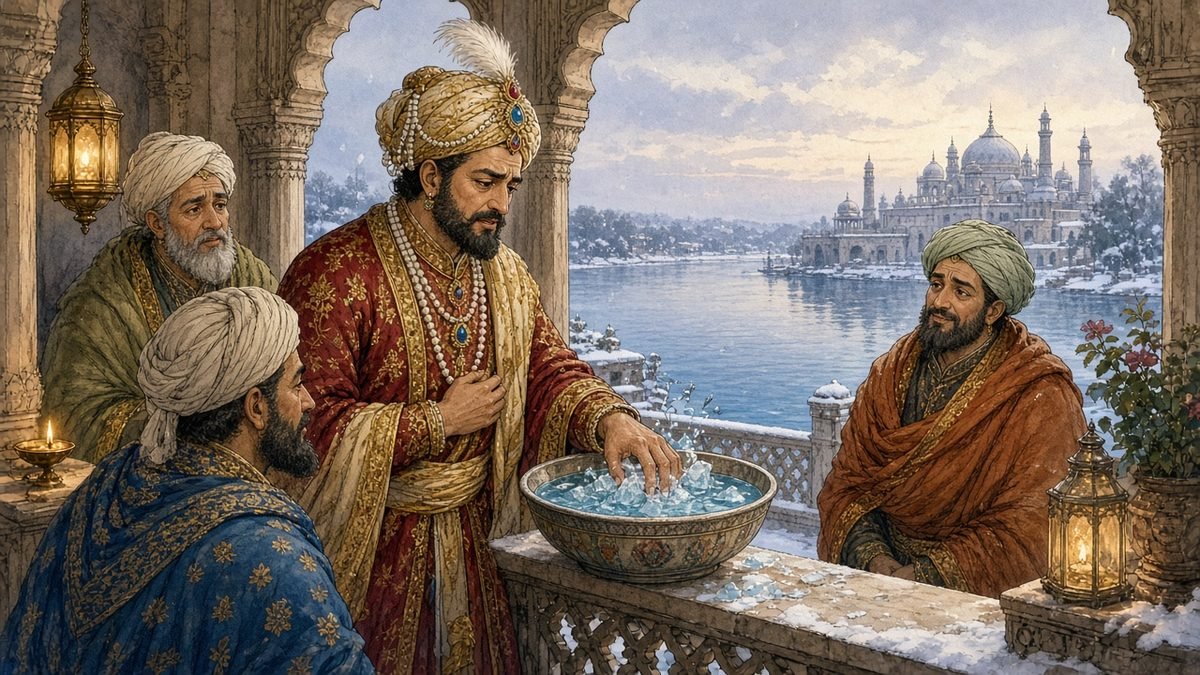
One evening, Emperor Akbar was standing by a palace window with his courtiers. A servant brought him a bowl of water from the lake. Akbar dipped his finger in and pulled it out at once.
“It’s freezing!” he said. “I don’t think any person could stand in the lake on a night like this. Not for a minute, let alone a whole night.”
“Surely not, Your Majesty,” the courtiers agreed.
Birbal, who was standing nearby, said quietly, “People can do surprising things, Your Majesty, when they really need to.”
Akbar raised an eyebrow. “Is that so? Then let’s find out.” He turned to his courtiers. “Announce it in the city. Anyone who can stand in the cold lake all night long, from sunset to sunrise, will receive a reward of a thousand gold coins.”
Part 2: A poor man takes the challenge
For days, nobody came forward. The water was simply too cold.
Then, one afternoon, a thin man in a worn shawl came to the palace gates. His name was Gangu, and he was very poor. His family often went to bed hungry.
“I’ll do it,” he told the guards. “My children need food. I’ll stand in the lake all night.”
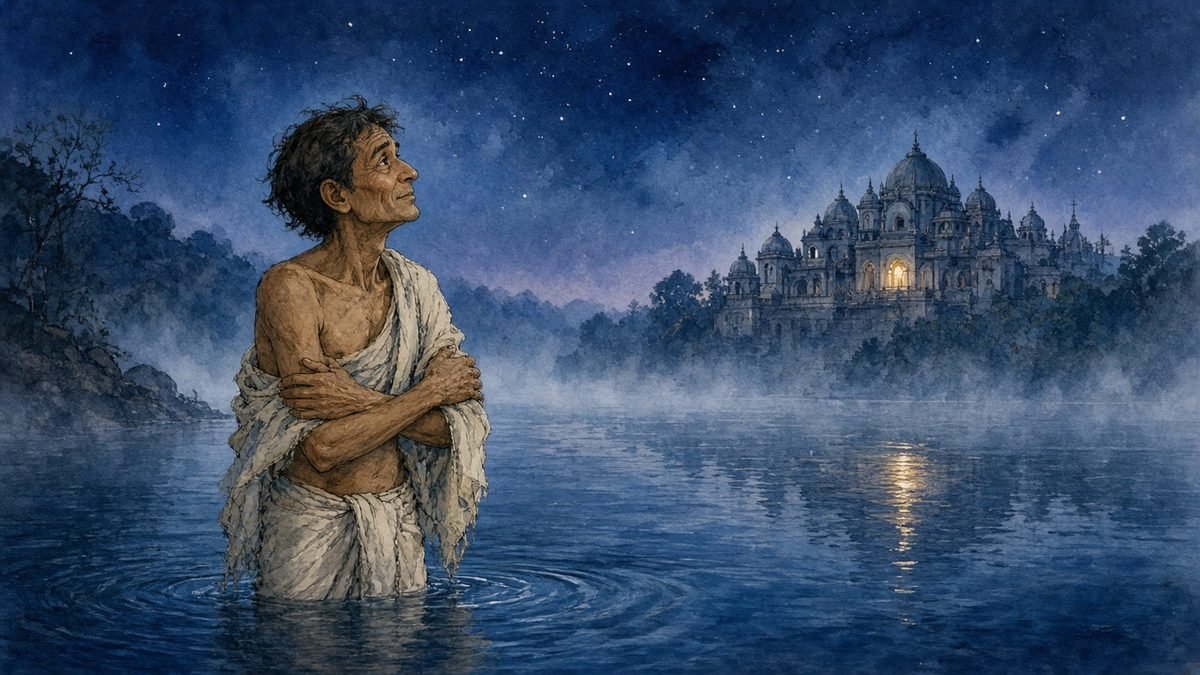
That evening, as the sun went down, Gangu waded into the icy water up to his chest. Two guards stayed on the shore to watch him.
The hours passed slowly. The water was so cold it made his bones ache. His teeth chattered. His fingers went numb. More than once he wanted to give up and climb out.
But far away across the dark water, high up in the palace, a single lamp was burning in a window. Gangu fixed his eyes on that small, warm light.
“Just look at the lamp,” he told himself. “Think of how warm it is. Think of your children. Just a little longer.”
All night long, he kept his eyes on that faraway flame. And when the sun finally rose over the lake, Gangu was still standing in the water, shivering but determined.
Part 3: An unfair decision
The guards brought Gangu to the royal court. He was wrapped in a blanket and still shivering.
“Your Majesty,” he said, bowing, “I stood in the lake all night, just as you asked. I’ve come for my reward.”
Akbar was amazed. “All night? In that freezing water? How did you manage it?”
“I kept looking at a lamp burning in one of the palace windows,” Gangu explained. “Looking at its light helped me get through the night.”
One of the courtiers stepped forward with a sly smile. “Your Majesty, that’s cheating! He was warmed by the palace lamp. He didn’t really face the cold on his own.”
Akbar stroked his beard and thought about it. “Yes,” he said finally. “I suppose that’s true. The lamp helped him. So he hasn’t really won the challenge. There will be no reward.”
Gangu’s face fell. He had suffered all night for nothing. With his head down, he walked slowly out of the court.
Birbal said nothing. But he watched the poor man leave, and his face grew thoughtful.
Part 4: Birbal cooks khichdi
The next day, Birbal didn’t come to court.
“Where is Birbal?” Akbar asked.
A messenger hurried in. “Your Majesty, Birbal says he can’t come today. He’s busy cooking his khichdi. He says he’ll come as soon as it’s ready.”
Akbar waited all morning. Birbal didn’t come. He waited all afternoon. Still no Birbal.
Finally, Akbar lost his patience. “Khichdi takes less than an hour to cook!” he said. “Let’s go and see what’s taking so long.”
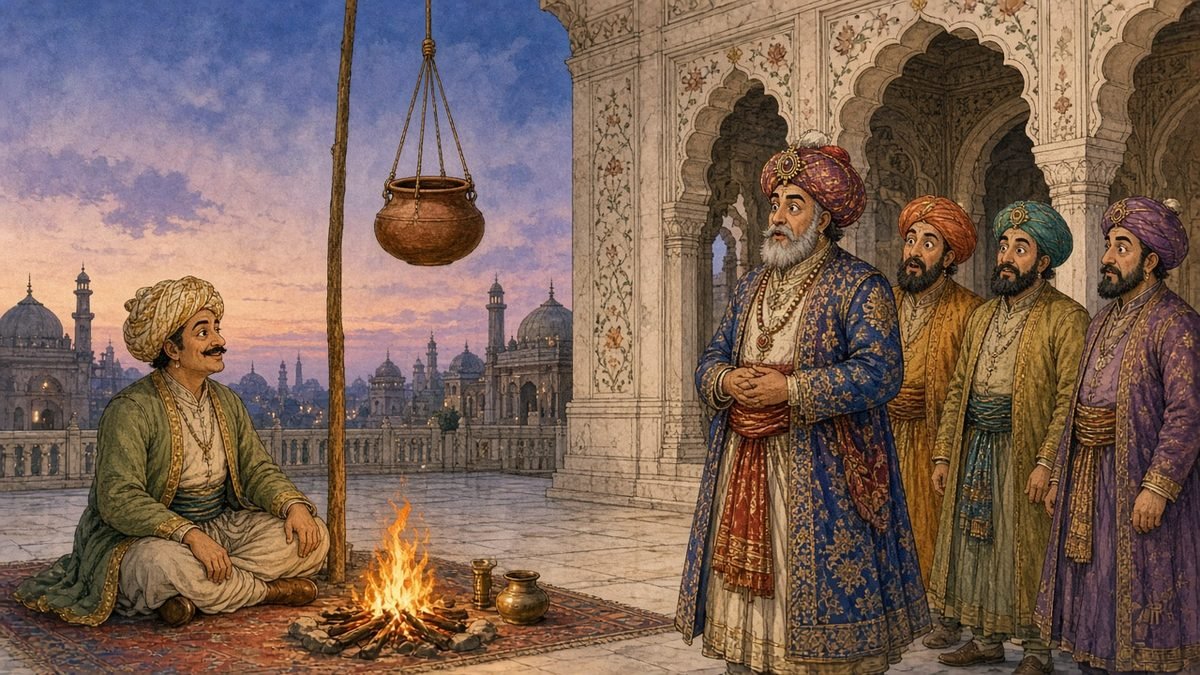
The emperor and his courtiers walked to Birbal’s house. They found him sitting calmly in his yard beside a tiny fire. Above the fire, tied to the top of a tall pole, hung a clay pot of rice and lentils. It was so high up that the little flames couldn’t possibly reach it.
Akbar stared. Then he burst out laughing.
“Birbal, have you lost your mind? How can your khichdi ever cook? The pot is so far from the fire that it won’t even get warm!”
Birbal looked up, all innocence. “But Your Majesty,” he said, “if a poor man in a freezing lake can be warmed by a lamp burning far away in the palace, surely my khichdi can be cooked by a fire only a few feet below it.”
Part 5: The emperor makes it right
Akbar stopped laughing. The courtiers went quiet.
The emperor looked at the pot hanging high above the tiny fire. Then he thought about Gangu, shivering in the lake all night, staring at a lamp so far away that it couldn’t possibly have warmed him.
“You’re right, Birbal,” Akbar said slowly. “That lamp gave the man no warmth at all, just as this fire gives your pot no heat. I was unfair to him. I let myself be talked into breaking my promise.”
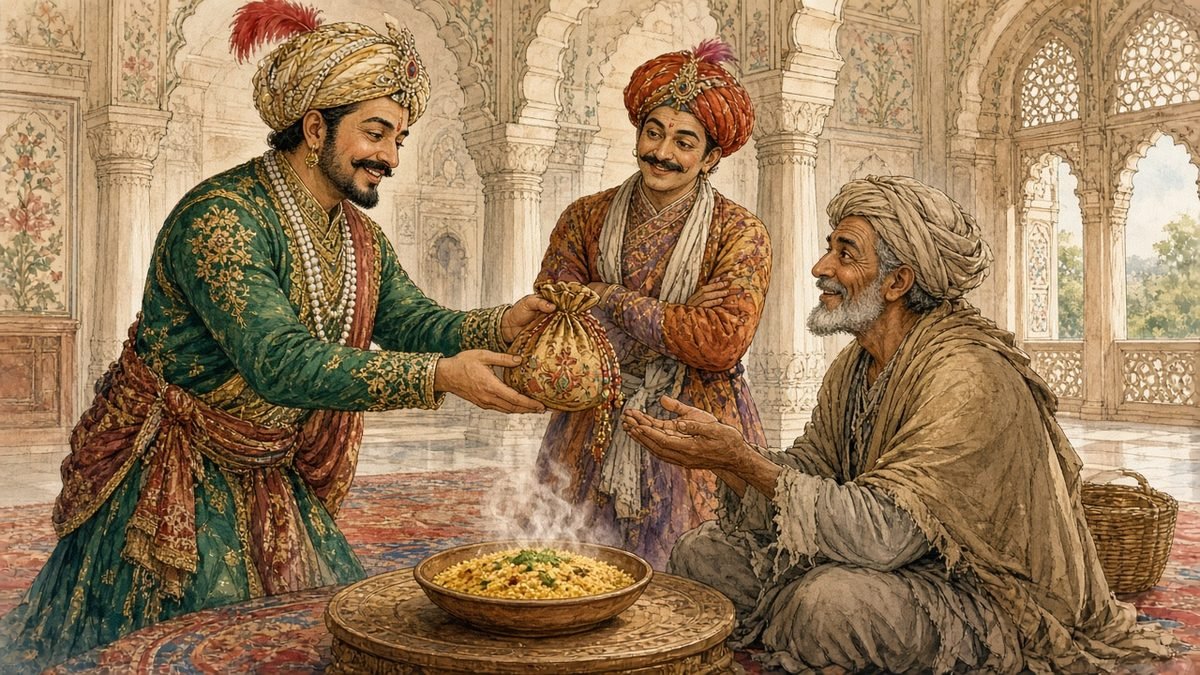
That very day, Akbar sent for Gangu. In front of the whole court, the emperor apologized and gave him the thousand gold coins he had earned, and a warm new shawl as well.
Gangu bowed, tears of happiness in his eyes. “Thank you, Your Majesty.”
Akbar smiled and pointed to Birbal. “Don’t thank me,” he said. “Thank him.”
And that evening, Birbal took the pot down from the pole, set it properly over the fire, and cooked a delicious khichdi. He shared it with the emperor, and with Gangu too.
The End
Moral of the story: Be fair and keep your promises
Akbar made a promise and then broke it because of a silly excuse. Birbal didn’t argue or lecture. He simply showed the emperor how unfair the excuse was. A good leader, and a good friend, admits a mistake and makes it right.
What kids can learn from Birbal’s Khichdi
- Keep your promises. Gangu did his part, so he deserved his reward.
- Be fair, even when it’s hard. It’s easy to make excuses, but fairness matters more.
- Showing works better than shouting. Birbal made his point with a pot of rice and lentils instead of an argument.
- Speak up for others. Birbal helped someone who couldn’t stand up for himself.
- Saying sorry is strong. Even an emperor can admit he was wrong.
Questions to talk about with your child
- Why did Gangu agree to stand in the cold lake?
- Why did the emperor refuse to give him the reward? Was that fair?
- What was Birbal trying to show the emperor with his khichdi pot?
- How did Akbar make things right?
- Have you ever been treated unfairly? What happened, and how did it feel?
Summary: Birbal’s Khichdi
On a freezing winter night, Emperor Akbar offers a reward to anyone who can stand in the cold lake until morning. A poor man named Gangu does it by keeping his eyes on a faraway palace lamp. The emperor refuses to pay, saying the lamp warmed him. Birbal then “cooks” khichdi with the pot hung high above a small fire. When Akbar laughs, Birbal points out that a faraway lamp can’t warm a man either. Akbar admits his mistake and gives Gangu his reward.
For more stories about doing what’s right, read our short stories about honesty for kids, or try the Indian classic Kabuliwala.
Read More: The Brahmin and the Goat
Frequently asked questions
What is the moral of the Birbal’s Khichdi story?
Be fair and keep your promises. It also shows that a clever example can change someone’s mind better than an argument.
Were Akbar and Birbal real people?
Yes. Akbar was a Mughal emperor of India who ruled from 1556 to 1605, and Birbal was a real member of his court. The funny stories about them, though, are folk tales that grew up over many years. They aren’t historical records.
What is khichdi?
Khichdi is a simple Indian dish made by cooking rice and lentils together, usually with a little salt, turmeric and ghee. It’s gentle on the tummy, and many families make it when someone is feeling unwell.
What is the name of the poor man in the story?
The poor man’s name changes from one version to another, and many tellings don’t name him at all. This retelling calls him Gangu.
What age is this story for?
It works well for ages 5 to 12. Younger kids enjoy the silly pot on the pole, and older kids can talk about fairness, promises and how to disagree politely.