Anansi the spider is one of the most famous characters in African folklore. His stories come from the Akan people of Ghana, including the Ashanti (also spelled Asante), and they traveled across the Atlantic to the Caribbean and the Americas, where people still tell them today. Anansi is clever, funny and often a little too pleased with himself, and Anansi and the Pot of Wisdom is one of his best-known tales.
In this story, he tries to keep all the wisdom in the world for himself. It doesn’t go the way he plans. This retelling is for children ages 5 to 12 and takes about 8 minutes to read aloud. Like all folk tales, it’s told in many different ways, and this is one of them.
Part 1: Anansi has a big idea
A long time ago, in a village at the edge of a great forest, there lived a spider named Kwaku Anansi. He had eight busy legs, a round brown body and a head full of schemes.
Anansi liked being clever. He liked it when the other animals came to him for advice. He liked it even more when they said, “Anansi, you’re the wisest creature in the whole village.”
But one day, he noticed something that bothered him. When the goat needed to fix her roof, she asked the weaver bird. When the farmers needed to know when to plant, they asked the old grandmother by the well. When the children wanted a story, they went to the tortoise.
“Everyone knows a little something,” Anansi grumbled. “That means I’m not the wisest of all. But what if I had all the wisdom in the world, every last bit of it? Then everyone would have to come to me.”
And so Anansi found a big clay pot, and he made a plan.
Part 2: Collecting wisdom
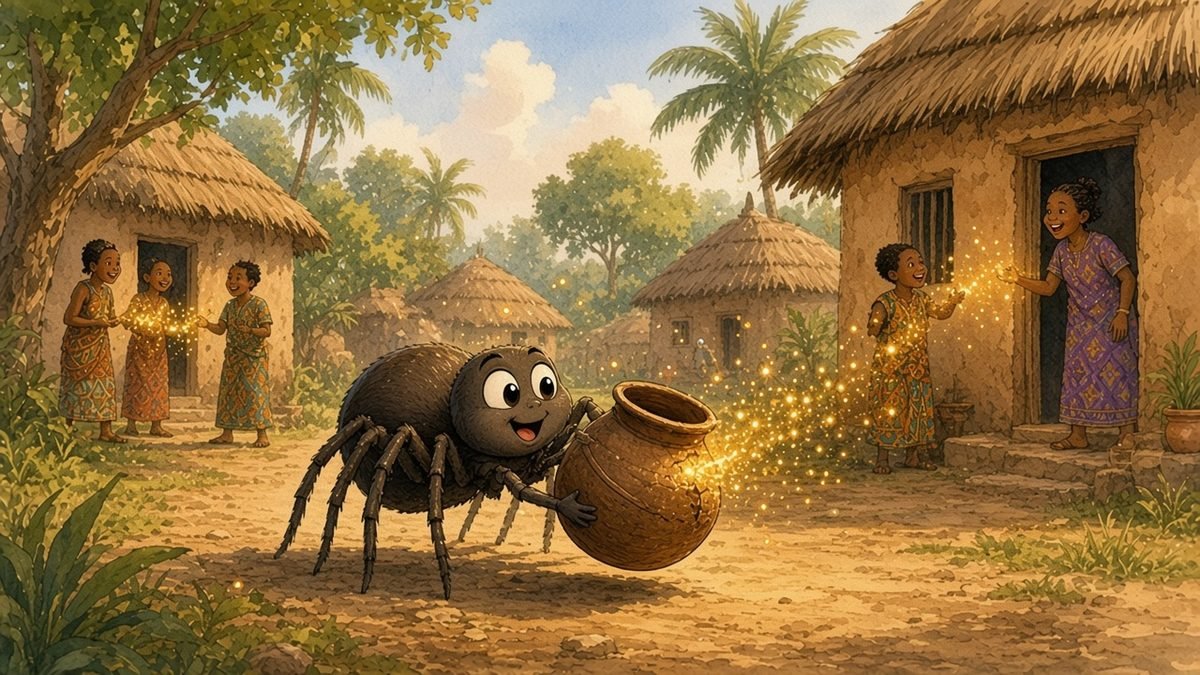
Anansi rolled his pot from house to house.
“Good morning, friend,” he said to the weaver bird. “Would you share a little of your wisdom? Just put it in my pot. I’ll keep it safe for everyone.”
The weaver bird was a generous creature. She shared how to weave a nest so tight that no rain could get through. Anansi scooped her wisdom into the pot, where it glowed like a tiny golden spark.
He went to the farmers, who shared how to read the clouds and when to plant the yams. He went to the old grandmother, who shared how to make medicine from leaves. He went to the tortoise, who shared how to be patient. He went to the drummers, the potters, the hunters and the cooks.
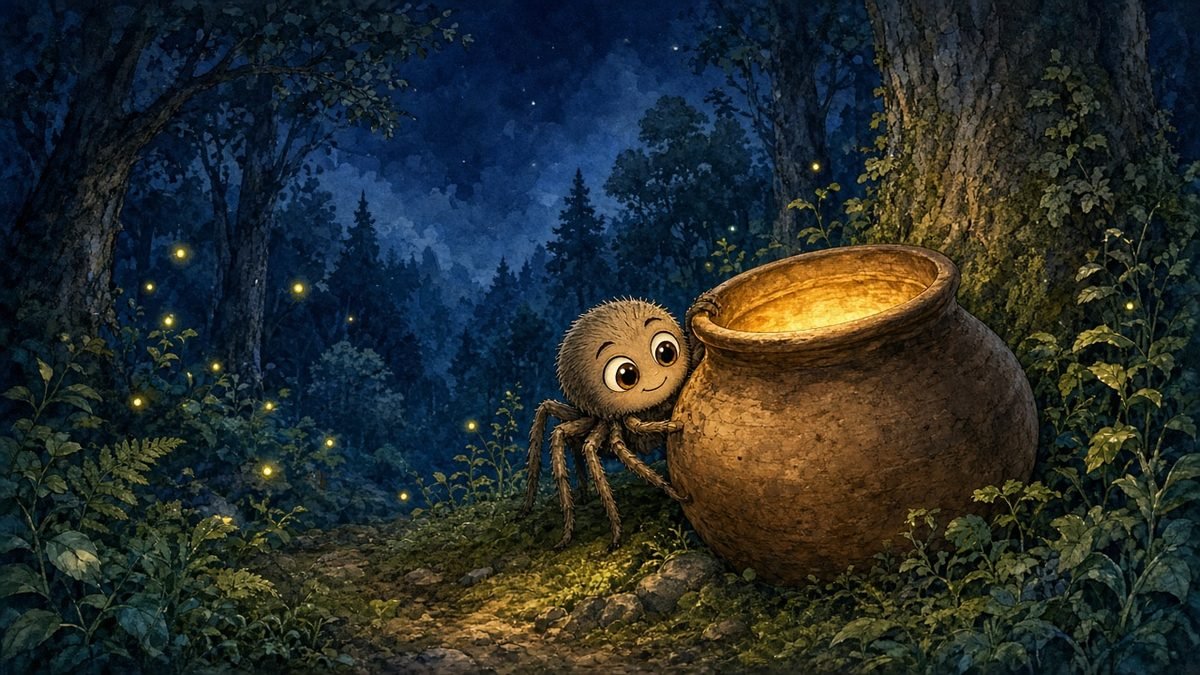
Every bit of wisdom went into the pot, and every bit glowed. Soon the pot was so full of golden light that it shone even at night.
Anansi peered inside, and his eyes grew wide. “It’s mine,” he whispered. “All the wisdom in the world, and it’s all mine.”
Part 3: Where to hide it?
Now Anansi had a new worry.
“What if someone steals it?” he thought. “What if someone takes a peek and learns something? I need to hide it somewhere nobody can ever reach.”
That night, he crept to the edge of the forest with his glowing pot. He looked at the ground. “Too easy to dig up,” he said. He looked at the river. “Too easy to wash away,” he said.
Then he looked up at the tallest tree in the whole forest. Its top branches seemed to touch the clouds.
“There,” said Anansi. “Nobody will ever find it up there.”
Part 4: The climb
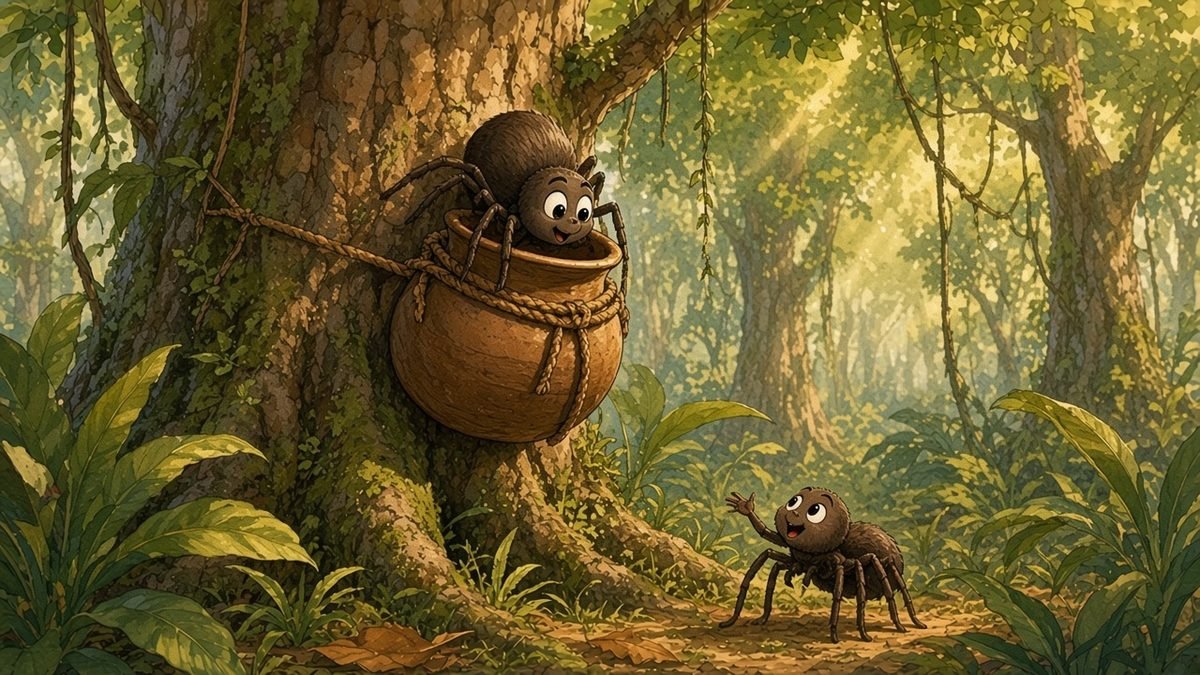
The next morning, Anansi tied a long piece of vine around the pot and hung it in front of his tummy. Then he began to climb.
It was very hard work. The heavy pot swung between him and the tree trunk. Every time he reached up, it bumped against the bark. Every time he pulled himself higher, it got in the way of his legs. He slipped. He slid back down. He tried again.
Huff. Puff. Bump. Slide.
Down below, Anansi’s young son, Ntikuma, had followed him into the forest. He watched his father struggle for a long time. At last, he called up.
“Father! Why don’t you tie the pot on your back? Then it won’t get in your way, and you can hold on to the tree with all your legs.”
Anansi stopped climbing. He hung there on the trunk, very still.
His son was right. It was a simple idea, a very good idea. And it hadn’t come from the pot.
Part 5: The pot falls
“I have all the wisdom in the world in this pot,” Anansi said slowly, “and still my little son knew something I didn’t.”
He was so surprised and so cross with himself that he threw up his front legs. And in that moment, the pot slipped from its vine.
Down it fell, down, down, down, until it hit a rock at the bottom of the tree.
CRASH!
The pot broke into pieces. All the golden sparks of wisdom burst out at once. A wind swept through the forest and caught them, carrying them over the treetops, across the village, into the river and far out to the sea.
The children in the village looked up and laughed as the sparkles floated down around them. They reached out their hands, and each one caught a little bit.
And that, the old storytellers say, is why there is a little wisdom in everyone, all around the world, and why no one person can ever have it all.

Anansi climbed down the tree. Ntikuma looked up at him, worried. “I’m sorry, Father. I didn’t mean to make you drop it.”
Anansi looked at his son for a long moment. Then he laughed, and he put one of his long legs around him.
“Don’t be sorry,” he said. “You taught me something today. Wisdom is meant to be shared. You can’t keep it in a pot.”
The End
Moral of the story: No one has all the wisdom, so share what you know
Anansi thought he could gather all the world’s wisdom and keep it for himself. But even his small son knew something he didn’t. Everyone has something to teach, young or old, big or small. Wisdom grows when we share it, and it’s wasted when we hide it away.
What kids can learn from Anansi and the Pot of Wisdom
- Everyone knows something. The weaver bird, the farmers and the tortoise all had wisdom to share.
- Kids can be wise too. Ntikuma’s idea solved the problem his father couldn’t.
- Greed doesn’t pay. Anansi wanted everything for himself and ended up with nothing in the pot.
- Listen to others. Good ideas can come from anyone.
- Share what you learn. Wisdom is meant to be passed around.
Questions to talk about with your child
- Why did Anansi want to collect all the wisdom in the world?
- Why did he want to hide the pot at the top of the tree?
- What did Ntikuma tell his father? Why did it surprise Anansi so much?
- What happened to the wisdom when the pot broke?
- What’s something you know that you could teach someone else?
Summary: Anansi and the Pot of Wisdom
Anansi the spider wants to be the wisest creature of all, so he collects everyone’s wisdom in a clay pot. To keep it safe, he decides to hide it at the top of the tallest tree. He ties the pot to his front, and it keeps getting in his way. His son Ntikuma suggests tying it on his back instead. Anansi realizes he doesn’t have all the wisdom after all, and the pot falls and breaks. The wind scatters the wisdom across the world, so everyone gets a little.
Clever animals show up in folk tales all over the world. Compare Anansi with the patient hero of The Tortoise and the Hare or the smart bird in The Thirsty Crow.
Read More: The Fox and the Crow
Frequently asked questions
Where do Anansi stories come from?
Anansi stories come from the Akan peoples of West Africa, especially the Ashanti (Asante) of present-day Ghana. They spread to the Caribbean and the Americas, where Anansi is also known by names like Aunt Nancy and Kweku Anansi.
What is the moral of Anansi and the Pot of Wisdom?
No one person can have all the wisdom in the world, so we should listen to others and share what we know.
Who is Ntikuma?
Ntikuma is Anansi’s son in many Akan folk tales. In this story, his simple suggestion shows Anansi that wisdom can come from anyone.
Where did Anansi get the pot of wisdom?
That depends on who’s telling it. In some versions, Anansi collects wisdom from everyone, as in this retelling. In others, the sky god Nyame gives him the pot. Either way, Anansi tries to keep it all for himself.
What age is this story for?
It’s a great fit for ages 5 to 12. It also works well for classroom units on world folk tales or African storytelling traditions.