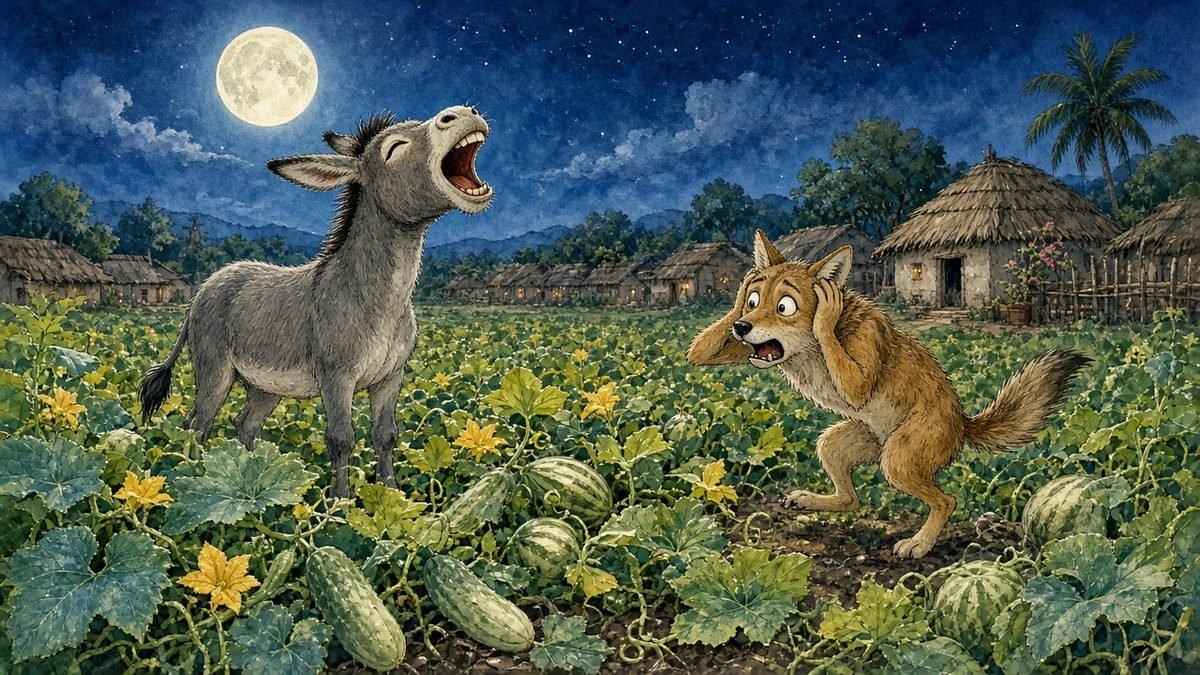
The Musical Donkey story is a funny tale from the Panchatantra, the ancient Indian book of animal fables. It’s about a donkey who loves to sing and a jackal who tries very hard to tell him that a moonlit cucumber field is not the place for a concert. Kids usually laugh at the donkey, and then they start to see a bit of themselves in him.
This retelling is for children ages 5 to 12 and takes about 8 minutes to read aloud. Feel free to do your loudest “Hee-haw!” when the moment comes.
Part 1: A hardworking donkey and a clever friend
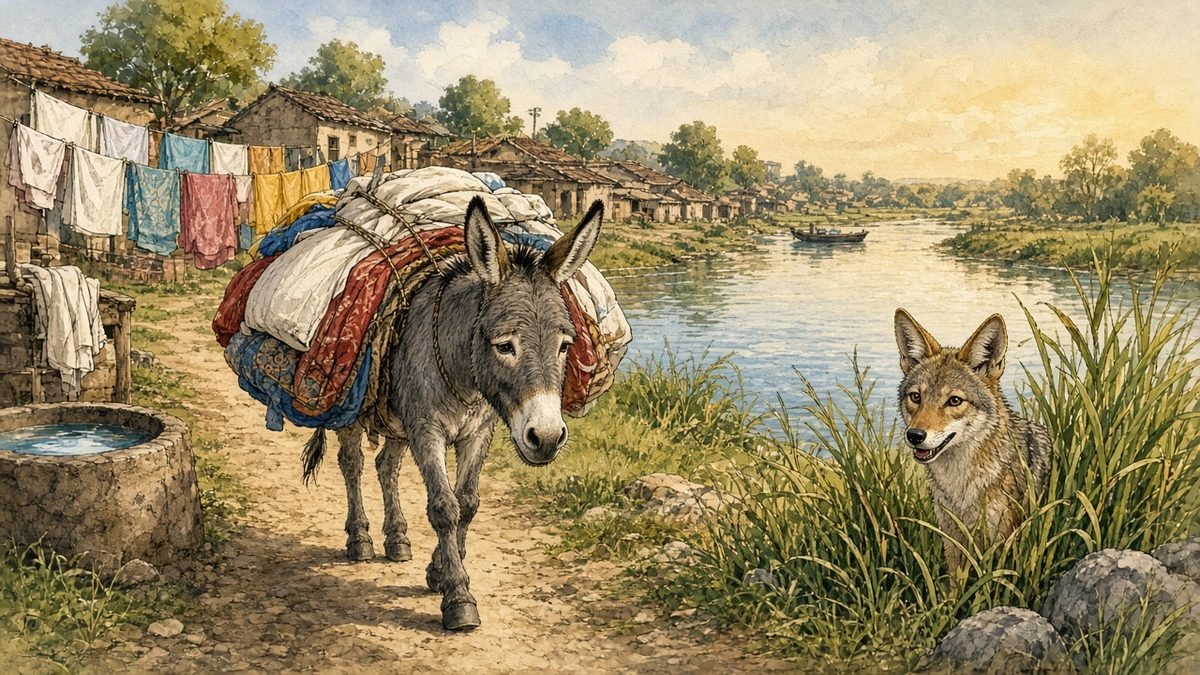
Once upon a time, in a small village by a river, there lived a washerman. Every day he washed the villagers’ clothes in the river and spread them out to dry in the sun. He owned a gray donkey named Udhata, who carried the heavy bundles of laundry from the village to the river and back again.
Udhata worked hard all day. In the evenings, the washerman let him wander free to find his own food. But the grass near the village was dry and thin, and Udhata was often hungry.
One evening, as he nibbled at some prickly weeds by the riverbank, a jackal stepped out of the tall grass.
“You look hungry, friend,” said the jackal.
“I’m always hungry,” sighed Udhata. “There’s nothing good to eat around here.”
The jackal grinned. “Then you’re lucky you met me. I know a field on the other side of the village full of the juiciest cucumbers you’ve ever tasted. I can’t reach them on my own, but you’re big and strong. If we go together, we can both have a feast.”
Udhata’s ears perked up. “Let’s go!”
Part 2: A secret feast in the moonlight
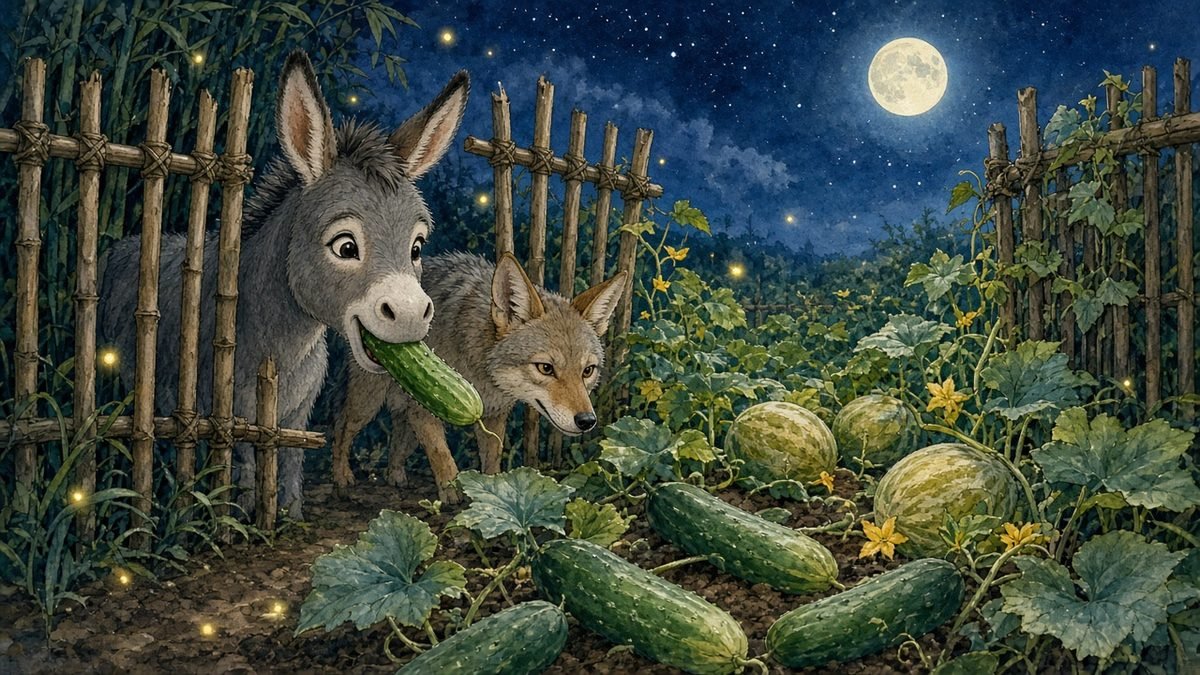
That night, when the village was asleep, the donkey and the jackal crept to the cucumber field. A bamboo fence ran all the way around it, but the jackal knew a spot where one of the poles had broken.
They squeezed through the gap, and there, glowing in the moonlight, were rows and rows of fat green cucumbers.
Crunch. Crunch. Crunch.
They were delicious, cool and sweet and full of juice. Udhata ate until his belly was round. The jackal ate until he could hardly move.
The next night, they came back. And the night after that. Every evening, they slipped through the gap in the fence, ate quietly in the dark, and slipped out again before anyone woke up.
The farmers were puzzled. “Something is eating our cucumbers,” they said. “But we never hear a thing.”
Part 3: The donkey wants to sing
One night the moon was especially big and bright. It hung over the field like a silver plate. A cool breeze blew through the leaves, and the crickets chirped.
Udhata finished his last cucumber and sighed with happiness.
“Nephew Jackal,” he said, “what a beautiful night. My belly is full, the moon is shining, and my heart is so happy that I feel like singing.”
The jackal nearly choked on his cucumber. “Singing? Uncle, please don’t! We’re stealing from this field. If the farmers hear you, they’ll come running.”
“Nonsense,” said Udhata. “Everyone loves music. And I have a lovely voice.”
The jackal chose his words carefully. “Uncle, your voice is very… strong. But it’s not exactly sweet. And even the sweetest song is a bad idea when you’re in someone else’s field in the middle of the night.”
Udhata stamped his hoof. “You’re just jealous because jackals can only howl. I’m a singer, and a singer must sing when the moon is full!”
The jackal could see there was no stopping him. “All right,” he said quickly. “But wait until I get to the gate. I’ll stand guard and warn you if anyone comes.”
And the jackal hurried off and hid in the bushes outside the fence.
Part 4: The concert
Udhata lifted his head toward the moon. He took a deep breath, filling his chest until it was round as a drum.
“HEE-HAW! HEE-HAW! HEE-HAAAAAW!”
It was the loudest sound the village had ever heard. Birds flew out of the trees. Dogs started barking. Babies woke up crying.
In every house, the farmers sat straight up in bed.
“That’s a donkey!” they shouted. “In our cucumber field!”
They grabbed their lanterns and sticks and ran out into the night.
Udhata was so busy singing, with his eyes closed and his head held high, that he didn’t hear them coming. He was in the middle of his very best “HEE-HAAAAW” when the lanterns surrounded him.
There stood the farmers, with angry faces, looking at the trampled leaves and the half-eaten cucumbers all around him.
“So you’re the thief!” said one farmer.
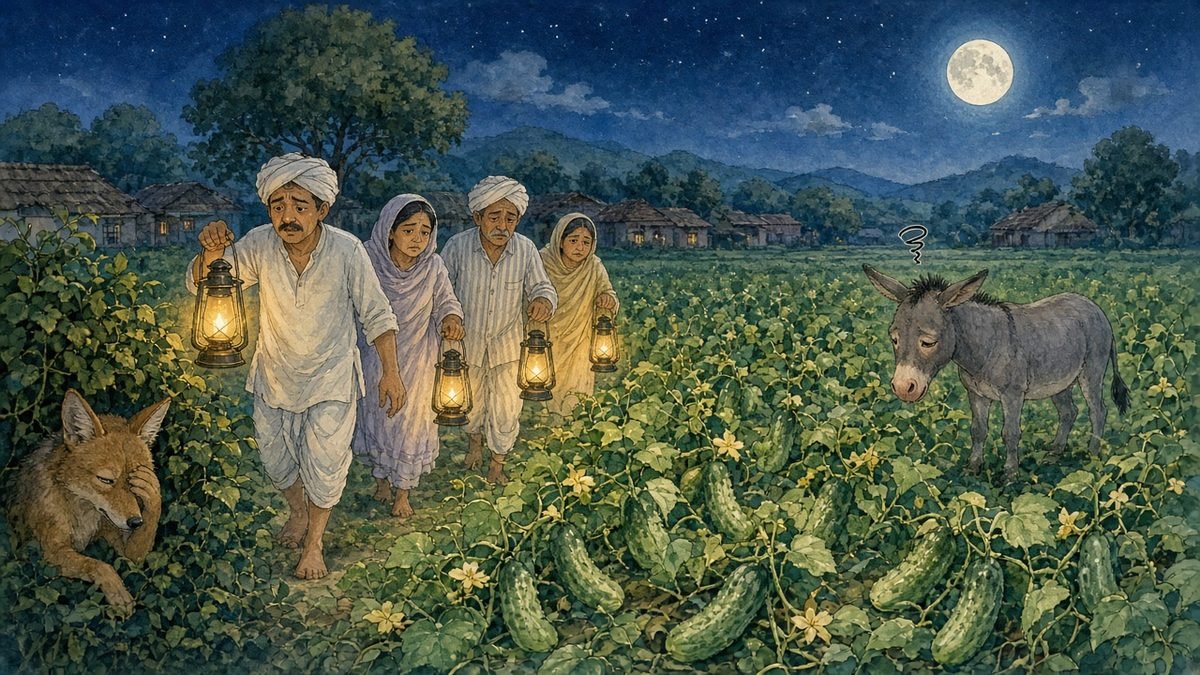
The farmers chased Udhata all around the field and gave him a good scolding. One of them tied a heavy wooden block around his neck so he couldn’t sneak through fences anymore. Then they shooed him out through the gate and sent him trotting home, tired, sore and very embarrassed.
Part 5: A lesson under the moon
Outside the field, the jackal stepped out of the bushes. He looked at the wooden block hanging from his friend’s neck and shook his head.
“Well, Uncle,” he said gently, “that was quite a song.”
Udhata hung his head. “You tried to warn me,” he said. “I should have listened.”
“There’s nothing wrong with singing,” said the jackal. “But there’s a time and a place for everything. A secret feast in the farmer’s field was not the time, and it was certainly not the place.”
Udhata nodded slowly. He never went back to the cucumber field. And from then on, whenever he felt like singing, he waited until he was home in the washerman’s yard in the middle of the afternoon, when no one minded at all.
The End
Moral of the story: There’s a right time and place for everything
Singing isn’t wrong, and neither is feeling happy. But Udhata picked the worst possible moment to show off, and he wouldn’t listen when his friend gave him good advice. Thinking about where we are and what’s happening around us helps us make better choices.
What kids can learn from The Musical Donkey
- Think before you act. Udhata did what he felt like without thinking about what might happen.
- Listen to good advice. The jackal warned him, and he didn’t listen.
- Pride can get us in trouble. Udhata was so sure of his “lovely voice” that he ignored the danger.
- Taking things that aren’t yours has consequences. The cucumbers belonged to the farmers.
- Timing matters. The same action can be fine in one place and a big mistake in another.
Questions to talk about with your child
- Why did the jackal tell Udhata not to sing?
- Why didn’t Udhata listen?
- Do you think the donkey and the jackal were right to eat the farmers’ cucumbers?
- Can you think of a place where it’s OK to be loud? Where is it better to be quiet?
- Has a friend ever given you good advice? Did you take it?
Summary: The Musical Donkey
Udhata, a washerman’s donkey, becomes friends with a jackal who shows him a field of juicy cucumbers. They secretly feast there every night. One moonlit night, the happy donkey decides to sing. The jackal warns him not to and hides outside the fence. Udhata brays loudly, the farmers wake up and catch him, and he’s chased home with a heavy wooden block tied around his neck. He learns that there’s a right time and place for everything.
Udhata isn’t the only show-off donkey in the old fables. Read The Ass in the Lion’s Skin, or try another Panchatantra tale, The Brahmin and the Goat.
Read More: The Blue Jackal
Frequently asked questions
What is the moral of the Musical Donkey story?
There’s a right time and place for everything. It also teaches kids to listen to good advice and think before they act.
Where does The Musical Donkey story come from?
It’s from the Panchatantra, a collection of Indian fables traditionally credited to Vishnu Sharma. The Panchatantra uses animal stories to teach practical wisdom about friendship, good judgment and getting along with others.
What is the donkey’s name in the story?
In many versions, the donkey is called Udhata or Uddhata, and the jackal is his friend. Some retellings don’t give them names at all.
What happens to the donkey at the end?
In many traditional versions, the farmers beat the donkey and tie a heavy wooden mortar or block around his neck. This retelling keeps the block but softens the rest for young listeners.
What age is The Musical Donkey for?
It’s a good fit for ages 5 to 12. Younger kids love the funny “Hee-haw” scene, and older kids can talk about why timing and good judgment matter.