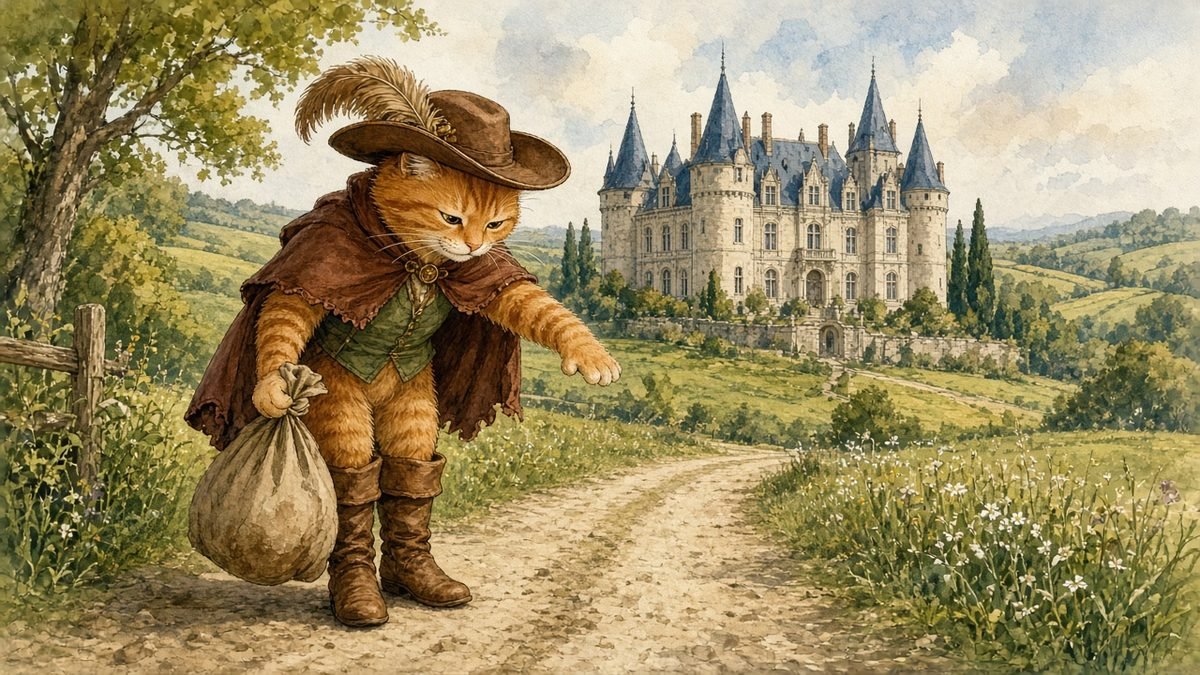
Puss in Boots is one of the best-known fairy tales in the world. It was written down by the French author Charles Perrault in 1697, in the same famous collection that gave us Cinderella and Sleeping Beauty. Its hero is a talking cat with a feathered hat, a pair of fine boots and more clever ideas than anyone in the kingdom. This Puss in Boots story for kids retells it simply.
It’s for ages 5 to 12 and takes about 10 minutes to read aloud. A few scary bits from the old version are softened for young listeners.
Part 1: The youngest son gets a cat
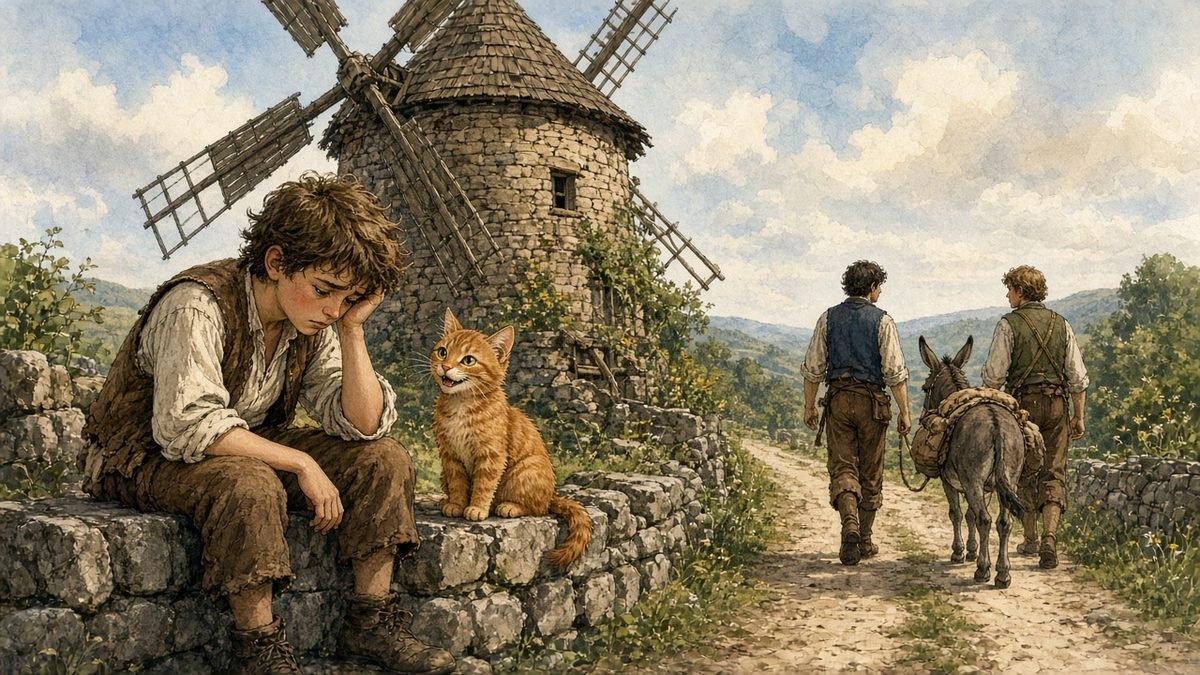
Once upon a time, an old miller died and left everything he owned to his three sons. He didn’t have much. The oldest son got the mill. The middle son got the donkey. And the youngest son, whose name was Jean, got only the cat.
His brothers rode off on the donkey to start their new lives. Jean sat on the stone wall by the windmill and put his head in his hands.
“My brothers can work together and earn a living,” he sighed. “But what can I do with a cat? Once I’ve eaten what’s left in the pantry, I’ll have nothing at all.”
The orange cat, who had been listening from the wall, cleared his throat.
“Don’t worry, master,” he said. “Give me a sack and a pair of boots so I can walk through the brambles, and you’ll see that you got a better share than you think.”
Jean was so surprised to hear a cat talk that he nearly fell off the wall. He didn’t really believe the cat could help him. But he had seen this cat do some very clever things to catch mice, like hanging upside down from the rafters and pretending to be asleep in the flour. So he spent his last coins on a pair of fine leather boots and an old sack.
The cat pulled on the boots and admired them. Then he found a cape and a feathered hat in the attic.
“Now,” he said, “I’m ready.”
Part 2: Gifts for the king
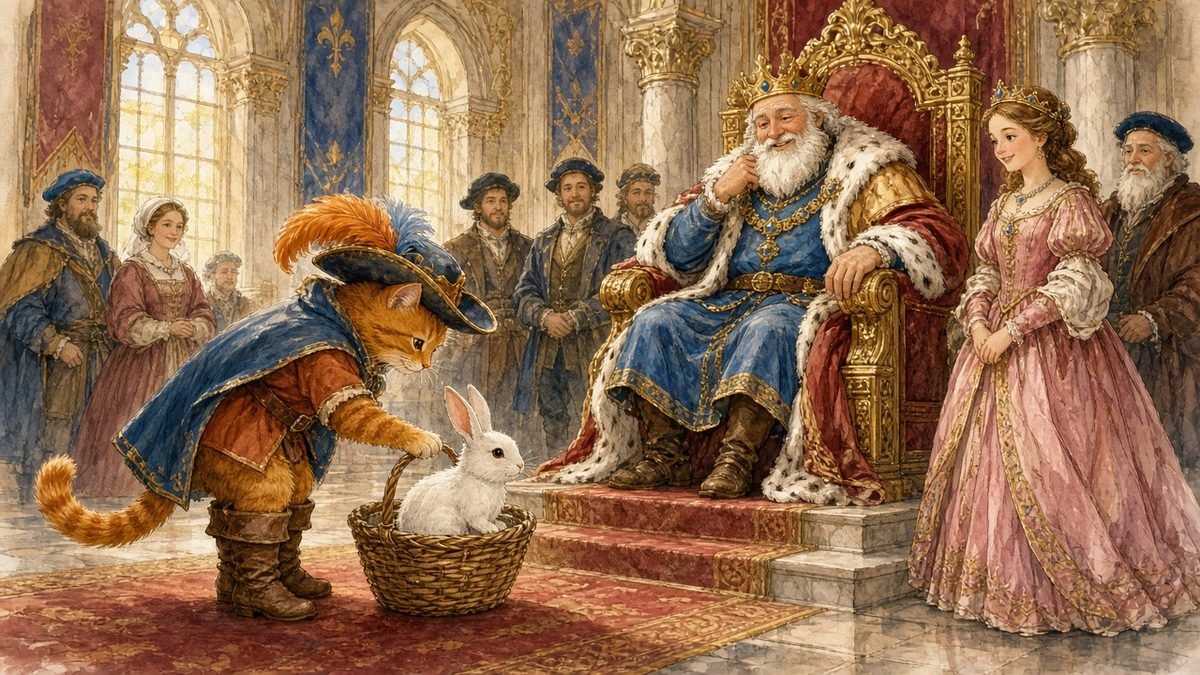
Puss in Boots went out to the woods. He put some lettuce and bran in his sack, left it open, and lay down very still beside it. Before long, a young rabbit hopped up and climbed in to nibble the lettuce. Puss pulled the string and closed the sack.
Proudly, he carried the rabbit to the king’s palace and asked to see the king.
When he came into the throne room, he swept off his feathered hat and gave a deep bow.
“Your Majesty,” he said, “here is a fine rabbit from the lands of my master, the Marquis of Carabas. He asked me to give it to you as a gift.”
There was no Marquis of Carabas, of course. Puss had just made up the fancy name for Jean.
“Tell your master that I thank him,” said the king, who was very fond of rabbit stew. “It’s very kind of him.”
A few days later, Puss caught two plump partridges and brought those to the king too. And he kept it up. For two or three months, Puss brought the king a present from “the Marquis of Carabas” every week. The king started to look forward to his visits. So did the king’s daughter, the princess, who thought the cat was very charming.
Part 3: A swim in the river
One day, Puss heard that the king and the princess would be taking a carriage ride along the river.
He ran home to Jean. “Master, do exactly what I say, and your fortune is made. Go and swim in the river at the place I show you, and leave the rest to me.”
Jean didn’t know what the cat was planning, but he did as he was told. While he was swimming, the king’s carriage came rolling along the road.
Puss jumped out onto the road and shouted, “Help! Help! The Marquis of Carabas is drowning!”
The king recognized the cat at once and ordered his guards to rescue the Marquis. While they pulled Jean out of the water, Puss explained that robbers had stolen his master’s clothes. (He had really hidden them under a rock.)
The king sent a servant to fetch one of his own finest suits. When Jean put it on, he looked so handsome that the princess smiled at him, and Jean smiled back. The king invited him to ride in the carriage with them.
Part 4: Whose land is this?
Puss ran ahead of the carriage, as fast as his boots would carry him. He came to a meadow where some farmers were cutting hay.
“Good people,” he said, “the king is coming this way. When he asks who owns this meadow, please tell him it belongs to the Marquis of Carabas. It will make him very happy.”
The farmers shrugged. It seemed harmless enough. So when the king passed by and asked, “Whose fine meadow is this?” they all answered, “It belongs to the Marquis of Carabas!”
Puss ran on to a field of golden wheat and said the same thing to the harvesters. And when the king asked, they answered, “It belongs to the Marquis of Carabas!”
The king was very impressed. “Your master owns a great deal of land,” he said to Jean, who blushed and didn’t know what to say.
But all of this land really belonged to someone else: a fearsome ogre who lived in a grand castle at the end of the road. And that was where Puss was going next.
Part 5: The ogre and the mouse
Puss knocked on the castle door. The ogre answered. He was huge and grumpy, with a voice like thunder.
Puss bowed politely. “I’ve heard that you have amazing powers,” he said. “People say you can turn yourself into any animal at all, even a lion or an elephant. I simply had to see it with my own eyes.”
The ogre liked being praised. “It’s true,” he boomed. “Watch this!”
In a flash, he turned into an enormous lion with a shaggy mane. He roared so loudly that Puss jumped onto a high shelf and hid there, his boots clattering.
When the ogre turned back into himself, Puss climbed down, still trembling.
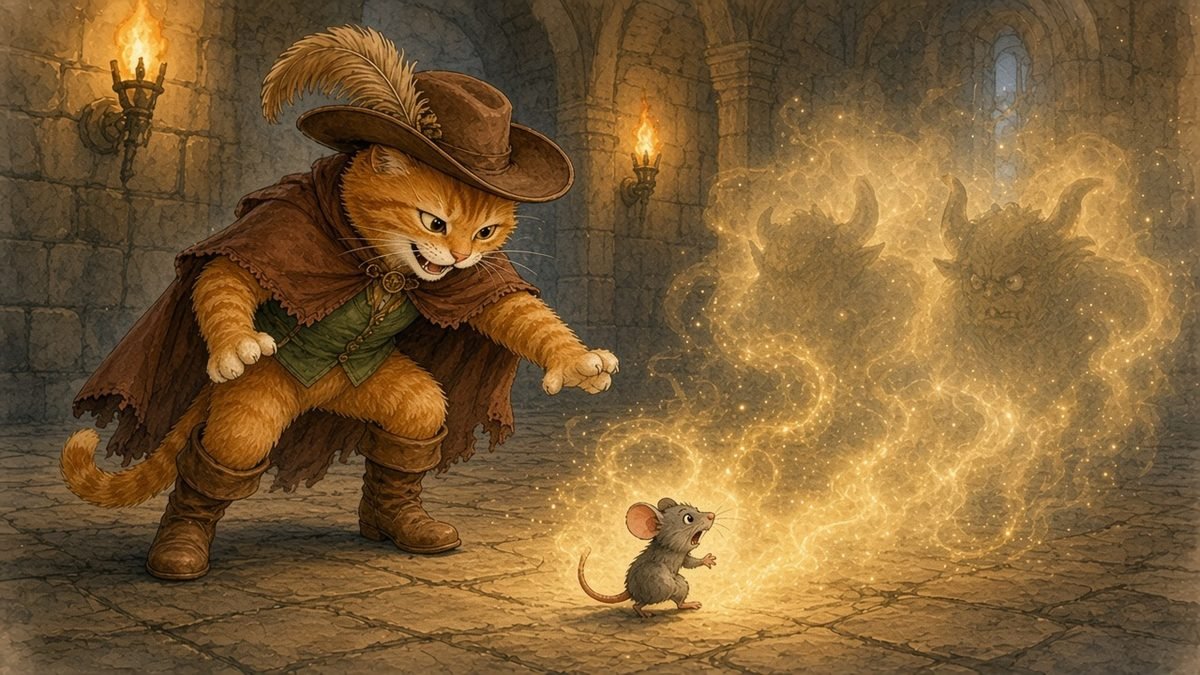
“Incredible!” he said. “But a lion is big, and you’re big already. I’m sure it’s much harder to turn into something tiny. I bet even you couldn’t turn into a little mouse.”
“Couldn’t I?” said the ogre. And with a puff of golden sparkles, he turned into a tiny gray mouse and ran across the floor.
Quick as a flash, Puss pounced. He scooped the mouse into his sack, ran to the castle window and shook him out far into the woods. The little ogre-mouse scampered away and was never seen in that kingdom again.
Part 6: Happily ever after
Just then, Puss heard the king’s carriage on the drawbridge. He ran out to greet it.
“Your Majesty,” he said with a sweeping bow, “welcome to the castle of the Marquis of Carabas!”
The king was amazed. Jean was even more amazed. They all went inside, where the ogre’s grand feast was laid out on the table, and they ate and laughed together.
Not long after, Jean and the princess were married. Jean became a fair and generous lord who looked after the farmers on his land. And Puss in Boots became a great gentleman. He only chased mice now and then, for fun.
The End
Moral of the story: Cleverness and hard work can change your luck
Perrault wrote that hard work, cleverness and good manners can be worth more to a young person than a big inheritance. Jean started with only a cat, and his cat’s quick thinking changed everything. But the story also gives families something good to talk about, because Puss tells a lot of fibs to get what he wants.
What kids can learn from Puss in Boots
- Don’t judge by first looks. Jean thought a cat was worthless. He was very wrong.
- Use your brain. Puss tricked a powerful ogre without fighting him.
- Bragging can backfire. The ogre showed off and lost his castle.
- Kindness makes a good leader. Jean looked after the people who worked his land.
- Clever isn’t always honest. Puss told many fibs. Is that OK? It’s worth talking about.
Questions to talk about with your child
- Why was Jean sad at the beginning of the story?
- Why did Puss bring presents to the king?
- How did Puss trick the ogre?
- Puss told a lot of fibs. Do you think that was fair? Why or why not?
Summary: Puss in Boots
A poor miller’s youngest son inherits only a cat. The cat asks for boots and a sack, then brings gifts to the king from “the Marquis of Carabas,” a made-up name for his master. He tricks the king into rescuing his master from the river and tells the farmers to say all the land belongs to the Marquis. Finally, he tricks an ogre into turning into a mouse and takes the ogre’s castle. The miller’s son marries the princess, and Puss lives happily as a great gentleman.
Love tales where a poor hero gets lucky? Read The Golden Goose and Jack and the Beanstalk.
Read More: Rumpelstiltskin
Frequently asked questions
Who wrote Puss in Boots?
The best-known version was written by Charles Perrault and published in France in 1697. Its French title is “Le Maître chat ou le Chat botté,” which means “The Master Cat, or the Booted Cat.” An earlier Italian version by Giovanni Francesco Straparola appeared in the 1550s.
What is the moral of Puss in Boots?
Perrault’s moral says that cleverness and hard work can help a young person more than money from their family. Many parents also use the story to talk about honesty, since the cat wins by tricking people.
What is the name of Puss in Boots’ master?
The cat calls him the Marquis of Carabas, which is a made-up title. In Perrault’s story he doesn’t have a real name, so this retelling calls him Jean.
How does the ogre end in the original story?
In Perrault’s version, Puss pounces on the ogre-mouse and eats him. This retelling has Puss send him off into the woods instead, which keeps the clever trick but suits younger listeners better.
Is Puss in Boots from Shrek the same cat?
The Puss in Boots in the Shrek movies is inspired by the fairy tale character. The movies give him a new personality and adventures, but the boots, hat and clever tricks all come from this old story.