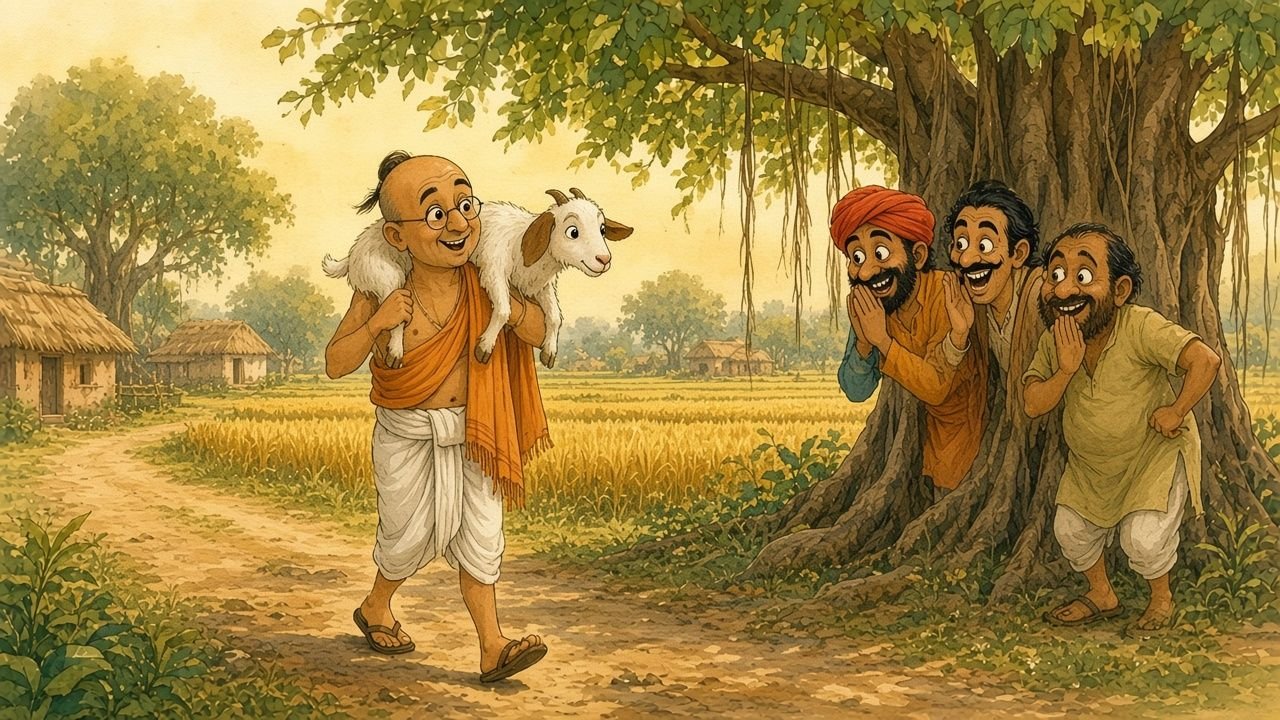
The Brahmin and the Goat is a short, funny story from the Panchatantra, the ancient Indian collection of animal fables and wise tales. In it, a kind old priest is given a fat goat as a gift, and three sly tricksters decide they want it for themselves. They don’t steal it. Instead, they try something sneakier: they try to talk him out of it.
This story is about believing your own eyes, even when other people keep telling you something different. In the old version the tricksters get the goat and the story stops there. Ours keeps all the tricks but adds a happier ending for the priest and his goat, which makes it a better fit for bedtime with kids aged 5 to 12. The moral, discussion questions, a summary and an FAQ follow the story.
Part 1: A Gift for Mitra Sharma
Once upon a time, in a small village in India, there lived a priest named Mitra Sharma. He was a gentle old man with a bald head, a little tuft of hair tied at the back, and round glasses that were always sliding down his nose. He wore a white dhoti and an orange shawl.
Mitra Sharma was kind, honest and very good at saying prayers. People from villages near and far asked him to bless their homes, their weddings and their harvests. But he was not very rich. Most days he ate a simple meal of rice and lentils, and he was happy with that.
One morning, a wealthy farmer from a village a few miles away invited Mitra Sharma to bless his new house. The priest walked all the way there, lit a little brass lamp, and said the prayers carefully, just as he had learned them long ago.
When he finished, the farmer was so pleased that he wanted to give him a special thank-you present.
“Panditji,” he said, using a polite word for a learned man, “please take this goat as my gift. She is healthy and strong, and she will give you good milk for many years.”
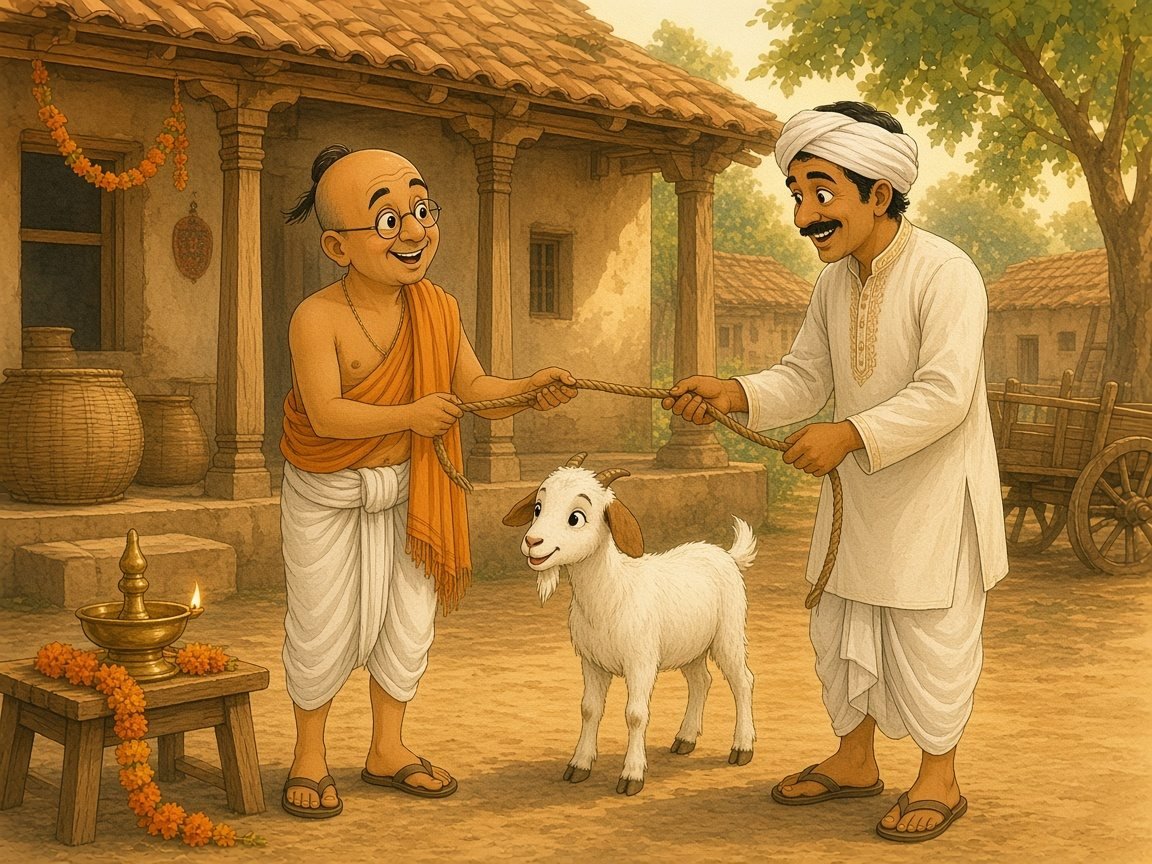
Mitra Sharma looked at the goat. She was plump and white, with soft brown ears and bright, curious eyes. She looked back at him and gave a little bleat.
“Thank you,” said the priest, beaming. “That is a wonderful gift.”
Part 2: Three Tricksters Under a Banyan Tree
The road home was long and dusty, and the goat kept stopping to munch leaves by the roadside. So Mitra Sharma lifted her up and carried her across his shoulders. She was heavy, but he didn’t mind.
Now, along that same road, three tricksters were resting in the shade of a big banyan tree. One wore a red turban and had a thick black beard. One was skinny, with a long, curly mustache. The third was short and plump, with a cheeky grin.
When they saw the priest coming with a fat goat on his shoulders, their eyes lit up.
“Look at that goat,” whispered the one in the red turban. “What a fine dinner she would make.”
“No, no,” said the skinny one, twirling his mustache. “People would see us, and we’d be in trouble. I have a better plan. We’ll make the old man give her away himself.”
“How?” asked the other two.
Then they split up and hurried ahead by different shortcuts, so that each of them would be waiting at a different spot along the road.
Part 3: “Why Are You Carrying a Dog?”
Mitra Sharma walked on until he reached an old stone well at the edge of a rice field. There stood the trickster in the red turban, looking very surprised.
“Panditji!” he cried, pointing. “Why on earth are you carrying a dog on your shoulders?”
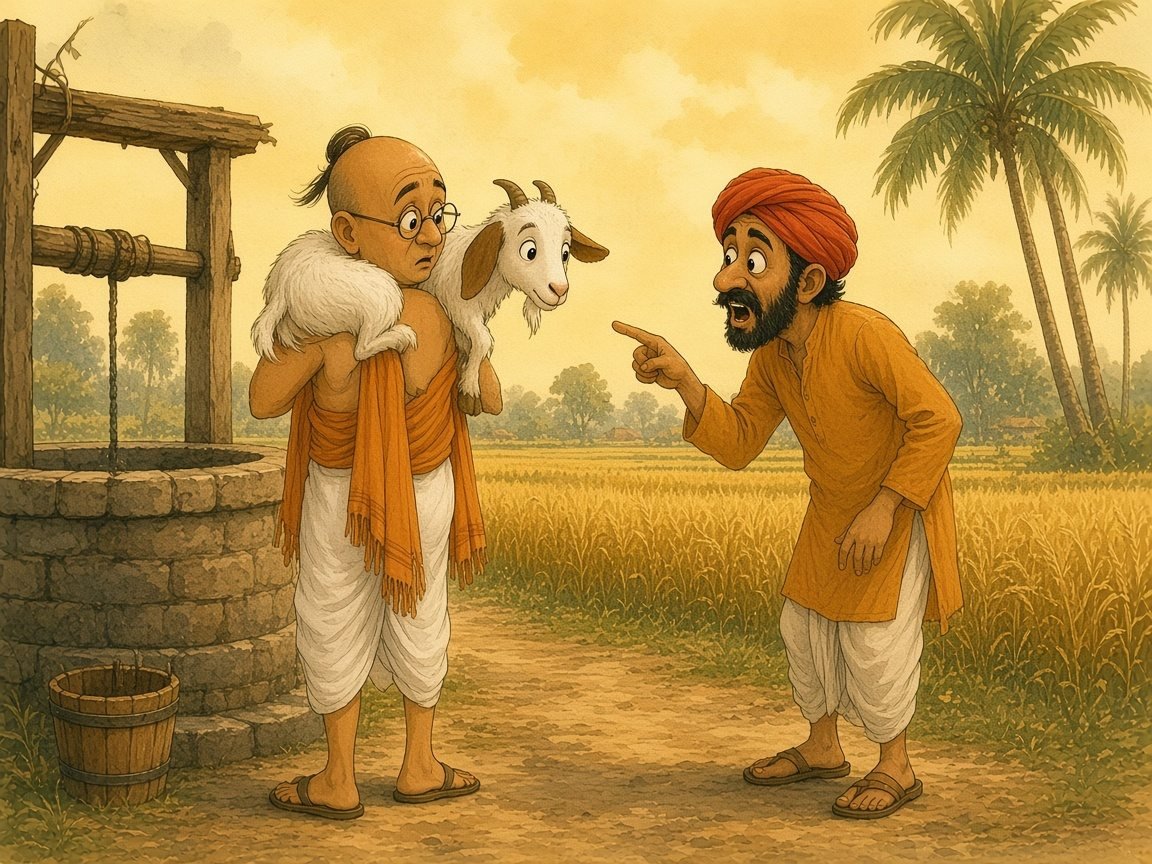
The priest blinked. “A dog? This isn’t a dog. It’s a goat. A farmer just gave her to me.”
“A goat?” said the trickster, shaking his head sadly. “Panditji, I think you need new glasses. That is a dog, plain as day. A holy man like you shouldn’t be seen carrying a dog around like a sack of rice. What will people say?”
Mitra Sharma turned his head and peered at the animal on his shoulders. White fur. Brown ears. Little hooves. A soft “meh-eh-eh.”
“It’s a goat,” he said firmly.
But as Mitra Sharma walked on, a small worry began to buzz in his head, like a mosquito you can’t quite swat. Why would a stranger say such a thing?
Part 4: “Why Are You Carrying a Calf?”
A mile or so down the road, the priest passed a grove of coconut palms. Sitting under one of them was the skinny trickster with the long mustache.
He jumped up when he saw the priest and gasped loudly.
“Panditji! What are you doing with a dead calf on your back?”
Mitra Sharma stopped in his tracks. “A dead calf?”
“Yes! Look at it, hanging there all floppy. Everyone knows a priest shouldn’t touch such things. You’ll have to take a long bath and say a hundred extra prayers to make yourself clean again.”
The goat, who was very much alive, chose that exact moment to nibble Mitra Sharma’s ear.
“It’s not dead,” said the priest, a little less sure of himself than before. “And it’s not a calf. It’s a goat. I think.”
He set the goat down for a moment and looked at her carefully. She stared up at him and wagged her short tail.
But the buzzing worry was louder now. First a dog, and now a calf. Two different people had seen something strange. Could his eyes be playing tricks on him? He was getting old, after all.
Part 5: “Why Are You Carrying a Donkey?”
The sun was getting low by the time Mitra Sharma reached the crossroads near his own village. There, leaning against a fence post, was the plump trickster.
He took one look at the priest and burst out laughing.
“Panditji! Oh, this is too funny! Why are you carrying a donkey? Has the donkey gotten too tired to walk, so now you have to carry him?”
That did it.
Mitra Sharma’s knees went wobbly. “A dog,” he muttered. “A calf. And now a donkey. Three people can’t all be wrong. Something very strange is going on. Maybe this isn’t a goat at all. Maybe it’s some kind of magic creature that changes its shape to fool me!”
He was so frightened that he set the goat down on the side of the road, untied the rope from his wrist, and hurried off toward his house as fast as his old legs could carry him, without looking back once.
The three tricksters came out from behind the fence, slapping each other on the back and laughing.
“Easy as pie,” said the skinny one. “He gave her away all by himself.”
They tied a rope around the goat’s neck and led her off to their hideout in an old cowshed at the edge of the woods, already arguing about who would get the biggest share of their dinner.
Part 6: The Goat Knows the Way Home
But there was one thing the tricksters had forgotten about. The goat.
She hadn’t liked them one bit. She didn’t like the way they pulled her rope, and she didn’t like the way they talked about dinner while looking at her. And while the three of them were busy squabbling over who should fetch the firewood, she quietly chewed through her rope.
Then she slipped out through a gap in the wall and trotted off into the night.
The next morning, when Mitra Sharma opened his front door, there she was, standing on his doorstep with a frayed bit of rope dangling from her neck and a mouthful of straw, looking very pleased with herself.
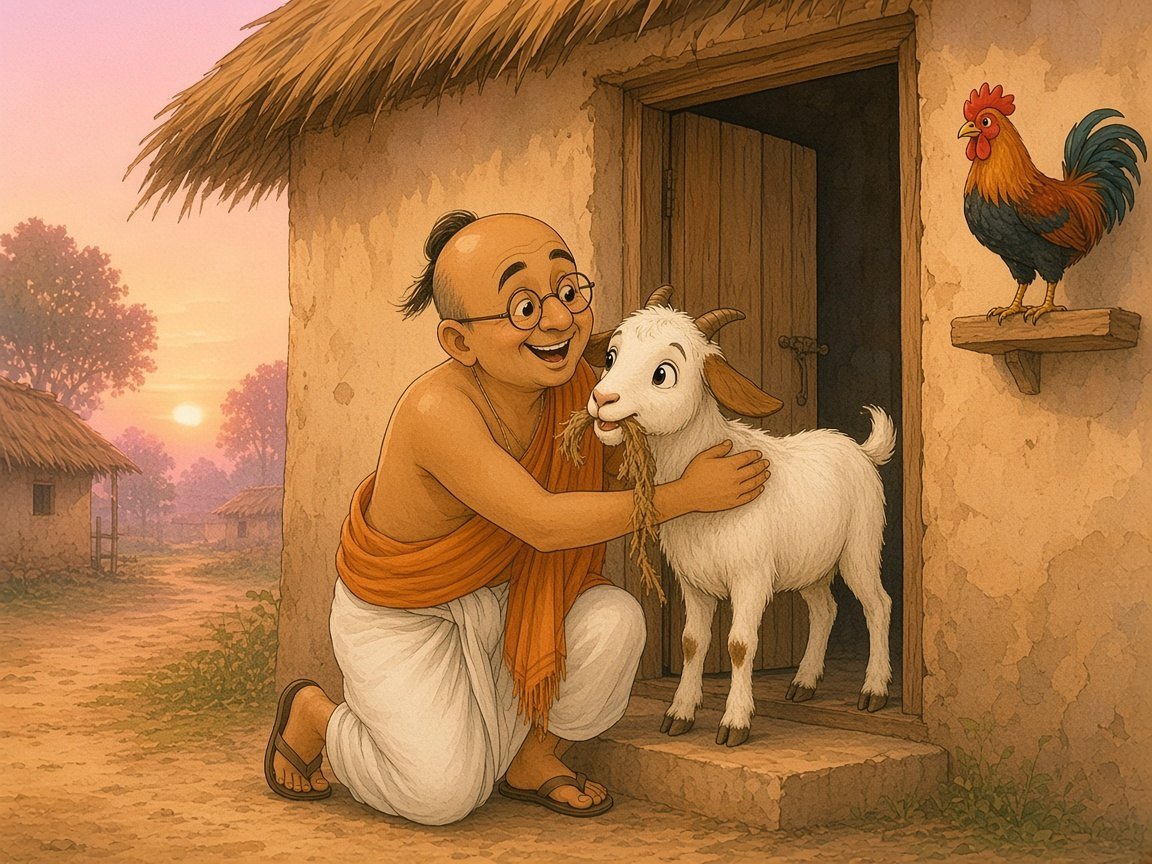
The old priest laughed out loud. He knelt down and hugged her.
“You’re not a dog,” he said. “You’re not a calf, and you’re certainly not a donkey. You’re a goat. My goat. And I should have believed my own eyes.”
Later that day, the farmer who had given him the goat came by to see how she was doing. Mitra Sharma told him the whole story. The farmer’s face grew red.
“Those three!” he said. “They’ve been fooling people all over this district. Next time someone tells you the sky is green, Panditji, take a good look at it yourself.”
And from that day on, Mitra Sharma did exactly that. As for the goat, she gave him fresh milk every morning, and the old priest made the best rice pudding in the village.
The End
Moral of the story: The Brahmin and the Goat
Trust your own eyes and good sense, even when other people keep telling you something different. If a lot of people say the same untrue thing, it doesn’t become true. Clever tricksters sometimes repeat a lie over and over, hoping you’ll start to believe it.
What kids can learn from this story
- Think for yourself. Mitra Sharma knew he was carrying a goat. He let other people’s words change his mind about something he could see with his own eyes.
- Repeating a lie doesn’t make it true. The tricksters’ whole plan was to say silly things again and again until he doubted himself.
- Slow down when something feels off. If the priest had stopped to ask why three strangers were all saying such strange things, he might have spotted the trick.
Questions to talk about with your child
- Why do you think Mitra Sharma started to believe the tricksters, even though he could see the goat?
- What could he have said or done when the first trickster called the goat a dog?
- Has anyone ever tried to convince you of something you knew wasn’t true? What did you do?
- Why do you think the goat ran home? What does that tell you about her?
Summary: The Brahmin and the Goat
A kind old priest named Mitra Sharma is given a goat as a thank-you gift and carries it home on his shoulders. Three tricksters want the goat, so they wait for him at different spots on the road. The first says he’s carrying a dog, the second says it’s a dead calf, and the third laughs that it’s a donkey. Confused and scared, the priest leaves the goat by the road, and the tricksters take her. In this gentle version, the goat chews through her rope and comes home the next morning, and the priest learns to trust his own eyes.
Read More: The Fox and the Crow
Frequently asked questions
Where does The Brahmin and the Goat come from?
It comes from the Panchatantra, a collection of Indian fables traditionally credited to a teacher named Vishnu Sharma. The story appears in the third book of the collection, which is about crows and owls. In the original, a wise crow tells it to show how a group of clever liars can fool even a sensible person.
What is a Brahmin?
In old Indian society, a Brahmin was a member of the priestly class. Brahmins said prayers, performed ceremonies and taught. In many Panchatantra tales, a Brahmin is a poor but learned man who is sometimes too trusting.
Does the Brahmin get his goat back in the original story?
No. In the traditional Panchatantra version, the tricksters keep the goat and the story ends there. This bedtime version adds a happier ending where the goat finds her own way home, so the lesson stays the same without leaving young listeners upset.
What is the moral of The Brahmin and the Goat?
The moral is to trust your own judgment and not be fooled just because several people repeat the same false thing. It is a good story for talking with kids about peer pressure and thinking for themselves.