The Banyan Deer story is one of the Jataka tales, the very old stories from India about the past lives of the Buddha. In this one, the Buddha is born as a golden deer, the king of a herd that lives near a great banyan tree. When a mother deer is in danger, he steps forward to take her place, and his courage changes the heart of a human king.
This retelling is for kids ages 5 to 12. It keeps the hard parts of the old tale offstage and takes about 8 minutes to read aloud. It’s a good story for talking about kindness and standing up for others.
Part 1: Two golden deer kings
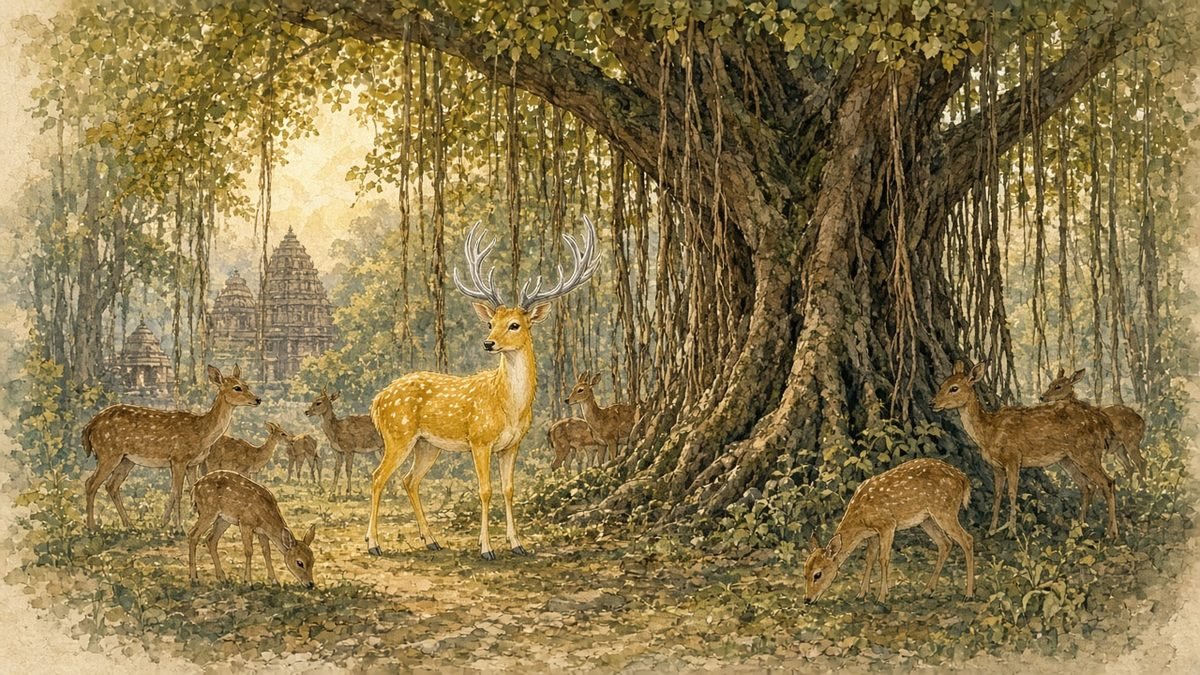
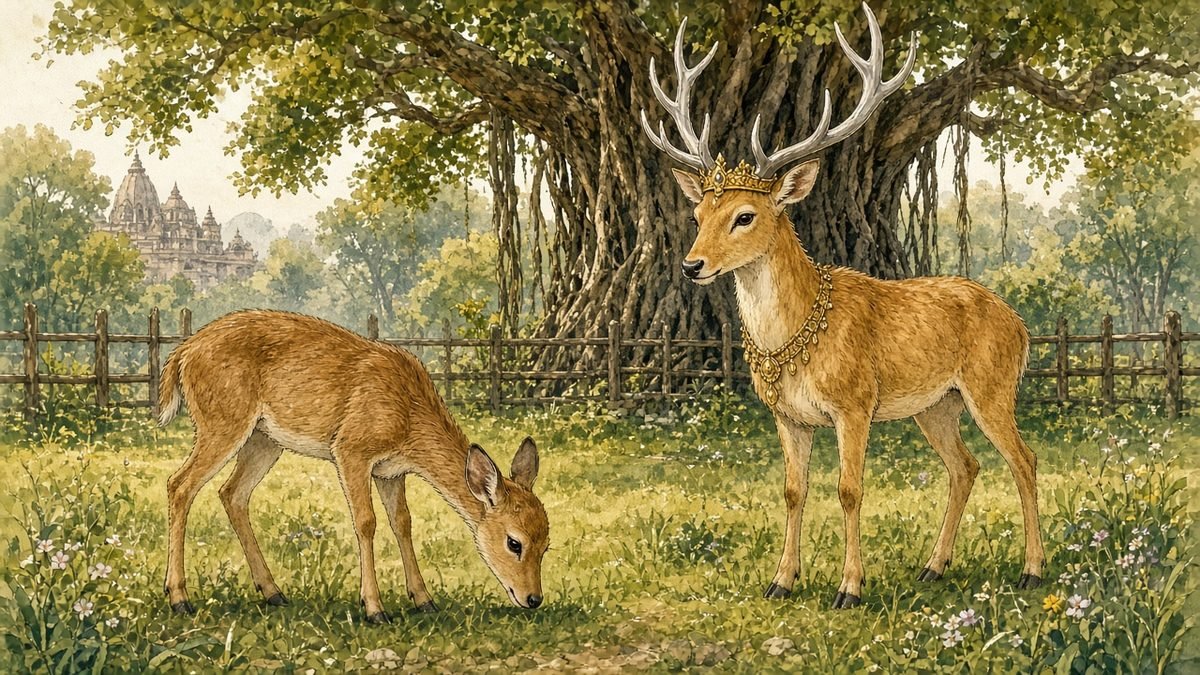
Long ago, when King Brahmadatta ruled the city of Benares in India, a deer was born in the forest with a coat that shone like gold. His eyes were bright as jewels, and his antlers gleamed silver in the sun. He grew up to be wise and gentle, and five hundred deer followed him. Because his herd lived around an enormous banyan tree, he was called the Banyan Deer.
Not far away lived another golden deer with a herd of five hundred more. His herd rested under the branches of the forest, so he was called the Branch Deer.
The king of Benares loved to hunt. Almost every day he rode out with his men, and the farmers and townspeople had to leave their fields and shops to help him chase the deer. The people grew tired of this. Their crops went unplanted, and their work went undone.
So they came up with a plan. “Let’s build a park for the deer,” they said. “We’ll plant grass and dig a pond, and drive the deer inside. Then the king can hunt there, and we can get back to our work.”
They built a big fenced park and drove both herds into it. The king came to look. When he saw the two golden deer, he was amazed. “Such beautiful creatures!” he said. “These two must never be hunted. They are under my protection.”
Part 2: A hard agreement
After that, the king or his cook came to the park to hunt. Every time they did, the whole park was in an uproar. The deer ran in every direction, crashing into each other and into the fences. Many were hurt in the panic, even the ones who weren’t caught.
The Banyan Deer went to talk to the Branch Deer.
“Friend,” he said, “we can’t stop the hunters. But we can stop the panic. What if we take turns? Each day, one deer will go by lot to the king’s kitchen gate, one day from my herd and the next from yours. Then the rest of the deer can live in peace and nobody else will be hurt.”
The Branch Deer agreed. It was a sad plan, but it was fair, and it spared the herds from the terrible chases. From then on, each day one deer walked to the gate and did not come back to the park.
Part 3: The mother deer’s turn
One day, the lot fell on a young doe from the Branch Deer’s herd. She was going to have a baby very soon.
She went to the Branch Deer and bowed her head. “My king,” she said, “I am going to be a mother. Please let someone else go today. When my fawn is born, I’ll take my turn. Then two lives won’t be lost instead of one.”
But the Branch Deer turned away. “The rules are the rules,” he said. “I can’t give your turn to someone else. Go.”
The doe walked away with her head down. Then she thought of the other golden deer. She went to the Banyan Deer and told him everything.
The Banyan Deer listened. Then he looked at her kindly. “Go back and rest,” he said. “I will make sure your turn passes you by.”
The doe went away, not sure what he meant.
The Banyan Deer didn’t ask anyone else in his herd to take her place. He couldn’t ask another deer to give up what he wouldn’t give himself. So he walked alone across the park, through the gate and up to the king’s kitchen, and he lay down on the ground by the door.
Part 4: The king comes running
The king’s cook came out and nearly dropped his basket. “That’s the golden deer the king promised to protect!” he cried. He ran straight to the palace.
The king climbed into his chariot and hurried to the kitchen with a crowd of people behind him. He found the Banyan Deer lying calmly by the door.
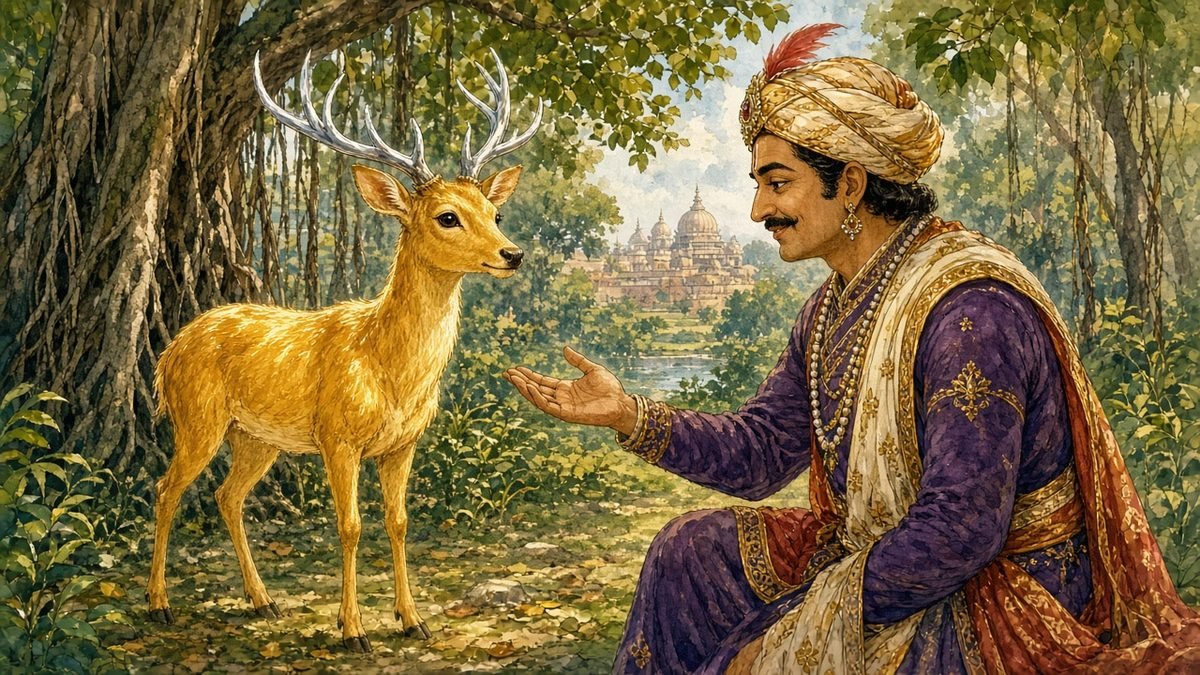
“My friend, king of the deer,” said the king, “didn’t I promise that you would be safe? Why are you here?”
“Great king,” said the Banyan Deer, “a mother deer came to me today. It was her turn, but she’s about to have a baby. I couldn’t send another deer in her place, so I came myself. Please don’t worry. I chose this.”
The king was silent for a long moment. He had never seen such kindness, not even among people.
“Stand up, golden deer,” he said at last. “I have never met anyone, man or animal, who would do what you have done. You are free, and so is the mother deer.”
The Banyan Deer stood up. But he didn’t leave.
“Great king,” he said, “two of us are safe. But what about the rest of the deer in the park?”
The king looked surprised. Then he smiled. “For your sake, I will spare them too.”
“And the deer outside the park, in the forests?”
“Them too.”
“And the other four-footed animals? And the birds? And the fish in the rivers?”
The king laughed out loud. “Very well! No one in my kingdom will hunt any of them again. You have my word.”
The Banyan Deer bowed low. He taught the king how to rule kindly and fairly, and then he walked back to the forest with his herd.
Part 5: Leaves on the fields
The deer were free now, and some of them began wandering into the farmers’ fields to munch on the tender young crops. The farmers didn’t dare chase them away, because of the king’s promise. They went to the palace to complain.
When the Banyan Deer heard about it, he called all the deer together. “We have been given our lives,” he said. “We will not repay that gift by eating the farmers’ food. From now on, nobody touches the fields.”
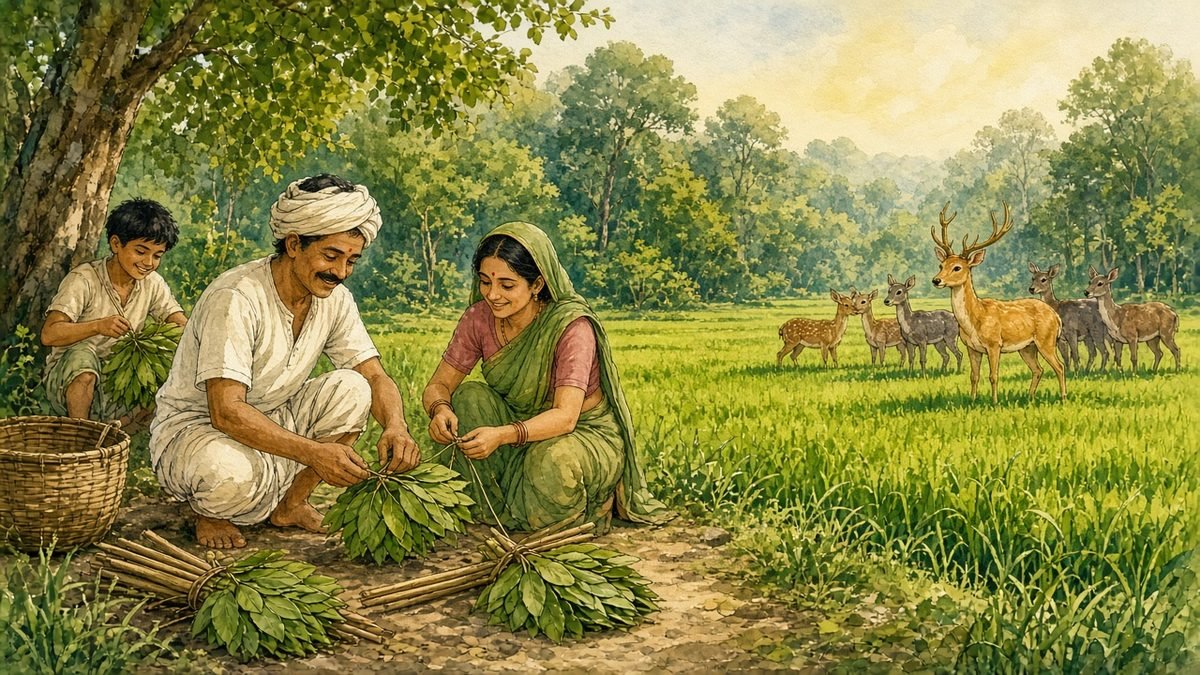
He sent a message to the farmers: “Tie a bundle of leaves on a stick at the edge of your fields. When the deer see it, they’ll know to stay out.”
The farmers did, and the deer kept their word. People say that’s why farmers in that land tied leaves around their fields for many years afterward.
Soon after, the young doe gave birth to a healthy fawn. She took him to see the Banyan Deer, and the little fawn grew up in his herd, learning to be gentle and brave.
The End
Moral of the story: Kindness can change hearts
The Banyan Deer did the kindest thing he could, at great risk to himself, and that one act moved the king so much that he protected every creature in the land. The story also shows the difference between two leaders. The Branch Deer followed the rules. The Banyan Deer followed his heart and looked after the weakest member of the herd.
What kids can learn from The Banyan Deer
- A good leader takes care of the people who need help most.
- Don’t ask others to do something you wouldn’t do yourself.
- Kindness can be braver than fighting.
- When someone does something kind for you, pay it back by treating others well, as the deer did with the farmers’ fields.
Questions to talk about with your child
- Why did the people build a park for the deer?
- How were the Banyan Deer and the Branch Deer different as leaders?
- Why do you think the Banyan Deer went himself instead of sending another deer?
- What made the king change his mind about hunting?
- Why did the Banyan Deer tell his herd to stay out of the farmers’ fields?
Summary: The Banyan Deer
In The Banyan Deer story, a king who loves hunting keeps two herds of deer in a park, each led by a golden deer king. To stop the painful chases, the deer agree that one deer will go to the king’s kitchen each day. When it’s a mother deer’s turn, the Banyan Deer goes in her place. The king is so moved that he spares the Banyan Deer, the doe and then every animal, bird and fish in his kingdom. The deer later show their thanks by staying out of the farmers’ fields.
For more Jataka tales, read The Rabbit in the Moon or The Monkey King.
Read More: The Four Harmonious Friends
Frequently asked questions
What is the moral of The Banyan Deer?
Kindness and courage can change even a powerful person’s heart. The story also teaches that a true leader protects the weakest members of the group.
What are Jataka tales?
Jataka tales are stories about the Buddha’s earlier lives, before he became the Buddha. In many of them he is born as an animal, such as a deer, a monkey or a rabbit, and shows a good quality like generosity or patience. In this one, the Banyan Deer is the Buddha in an earlier life. The story is known as the Nigrodhamiga Jataka. “Nigrodha” means banyan tree and “miga” means deer.
How does the original story end?
The ending in this retelling follows the old tale: the king spares the Banyan Deer and the doe, then promises safety to every animal, bird and fish, and the deer agree to stay out of the farmers’ fields. What’s different is how the hard parts are told. In the original, the deer chosen each day is killed for the king’s table, and the Banyan Deer lays his head on the cook’s chopping block. This version keeps that offstage for younger readers.
Is The Banyan Deer a true story?
No. It’s a teaching story that Buddhists have told for many centuries. It’s meant to show qualities like compassion and self-sacrifice, not to describe real events.
What age is this story good for?
It works for ages 5 to 12. Younger kids will follow the brave golden deer, and older kids can talk about fairness, leadership and why the rules alone weren’t enough.