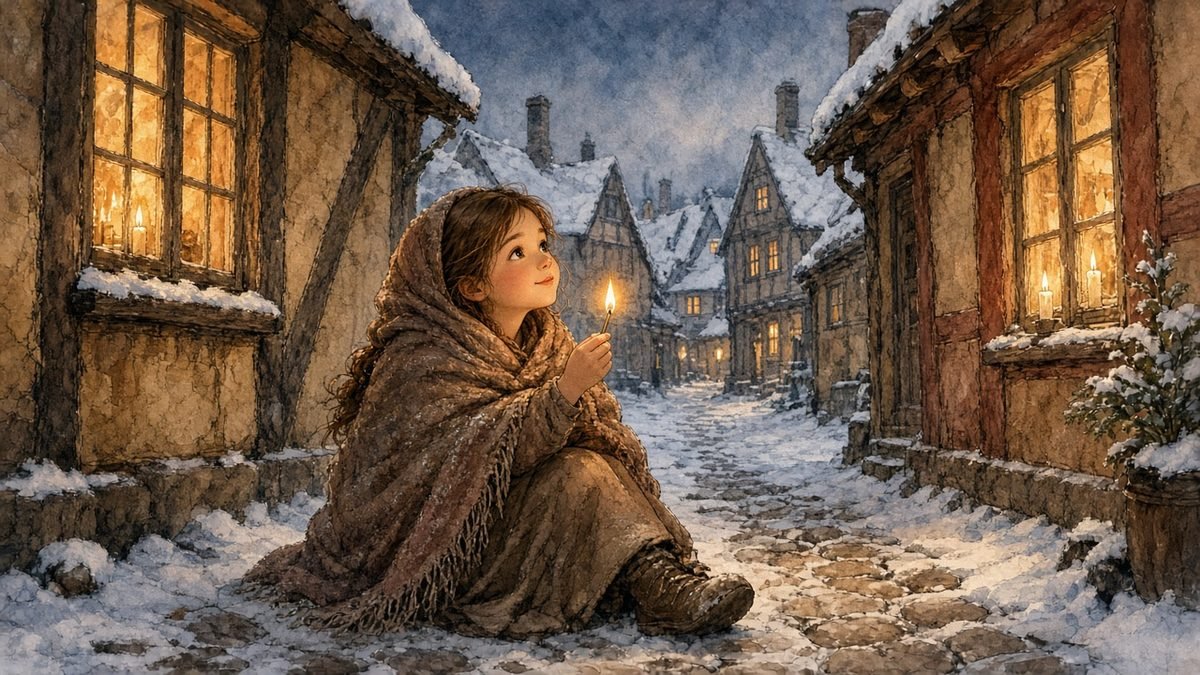
The Little Match Girl story was written by Hans Christian Andersen, the Danish author who also gave us The Ugly Duckling and The Snow Queen. It first came out in 1845. It takes place on the last night of the year, in a cold city full of lit-up windows, and it follows a poor girl who has nothing but a bundle of matches and a big imagination.
Andersen’s ending is one of the saddest in any fairy tale, so this retelling for ages 5 to 12 keeps his story and his magic but gives the girl a warm place to go at the end. You’ll find a note about the original ending in the FAQ. It takes about 9 minutes to read aloud and is a gentle way to talk about kindness during the holidays.
Part 1: A cold night in the city
It was New Year’s Eve, and it was bitterly cold. Snow was falling, and the streets were growing dark.
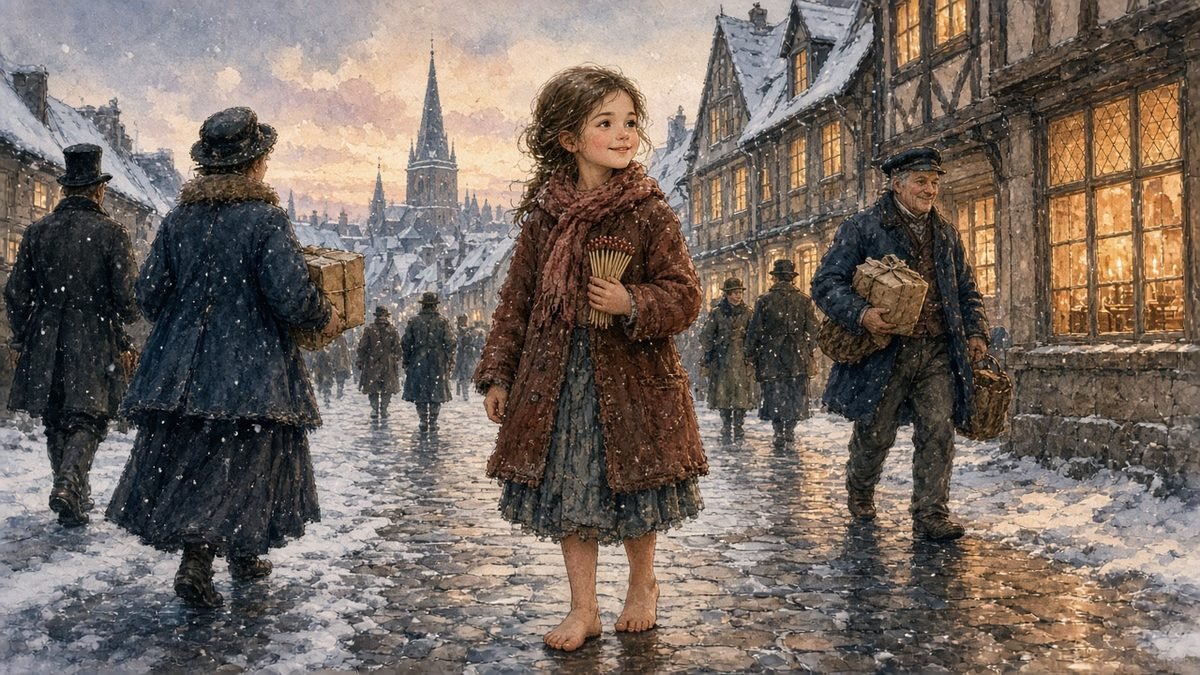
Through the snow walked a little girl with no hat and bare feet. She had left home that morning in a pair of slippers that had once been her mother’s. They were much too big, and when she ran across the street to get out of the way of two fast carriages, they fell right off. One slipper disappeared under the wheels. A boy grabbed the other one and ran away laughing.
So now she walked on bare feet that were red and blue with cold, carrying a bundle of matches in her old apron.
“Matches!” she called in a small voice. “Who will buy my matches?”
Nobody stopped. People hurried past with packages under their arms, in a rush to get home to their own warm houses. All day long, nobody had bought a single match.
Snowflakes settled in her long yellow hair, but she didn’t notice. She was looking at the windows. Every one glowed with candlelight, and the whole street smelled of roast goose.
Part 2: The first matches
The girl found a corner between two houses, where one stuck out a little farther than the other. She sat down there and pulled her feet up under her, but she only got colder.
She didn’t dare go home without any money. Besides, home was a drafty attic where the wind whistled through the cracks in the roof. It was hardly warmer there than in the street.
Her hands were nearly frozen. “One match would help,” she thought. “If I could just pull one out and strike it against the wall, I could warm my fingers.”
She pulled one out. Scratch! It sputtered and burst into flame. It gave off a warm, bright light, like a tiny candle, and she cupped her hand around it.
What a strange light it was! It seemed to the little girl that she was sitting in front of a big iron stove with shiny brass knobs. The fire inside burned so warmly. She stretched out her feet to warm them too.
Then the flame went out. The stove vanished. She was sitting in the snow again with a burnt match in her hand.
She struck a second match. It flared up, and where its light fell on the wall, the wall turned as thin and clear as a veil. She could see right into a room. The table was covered with a snowy white cloth, fine china dishes and a roast goose stuffed with apples and prunes. Steam rose from it. Better still, the goose hopped down from the platter and came waddling across the floor toward her.
Then the match went out, and there was only the thick, cold wall.
Part 3: The Christmas tree of stars
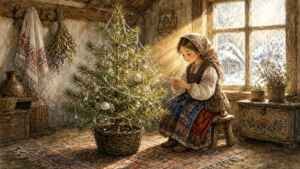
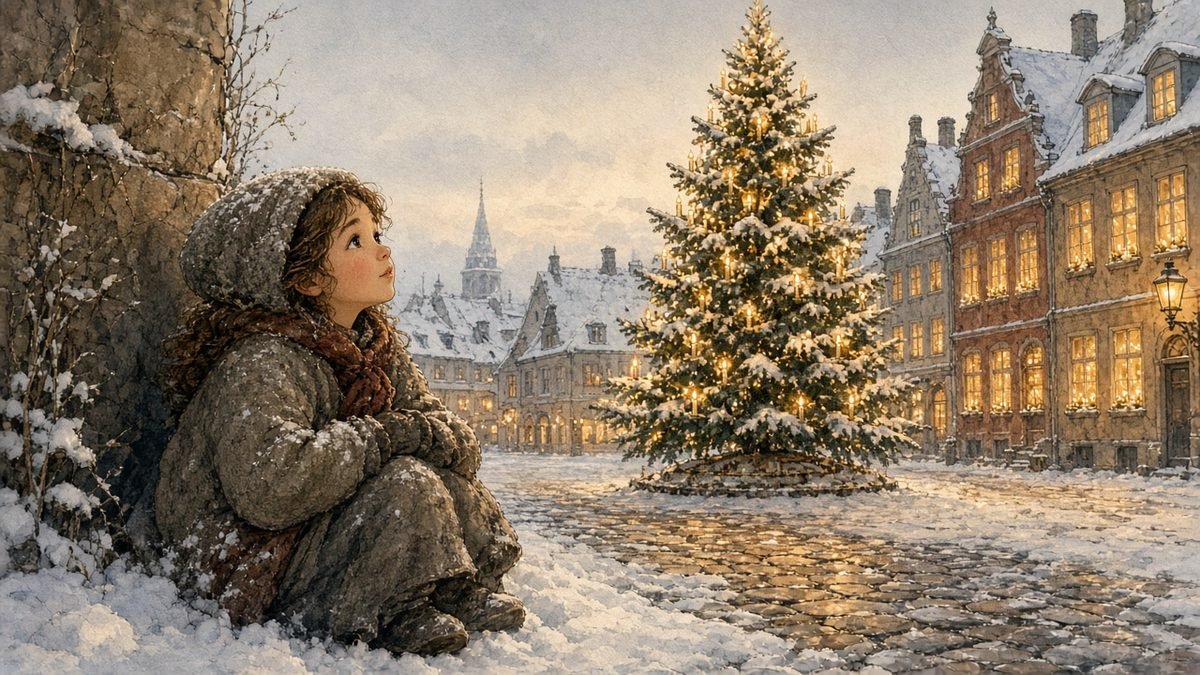
She lit a third match. Now she was sitting under the most beautiful Christmas tree she had ever seen. It was even grander than the one she had once seen through the glass door of a rich merchant’s house. Thousands of candles burned on its green branches.
The girl reached up both hands toward them, and the match went out.
But the Christmas candles rose higher and higher. She saw now that they were the stars in the sky. One of them fell, leaving a long streak of fire behind it.
“Someone is thinking of me,” the girl whispered. Her grandmother, the only person who had ever been really kind to her, used to say that when a star falls, someone’s heart is reaching toward heaven.
Part 4: Grandmother
She struck another match against the wall. It lit up all around her, and in the glow stood her old grandmother, as clear and bright as day, smiling at her with the gentlest face in the world.
“Grandmother!” cried the little girl. “Oh, please take me with you! I know you’ll go away when the match burns out, just like the warm stove and the goose and the Christmas tree.”
Quickly she struck all the rest of the matches, because she wanted to keep her grandmother there. They blazed brighter than daylight. She lifted the little girl into her arms, and the girl felt warm and safe for the first time in a very long while.
“You’re not alone, my darling,” her grandmother said softly. “Somebody is coming. Hold on just a little longer.”
Then the last match burned out, and the girl fell asleep in the corner with a smile on her face.
Part 5: New Year’s morning
Very early on New Year’s morning, a baker named Mrs. Holm came down the street to open her shop. Her arms were full of firewood for the ovens. As she passed the corner between the two houses, she saw something small curled up in the snow, surrounded by burnt matches.
She dropped the firewood at once.
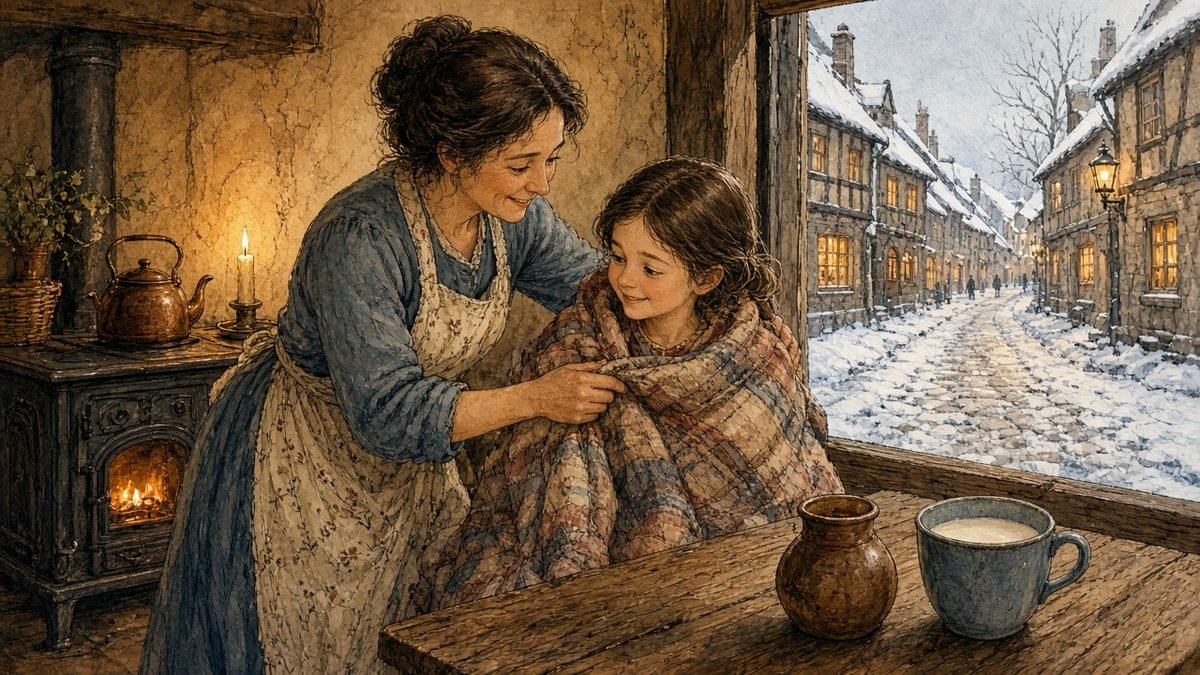
“Oh, you poor little thing,” she said, kneeling down. The girl’s cheeks were pale and her lips were blue, but she was breathing. Mrs. Holm wrapped her in her own thick shawl, picked her up and ran back to the bakery as fast as she could.
The bakery ovens were already warm. Mrs. Holm set the girl in a chair right next to them, rubbed her cold hands and feet and tucked a blanket around her. Her husband heated a pot of milk with honey.
Slowly, slowly, the little girl opened her eyes. She saw a warm stove with shiny brass knobs, a table with a clean cloth, and fresh rolls cooling on a rack. For a moment she thought she was dreaming again.
“Did I strike another match?” she asked.
“No, sweetheart,” said Mrs. Holm. “This one is real. And it won’t go out.”
The girl drank her milk, ate two soft rolls and told them about the cold attic and her grandmother in the light. Mrs. Holm and her husband looked at each other for a long time.
“We could use a helper in the bakery,” Mr. Holm said finally. “Someone to fold the napkins and count the rolls. Someone who’d live upstairs, where it’s warm.”
The little girl didn’t know what to say, so she just nodded, and Mrs. Holm hugged her tight.
That night, as the girl climbed into a real bed with real blankets, she looked out the window and saw a star shining over the rooftops. She remembered what her grandmother had said: somebody is coming. Somebody had.
The End
Moral of the story: Notice the people who need help
On one of the busiest nights of the year, hundreds of people hurried past a child who was cold and hungry, and none of them stopped. Andersen wanted readers to see what those people missed. In this version, one baker does stop. What she does is small (a shawl, a warm chair, a cup of milk), and it changes the girl’s whole life, all because she noticed.
What kids can learn from The Little Match Girl
- Look around you, because someone nearby may need help even when they don’t ask for it.
- The holidays are a good time to share, since many families don’t have enough food or warm clothes.
- Being grateful for a warm home, a meal and people who love you is a good habit all year.
Questions to talk about with your child
- Why didn’t the little girl want to go home?
- What did she see each time she struck a match? Which vision would you have wished for?
- Why do you think so many people walked past her without stopping?
- How did Mrs. Holm help? What else could people in the city have done?
- What is one way your family could help someone this winter?
Summary: The Little Match Girl
In The Little Match Girl story, a poor girl tries to sell matches on a freezing New Year’s Eve, but nobody buys any. Too afraid to go home, she sits in a corner and lights her matches one by one to stay warm, and in each flame she sees something wonderful, ending with her loving grandmother. In this gentle retelling, a kind baker finds her in the morning, warms her up and gives her a new home.
For another Andersen winter tale, read The Snow Queen. Oscar Wilde’s The Happy Prince also has a little match girl in it, and a statue who wants to help her.
Read More: The Gift of the Magi for Kids
Frequently asked questions
Who wrote The Little Match Girl?
Hans Christian Andersen, a Danish writer of fairy tales. The story was first published in 1845. Its Danish title means “The Little Girl with the Matches.”
How does the original Little Match Girl story end?
In Andersen’s version, nobody finds the girl in time. She freezes during the night, and her grandmother carries her up to heaven, where she is never cold or hungry again. People find her in the morning and say she was trying to warm herself, but they don’t know about the beautiful things she saw. This retelling keeps the grandmother and the visions but adds the baker’s family, so the girl is rescued instead. If you read the original with older kids, it’s worth preparing them for the sad ending.
Is The Little Match Girl a Christmas story?
It takes place on New Year’s Eve, but it has a Christmas tree in it, and people often read it during the Christmas season.
What is the moral of The Little Match Girl?
Notice and help people in need, especially children, and especially when everyone around you is busy celebrating.
What age is this story good for?
This gentle version works for ages 5 to 12. Younger children usually focus on the magic of the matches, and older kids can talk about why nobody stopped to help.