The Fox and the Stork is one of Aesop’s fables about treating others the way you want to be treated. A fox invites a stork to dinner and serves soup in a flat dish the stork cannot drink from. Later the stork returns the invitation with a meal in a tall jar. Kids recognize the pattern right away, and the talk afterward is half the fun.
This retelling is for ages 5 to 12 and takes about ten minutes to read aloud. It is gentle, a little funny and clear on the golden rule. After the story you’ll find the moral, questions, a summary and a FAQ.
Part 1: A Clever Fox With a Mean Idea
Once upon a time, at the edge of a meadow full of wildflowers, there lived a fox with a shiny red coat and a reputation for tricks. Rabbits gave him a wide path. Squirrels counted their acorns twice when he strolled by. He was not always unkind. He could be charming when he wanted to be, full of compliments and quick jokes. The trouble was how often he wanted to be clever more than he wanted to be fair.
One afternoon the fox spotted a stork wading in the shallow creek, hunting minnows with her long beak. The stork was polite, a little shy and very good at standing still.
“Neighbor Stork!” called the fox, waving. “You must come to dinner at my den tomorrow evening. I insist. I’ll cook something special.”
The stork dipped her head. “That is kind of you. I would be happy to come.”
The fox trotted home with a smirk already forming. He had an idea that felt, to him, like a joke. Jokes that leave someone hungry are not funny, but the fox had not learned that yet.

Part 2: Soup in a Flat Dish
The next evening the stork arrived at the fox’s den right on time, stepping carefully so her long legs would not tangle in the brambles by the door. She had preened her feathers until they shone and brought a small bunch of meadow flowers as a thank-you gift. The den smelled wonderful: onion, herbs and warm broth. A candle stump flickered on a shelf. It all looked like a real invitation.
“Sit, sit,” said the fox, whisking the flowers into a jar. “Dinner is ready.”
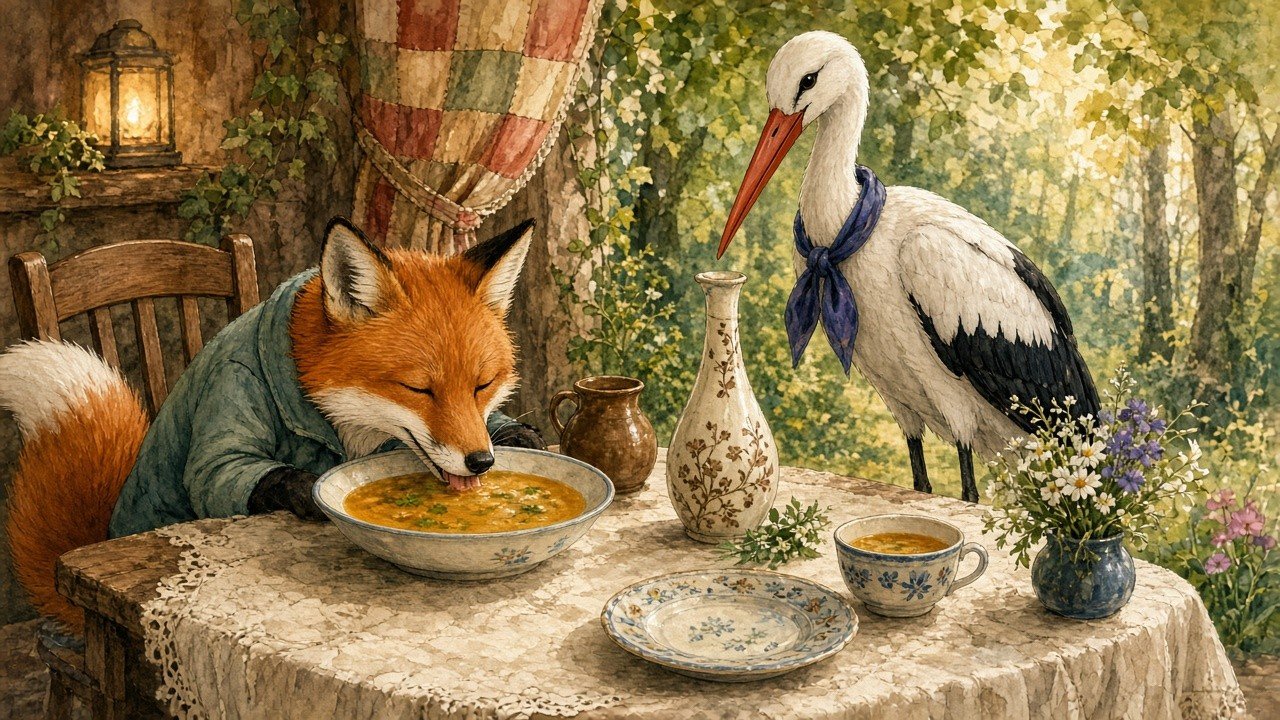
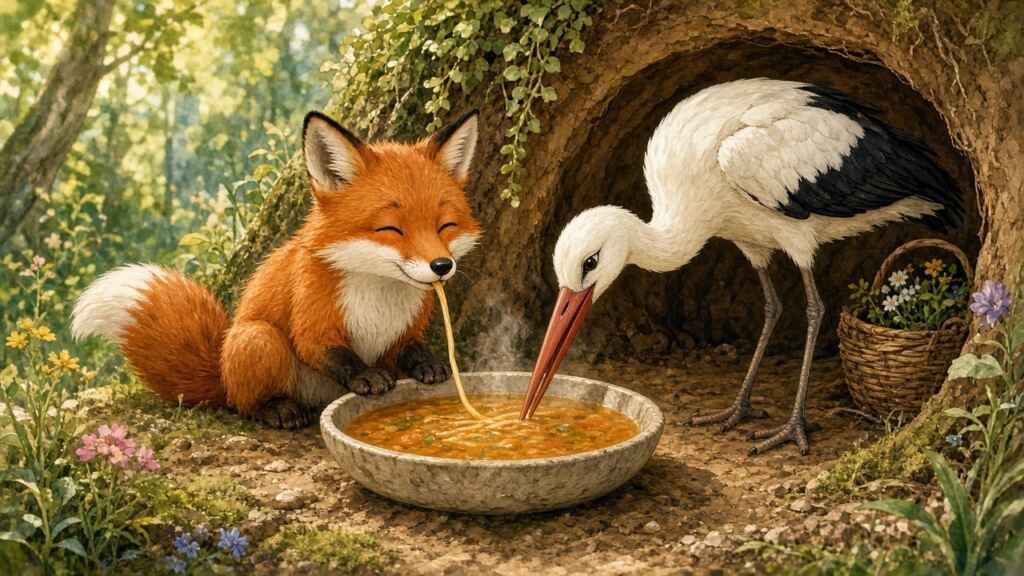
He set out a wide, shallow dish of delicious soup. Steam curled up. The fox lapped and slurped with delight, his tongue making quick work of every drop. The stork tried to drink too. Her long beak clacked against the flat dish. She could wet the tip, nothing more. The soup she came for stayed just out of reach.
“Is something wrong?” the fox asked, eyes bright with fake concern. “You haven’t eaten a bite. Don’t you like my cooking?”
The stork stood tall and quiet for a moment. Her stomach rumbled. Her feelings did too.
“The soup smells wonderful,” she said carefully. “I’m afraid this dish does not suit my beak. Thank you for inviting me all the same.”
She left with empty insides and a thoughtful look, flowers still bright in the fox’s jar. The fox laughed into his whiskers and finished every last spoonful of what was left, even the bits stuck to the rim. He told himself it was only a prank. He told himself the stork was too serious. He did not ask how the prank felt from the other side of the dish.
Part 3: An Invitation Returned
Two days later a polite note arrived at the fox’s den, written in careful marks on a birch leaf.
Dear Fox, please come to dinner at my nest by the reeds tomorrow evening. I would love to return your hospitality. Yours, Stork.
The fox grinned so hard his whiskers quivered. “She wants another meal with me. My joke must not have bothered her at all. Maybe she even liked the surprise.”
He spent the next day imagining seconds and thirds. He brushed his coat until it gleamed. He practiced compliments in the mirror of a puddle: “Stork, your nest is lovely. Stork, your stew smells divine.” He did not practice thinking about tall containers. That idea never crossed his mind.
Evening came soft and purple. The fox followed the path to the reeds, where the stork had set a low table of smooth stones. Lantern bugs blinked in the grass. The smell of fish stew made the fox’s mouth water.
“Welcome,” said the stork. “Please sit. I made plenty.”
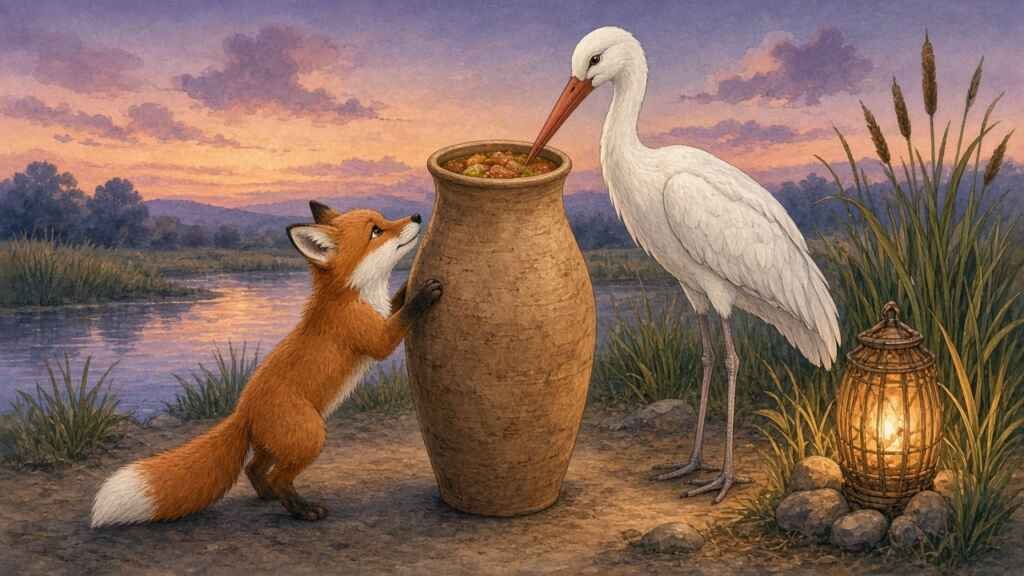
She brought out a tall, narrow jar with a long neck. Inside, the stew smelled even better up close: rich, savory, perfect. The stork dipped her beak into the jar and ate with easy grace. Sip after sip, she enjoyed her meal.
The fox pressed his nose to the jar’s mouth. His snout was too wide. His tongue could not reach the stew, no matter how he stretched. He tipped the jar and nearly spilled it. He pawed it. He circled it like a puzzle he refused to admit he could not solve. A drop of stew clung to the rim, teasing him. Nothing worked. The food stayed where only a long beak could go.
Part 4: The Fox Learns the Shape of Fairness
“Is something wrong?” the stork asked gently, echoing his words from before. “You haven’t eaten a bite. Don’t you like my cooking?”
The fox’s ears flattened. Heat climbed his cheeks under the fur. A cricket chirped, unhelpful. He understood, all at once, how the flat dish had felt: the smell of a good meal, the sight of someone else enjoying it, and the stubborn shape of a dish that said you did not count. The joke was not a joke when you were the hungry one.
“I… I see what you did,” he mumbled. “And I see what I did. I’m sorry, Stork. The shallow dish was a mean trick. You didn’t deserve that.”
The stork regarded him for a long moment. Then she tipped a second, wider bowl from behind a reed curtain and poured a share of stew into it.
“Apology accepted,” she said. “Next time we both eat from dishes that work for both of us. That is how friends dine.”
The fox ate slowly, tasting more than fish and herbs. He tasted the lesson. They talked until the lantern bugs faded. When he walked home, he left the smirk behind in the reeds.
Part 5: Dinners After That
From then on, when the fox invited the stork, he set out a bowl and a tall cup side by side, and he tasted both dishes himself first to be sure. When the stork invited the fox, she did the same, sometimes adding a flat plate of berries they could both manage. Other animals noticed. A badger who used to “forget” to share berries started setting out two equal piles. A magpie who mocked accents practiced saying kind hellos instead. Even the rabbits relaxed a little when the fox walked past, because word gets around in a meadow.
One autumn evening the two of them hosted a small picnic for anyone who wanted to come. There were low dishes and tall jars, wide plates and narrow cups. Nobody went home hungry for lack of the right shape. The fox stood at the edge of the blanket and made sure of that himself.
The meadow did not become perfect. No meadow does. But the fox and the stork became a story parents told when a child hid a toy from a sibling, or served the last cookie to himself first, or laughed at someone who could not keep up on the playground.
“Think of the dish,” they said. “Would you want to eat from it?”
Most kids, after a pause, shake their heads and go find a fairer way.
When teachers read this fable aloud, they often pause after the tall jar appears and ask the class to predict the fox’s face. Kids almost always get it right. That little spark of recognition is why The Fox and the Stork still earns a place beside The Fox and the Grapes and The Fox and the Crow on bedtime shelves.
The End
Moral of the story: The Fox and the Stork
Treat others the way you want to be treated. The fox thought a tricky dish was funny until he faced a jar he could not use. Fairness means making sure everyone at the table can actually share the meal.
What kids can learn from this fable
- A joke is not funny if only one person is laughing.
- Apologies work better when they come with a changed plan.
- The stork taught the lesson without yelling or chasing.
- Thinking about someone else’s body, tools or needs is part of kindness.
Questions to talk about with your child
- Why couldn’t the stork eat from the flat dish?
- Was the stork mean to serve food in a tall jar, or was she teaching?
- How did the fox’s feelings change during the second dinner?
- What is a modern version of a “flat dish” at school or home?
- If you were the stork, would you have poured the second bowl? Why?
Summary: The Fox and the Stork
A fox invites a stork to dinner and serves soup in a shallow dish the stork’s beak cannot manage. The stork goes home hungry. Later she invites the fox and serves stew in a tall jar he cannot reach into. The fox understands how his trick felt, apologizes and learns to set a table that works for both of them. The story is Aesop’s reminder of the golden rule.
Read More: The Fox and the Crow
Frequently asked questions
Who wrote The Fox and the Stork?
It is one of Aesop’s fables from ancient Greece. Artists and writers have retold it for centuries, sometimes with a crane instead of a stork.
What is the moral of The Fox and the Stork?
Do unto others as you would have them do unto you. If you play a trick that leaves someone out, you may face the same trick in return.
Is the stork being revengeful?
In many tellings the stork’s dinner is a lesson, not endless revenge. In this version she also offers a second bowl once the fox understands, so the story ends in repair.
Is this a good bedtime story?
Yes. It is short, funny and free of scary scenes. Kids like acting out the clacking beak and the stuck snout, then talking about fairness before lights-out.
How is this different from The Fox and the Crow?
The Fox and the Crow is about flattery and trickery over cheese. The Fox and the Stork is about mutual treatment and empathy at the dinner table. Same fox energy, different lesson.
How long does this story take to read aloud?
About eight to twelve minutes, depending on voices and pauses. Parents who want a quick script can stop after Part 4 and save the picnic ending for another night.