The Steadfast Tin Soldier story is a fairy tale by Hans Christian Andersen, the Danish author of The Ugly Duckling and Thumbelina. It was first published in 1838. It tells the story of a toy soldier with only one leg who falls in love with a paper ballerina and goes on a wild adventure through the gutters and canals of a city,. “Steadfast” means brave, loyal and not giving up, even when things get hard.
Andersen’s ending is a sad one, so this retelling for ages 5 to 12 keeps his adventure and gives the soldier and the dancer a happier ending. The FAQ explains how the original ends. It takes about 9 minutes to read aloud.
Part 1: Twenty-five tin soldiers
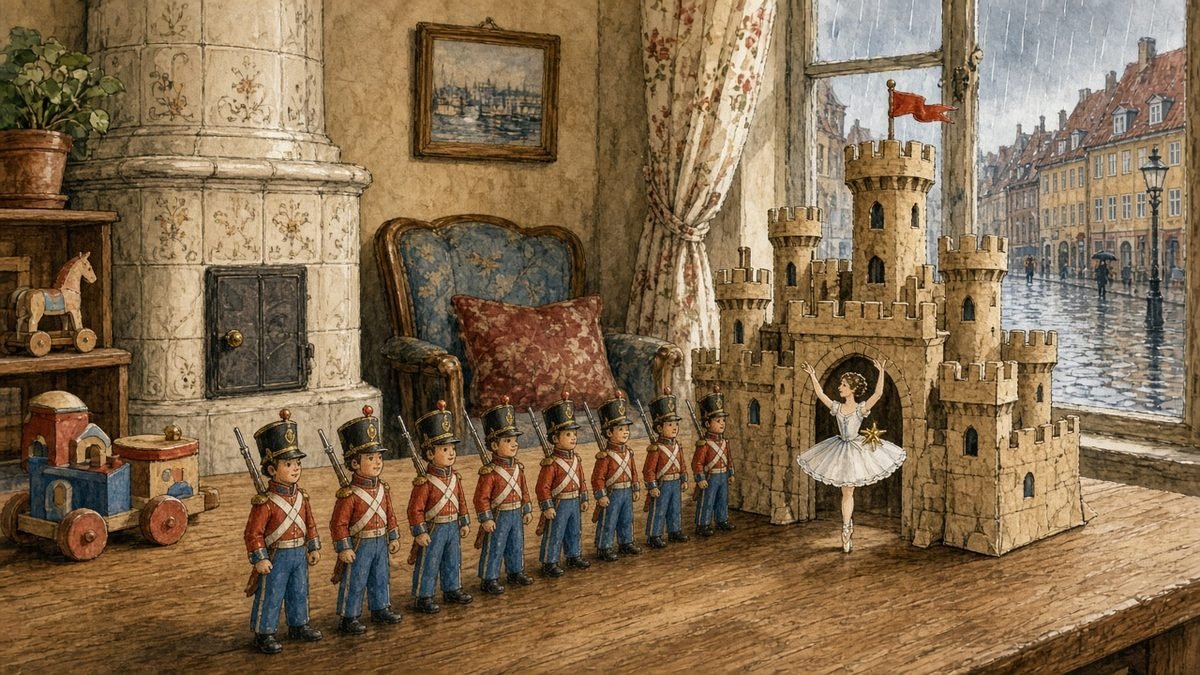
There were once twenty-five tin soldiers, and they were all brothers, because they had all been made from the same old tin spoon. They wore red and blue uniforms, held their rifles on their shoulders and looked straight ahead.
The very first thing they heard in this world, when the lid was taken off their box, was a little boy clapping his hands and shouting, “Tin soldiers!” They were a birthday present. The boy lined them all up on the table.
The soldiers were exactly alike, except for one. He had only one leg. He had been made last, and there wasn’t quite enough tin left to finish him. But he stood just as firmly on his one leg as the others did on two.
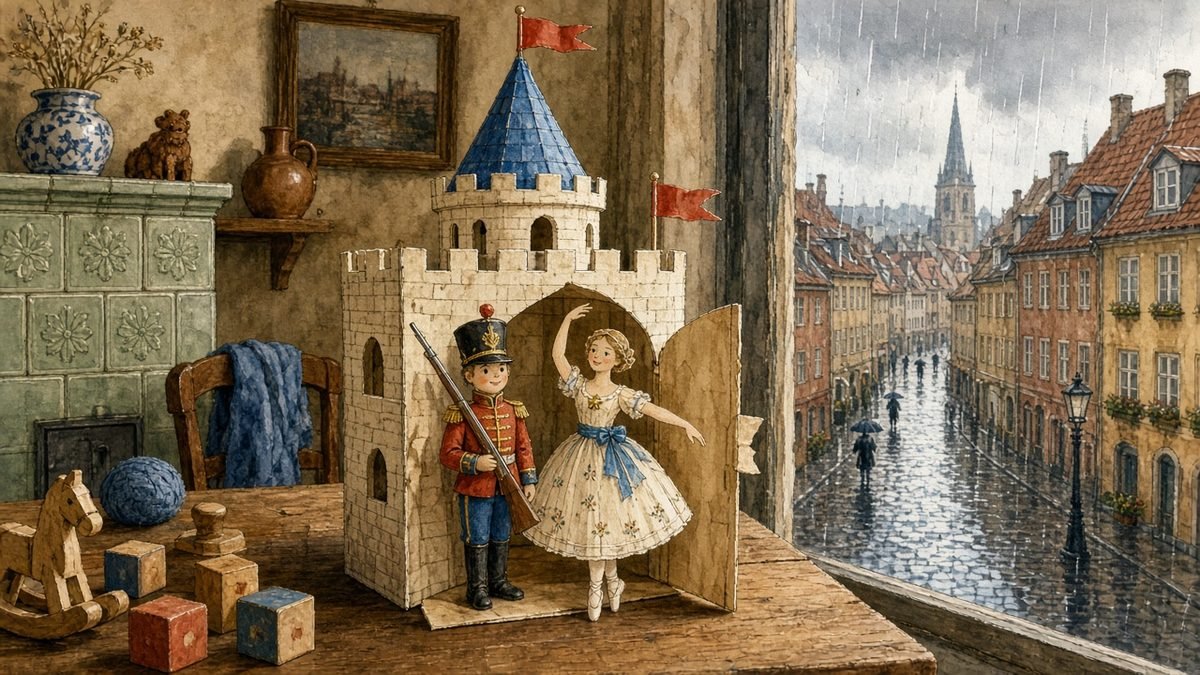
On the same table were many other toys, but the one everyone noticed was a paper castle. Through its tiny windows you could see right into the rooms.
The prettiest thing of all was a little lady standing in the open doorway of the castle. She was cut out of paper, and she wore a dress of fine white cloth. A narrow blue ribbon hung over her shoulder, and in the middle of it was a shiny spangle as big as her face. She was a dancer. She held both arms out, and she had lifted one leg so high behind her that the tin soldier couldn’t see it at all. He thought that she, like him, had only one leg.
“She would be the perfect friend for me,” he thought. “But she lives in a castle, and I live in a box with twenty-four others. Still, I’d like to get to know her.”
So he lay down behind a snuffbox on the table, where he could watch her.
Part 2: The goblin’s warning
When night came and the people of the house went to bed, the toys began to play.
The only two who didn’t move were the tin soldier and the little dancer. She stood on the tip of her toe with her arms out, and he stood on his one leg. He never took his eyes off her.
Then the clock struck twelve, and pop! The lid of the snuffbox flew open. There was no snuff inside. Instead, out jumped a little black goblin on a spring. It was a jack-in-the-box.
“Tin soldier!” said the goblin. “Keep your eyes to yourself!”
The tin soldier pretended not to hear.
“Just you wait until tomorrow,” said the goblin.
Part 3: A fall and a paper boat
The next morning, when the children got up, the boy set the tin soldier on the windowsill. Maybe it was the goblin’s doing, or maybe it was just the wind, but suddenly the window flew open, and the soldier tumbled head first from the third floor.
Down he fell, faster and faster, and landed upside down with his bayonet stuck between two paving stones and his one leg in the air.
The maid and the little boy hurried downstairs and nearly stepped on him, but they didn’t see him. He could have called out, “Here I am!” But he didn’t think it was proper for a soldier in uniform to shout.
Then it began to pour. When the rain was over, two boys came along.
“Look!” said one. “There’s a tin soldier. Let’s give him a ride.”
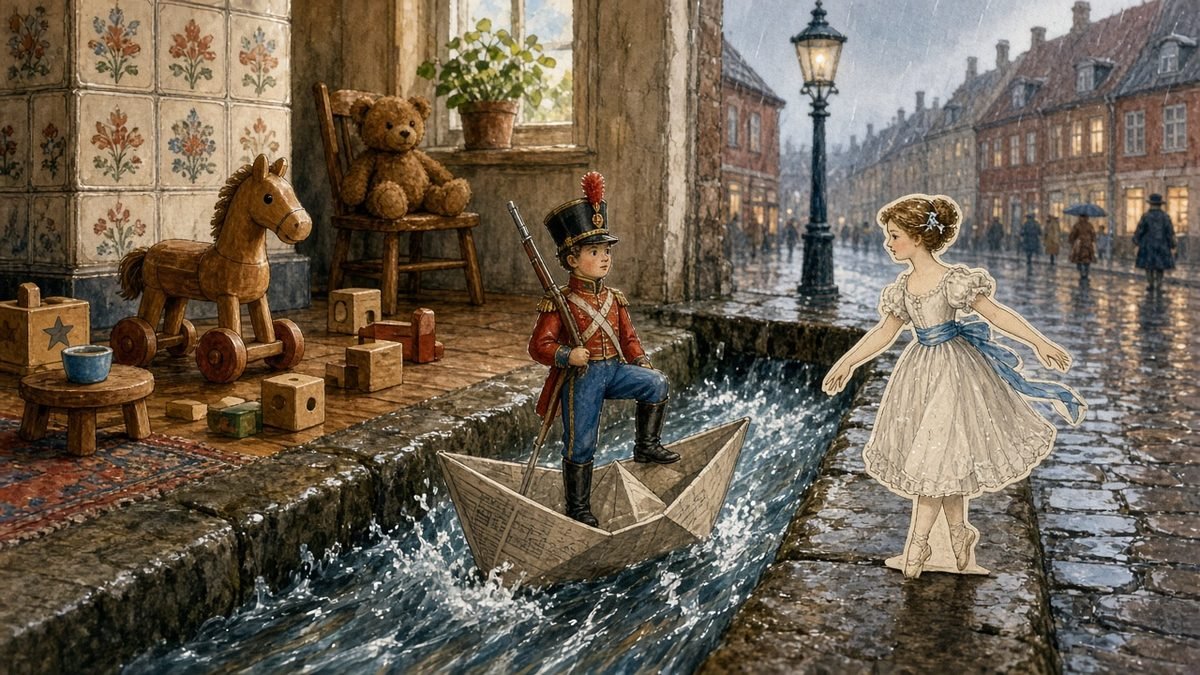
They folded a newspaper into a boat, put the tin soldier in it and set it in the gutter. Away he sailed! The water rushed along so fast that the paper boat rocked and spun. The tin soldier trembled, but he didn’t show it. He kept looking straight ahead, with his rifle on his shoulder.
Part 4: Down the dark tunnel
All of a sudden, the boat sailed into a long, dark tunnel under the street. It was as dark as it had been in his box.
“If only the little dancer were here in the boat with me,” thought the tin soldier, “I wouldn’t care if it were twice as dark.”
Just then, a big water rat who lived in the tunnel popped up. “Do you have a pass?” it squeaked. “Show me your pass!”
The tin soldier didn’t say a word. He held his rifle tighter than ever, and the boat rushed on while the rat squeaked behind him, “Stop him! He didn’t show his pass!”
But the water rushed faster and faster.
The boat shot out of the tunnel into a big canal, and the paper got soggier and soggier. The water rose up to the soldier’s neck. As the boat sank, he thought of the pretty little dancer he would probably never see again.
Then the paper fell apart, and the tin soldier sank. At that very moment, a big fish swam by and swallowed him in one gulp.
Part 5: Home again
It was even darker inside the fish, and there was hardly any room. But the tin soldier lay there, just as steady as ever, with his rifle on his shoulder.
The fish swam around and around. Then it stopped moving, and after a while, something like a flash of lightning shone through. Daylight! Someone called out, “The tin soldier!”
The fish had been caught, carried to the market and sold. And who had bought it? The cook from the very same house! When she cut it open in the kitchen, there was the tin soldier. She picked him up with two fingers, washed him off and carried him up to the playroom.
The boy set him on the table, and there, right in front of him, was the very same castle, and the very same little dancer, still standing on one toe with her arms out. She had been steadfast too.
Then the door to the hall swung open, and a gust of wind blew across the room. It caught the little paper dancer and lifted her off her feet. She fluttered across the table like a butterfly, straight toward the warm stove, where the fire was crackling.
The tin soldier didn’t stop to think. He leaned forward on his one leg, farther and farther, until he toppled off the edge of the table. He landed on the floor right in front of the stove, and the dancer fell gently against him instead of into the fire.
“Look!” cried the little boy. “He caught her!”
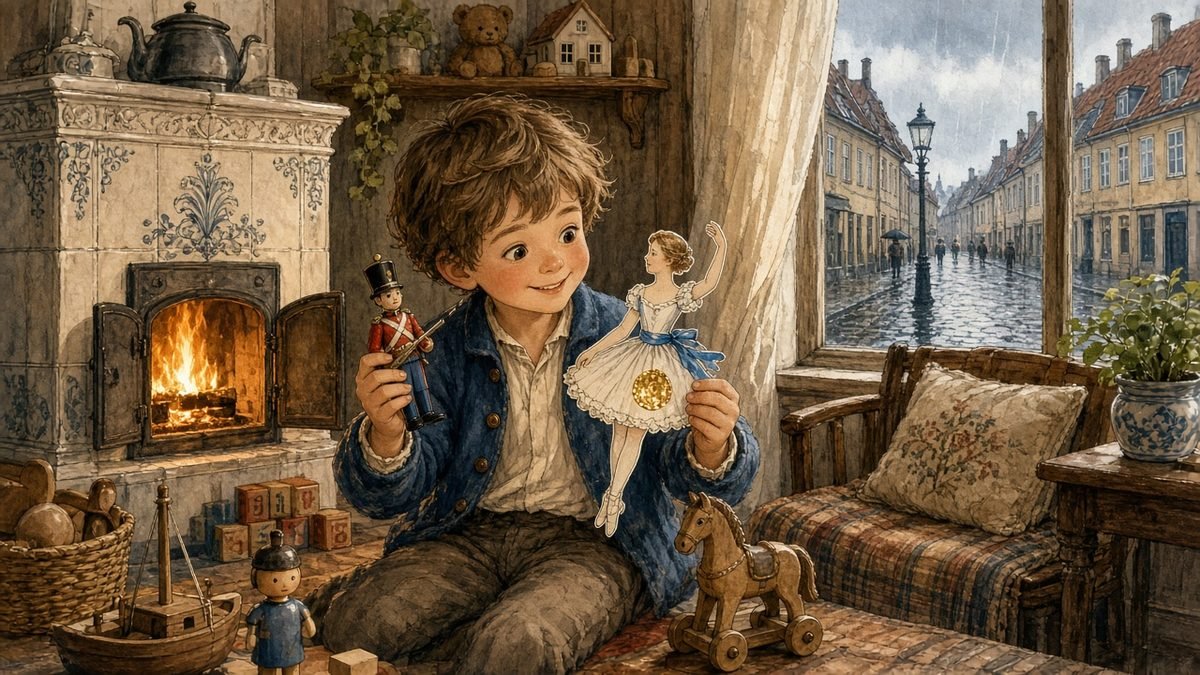
The boy picked them both up. The soldier had a little dent in his chest from the fall, right where his heart would be. It was shaped almost like a heart.
From then on, the boy never put the one-legged soldier back in the box. He stood him in the doorway of the paper castle, right next to the little dancer. And there they stayed, side by side, steady and brave, for a very long time.
The End
Moral of the story: Stay brave, even when things go wrong
The tin soldier falls out of a window, gets lost in the rain, sails through a dark tunnel, faces a scary rat and gets swallowed by a fish. He’s scared, but he never gives up and never stops being himself. Being steadfast means staying brave and loyal, no matter what happens.
What kids can learn from The Steadfast Tin Soldier
- You can be scared and brave at the same time.
- Being different, like having one leg, doesn’t make anyone less strong.
- Staying loyal to the people you care about is a kind of courage.
Questions to talk about with your child
- Why did the tin soldier have only one leg?
- Why do you think he liked the little paper dancer so much?
- What was the scariest part of his adventure? What did he do?
- What does “steadfast” mean? Can you think of a time when you were steadfast?
Summary: The Steadfast Tin Soldier
In The Steadfast Tin Soldier story, a boy gets twenty-five tin soldiers for his birthday, and one of them has only one leg. The soldier falls for a paper ballerina who stands on one leg in a toy castle. The next day he falls out of a window. Two boys float him in a paper boat through the gutter and a dark tunnel into a canal, where a fish swallows him. The fish is sold to the cook of the very same house, and the soldier comes home. In this retelling, he saves the dancer from the stove, and they stay together in the castle.
For another Andersen story about someone who feels different, read The Ugly Duckling. And for a famous story about toys that come alive at night, try The Nutcracker.
Read More: Thumbelina
Frequently asked questions
What is the moral of The Steadfast Tin Soldier?
Stay brave and loyal, even when life throws hard things at you. The soldier never gives up, and he never lets having one leg hold him back.
Who wrote The Steadfast Tin Soldier?
Hans Christian Andersen wrote it, and it was first published in Denmark in 1838. In some English books it’s called The Brave Tin Soldier or The Constant Tin Soldier.
How does the original story end?
In Andersen’s version, the little boy throws the tin soldier into the stove for no reason, and the story suggests the goblin was to blame. Then a draft blows the paper dancer into the stove too. The soldier melts into a small tin heart, and all that’s left of the dancer is her spangle, burned black. This retelling changes the ending so the soldier catches the dancer before she reaches the fire, and the two stay together. The dent shaped like a heart is a nod to Andersen’s tin heart.
Is The Steadfast Tin Soldier a Christmas story?
Not in the original. The soldiers are a birthday present. It’s still a popular winter read alongside other toy stories like The Nutcracker.
What age is this story good for?
It works for ages 5 to 12. Younger kids love the boat ride and the fish, and older kids can talk about what being steadfast means.