The Monkey and the Wedge story is a short fable from the Panchatantra, a very old collection of Indian animal stories that were used to teach young princes how to act wisely. It’s about a curious monkey who can’t keep his paws off something that isn’t his. In the Panchatantra, one jackal tells it to another to warn him not to meddle in matters that don’t concern him.
The original story ends badly for the monkey. This retelling for kids ages 5 to 12 keeps the lesson and gives the monkey a sore tail and a second chance. The FAQ explains how the old version ends. It takes about 7 minutes to read aloud.
Part 1: The new temple
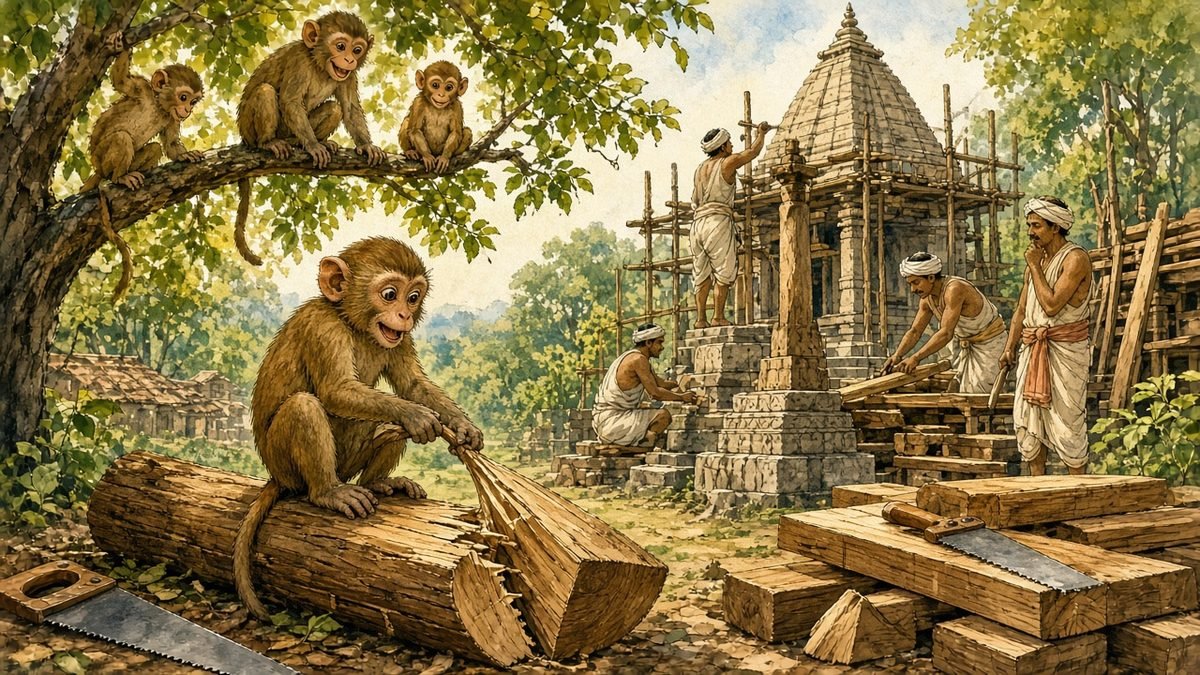
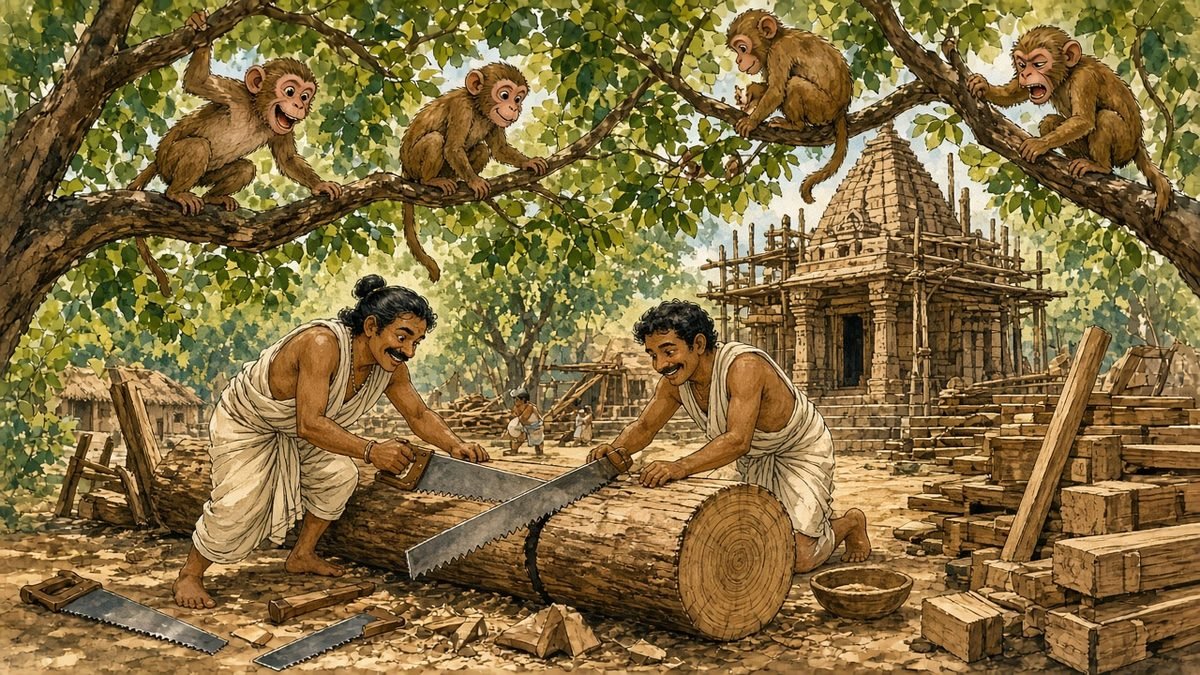
Long ago, near a town in India, a rich merchant decided to build a temple in a grove of trees. He hired a team of carpenters to do the work, and every morning they arrived with their saws, hammers and chisels and got busy.
The carpenters had a lot of work to do. They had to cut big logs into long, flat boards for the walls and roof. It was slow, hard work, and they did it the old way: by hand.
To split a big log, a carpenter would saw partway down the middle. Then, before the saw could get stuck, he would hammer a wedge into the crack. A wedge is a thick piece of wood shaped like a slice of cheese, thin at one end and fat at the other. It held the two halves of the log apart so the carpenter could keep sawing.
In the trees all around the building site lived a big troop of monkeys. They were noisy and playful, and they loved to watch the carpenters work. They hung from the branches by their tails, chattering and pointing, and they copied the carpenters when they hammered and sawed.
One of the monkeys was a young fellow named Bandu. Bandu was the most curious monkey in the whole troop. He wanted to touch everything, poke everything and find out how everything worked.
“One day,” Bandu told his friends, “I’m going to get down there and try those tools myself.”
“You’d better not,” said his grandmother, an old gray monkey with wise eyes. “Those are the carpenters’ things, not ours. Leave them alone.”
Part 2: Lunchtime
One hot day around noon, the carpenters stopped working. “Time to eat,” said the head carpenter, wiping his forehead. “Let’s go into town for lunch. We’ll finish this log when we get back.”
He had been sawing a long, heavy log. It was split halfway down the middle, and a big wooden wedge was jammed into the crack to keep it open. The carpenters left the log right where it was, put down their tools and walked off down the road.
As soon as they were gone, the monkeys came swinging down from the trees.
What a party they had! They climbed on the piles of boards. They rolled around in the sawdust and threw wood shavings at each other. One monkey picked up a hammer and banged it on a stone. Another tried to lift a saw and nearly fell over.
Bandu didn’t care about any of that. He had his eye on the half-split log with the wedge sticking out of it.
“I wonder what that thing does,” he said to himself.
Part 3: Bandu can’t resist
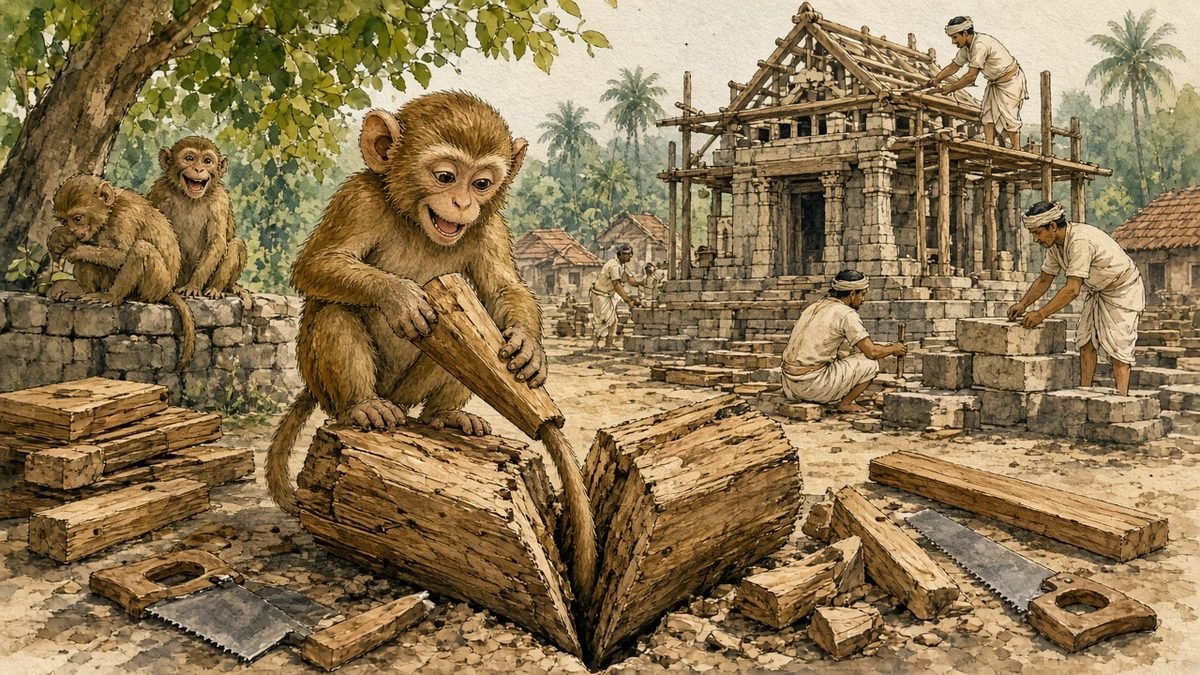
Bandu climbed up onto the log and sat right on top of it, on one of the split halves. His long tail dangled down into the gap between the two halves. He didn’t even notice.
He leaned over and looked at the wedge. He tapped it. He knocked on it with his knuckles. He sniffed it.
“Why is this stuck in here?” he wondered. “It looks like it doesn’t belong. I bet I can pull it out.”
His grandmother saw him from across the clearing. “Bandu!” she called. “Get off that log! That’s not yours to play with!”
“I’m just looking, Grandma,” Bandu called back. But he wasn’t just looking. He grabbed the wedge with both hands and pulled.
It didn’t move.
He pulled harder. He wiggled it back and forth. He braced his feet against the log, gritted his teeth and pulled with all his might.
Little by little, the wedge started to slide. It was working!
“Look, everybody!” Bandu shouted. “I’m doing it!”
With one last tug, the wedge popped free. And the moment it did, the two halves of the log snapped shut with a loud CLACK!
Part 4: Stuck
“YEOWWW!” Bandu screamed. His tail was caught tight between the two halves of the log!
He pulled. He twisted. He jumped up and down. But his tail was stuck fast, and every time he pulled, it hurt even more.
All the other monkeys came running. They gathered around the log, chattering and screeching. Some of them tried to pull the two halves apart, but the log was much too heavy. Others tried to push the wedge back into the crack, but there was no crack left to push it into.
“Help me!” Bandu cried. “Somebody, please get me out!”
His grandmother climbed up beside him. She stroked his head gently. “Stay still, Bandu,” she said. “Pulling will only make it worse. We monkeys can’t fix this. Only the carpenters know how to open a log.”
So Bandu sat still. His tail throbbed, and big tears rolled down his cheeks. He felt foolish and frightened, and he wished more than anything that he had stayed up in the trees.
Part 5: The carpenters return
After what felt like forever, the carpenters came walking back up the road from town. When they saw the clearing, they stopped short. There were wood shavings everywhere, tools lying in the dirt and a big troop of monkeys crowded around one of the logs.
Then they saw Bandu.
“Well, look at that,” said the head carpenter, shaking his head. “Somebody pulled out my wedge.”
The other monkeys scattered back into the trees, but Bandu couldn’t go anywhere. He looked up at the carpenter with big, scared eyes.
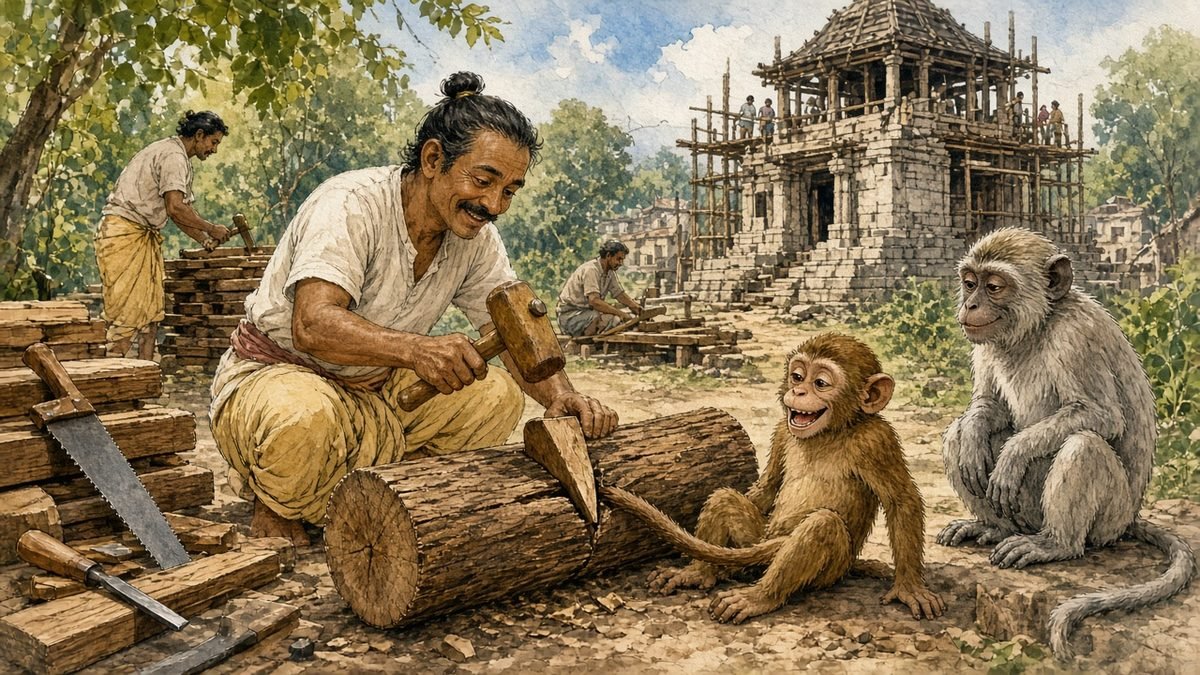
The head carpenter could have been angry. But he wasn’t. He picked up a hammer and a new wedge, and he carefully tapped it into the end of the log, a little at a time. Slowly the two halves creaked apart, just enough. Bandu’s tail slipped free.
Bandu leaped off the log and scrambled up the nearest tree as fast as he could. He sat on a branch and held his tail in his hands. It was sore and bent, and a little tuft of fur was missing from the end, but it would heal.
The carpenter looked up at him and chuckled. “Let that be a lesson, little monkey,” he said. “Leave other people’s work alone.”
His grandmother came and sat next to him on the branch. She didn’t scold him. She didn’t have to.
“I should have listened to you, Grandma,” Bandu said in a small voice.
From that day on, Bandu still watched the carpenters every day. He was still curious about everything. But he watched from up in the tree, and he never touched their tools again.
The End
Moral of the story: Don’t meddle in things that aren’t yours
The Panchatantra uses this fable to warn against getting involved in business that isn’t yours. Bandu had no reason to touch the wedge. He didn’t know what it was for, and it belonged to someone else. Curiosity is a good thing, but when you’re curious about something that isn’t yours, the smart move is to ask or to watch, and to keep your hands to yourself.
What kids can learn from The Monkey and the Wedge
- Leave other people’s things and work alone unless they say it’s okay.
- If you don’t know what something does, ask before you touch it.
- Listen to grown-ups who warn you about something.
- When you make a mistake, it’s okay to say sorry and learn from it.
Questions to talk about with your child
- What is a wedge, and why did the carpenter put it in the log?
- Why did Bandu want to pull out the wedge?
- What did his grandmother tell him? Why didn’t he listen?
- Why do you think the carpenter wasn’t angry with Bandu?
- Is it good to be curious? How can you be curious in a safe way?
Summary: The Monkey and the Wedge
In The Monkey and the Wedge story, carpenters building a temple leave a half-split log with a wedge in it while they go to lunch. A troop of monkeys comes down to play. One curious monkey sits on the log with his tail hanging in the gap and pulls out the wedge. The log snaps shut and traps his tail. In this retelling, the carpenters come back, open the log and set him free, and the monkey learns not to meddle with things that aren’t his.
For another Panchatantra story about a monkey, read The Monkey and the Crocodile. And for a Panchatantra tale about an animal who gets into trouble, try The Blue Jackal.
Read More: The Talkative Tortoise
Frequently asked questions
What is the moral of The Monkey and the Wedge?
Don’t meddle in things that don’t concern you. Leave alone what isn’t yours, especially when you don’t know how it works.
Which book is The Monkey and the Wedge from?
It comes from the first book of the Panchatantra, an ancient collection of Indian fables. In the Panchatantra, a jackal named Karataka tells the story to his friend Damanaka to warn him not to get mixed up in the lion king’s business.
How does the original story end?
In the Panchatantra, the monkey pulls out the wedge, the log snaps shut on him, and he dies. This retelling keeps the trap and the lesson but has the carpenters come back and free the monkey, so he gets a sore tail and a second chance instead. It also gives the monkey a name and adds his grandmother.
What is a wedge?
A wedge is a piece of wood or metal that is thick at one end and thin at the other. Woodworkers tap it into a crack to hold it open or to split wood. It’s one of the simple machines kids learn about in science class.
What age is this story good for?
It works for ages 5 to 12. It’s short and funny for little kids, and older kids can talk about the difference between good curiosity and meddling.