The Three Wishes story is an old folk tale about a poor woodcutter and his wife who are given three wishes and use them in the silliest way possible. Versions of it have been told for hundreds of years. Charles Perrault wrote one in France in 1697, and Joseph Jacobs put an English version in his book More English Fairy Tales in 1894. It’s a funny story with a lesson that sticks.
This retelling for ages 5 to 12 follows the classic plot. The FAQ explains how the older versions go and what was changed. It takes about 8 minutes to read aloud, and it’s a good one to read together by the fire on a winter night.
Part 1: The old oak tree
Once upon a time, in a cottage at the edge of a great forest, there lived a woodcutter named Tom and his wife, Martha. They worked hard every day, but they were poor. Their cottage had one room, one fireplace and one cooking pot, and some nights there wasn’t much to put in it.
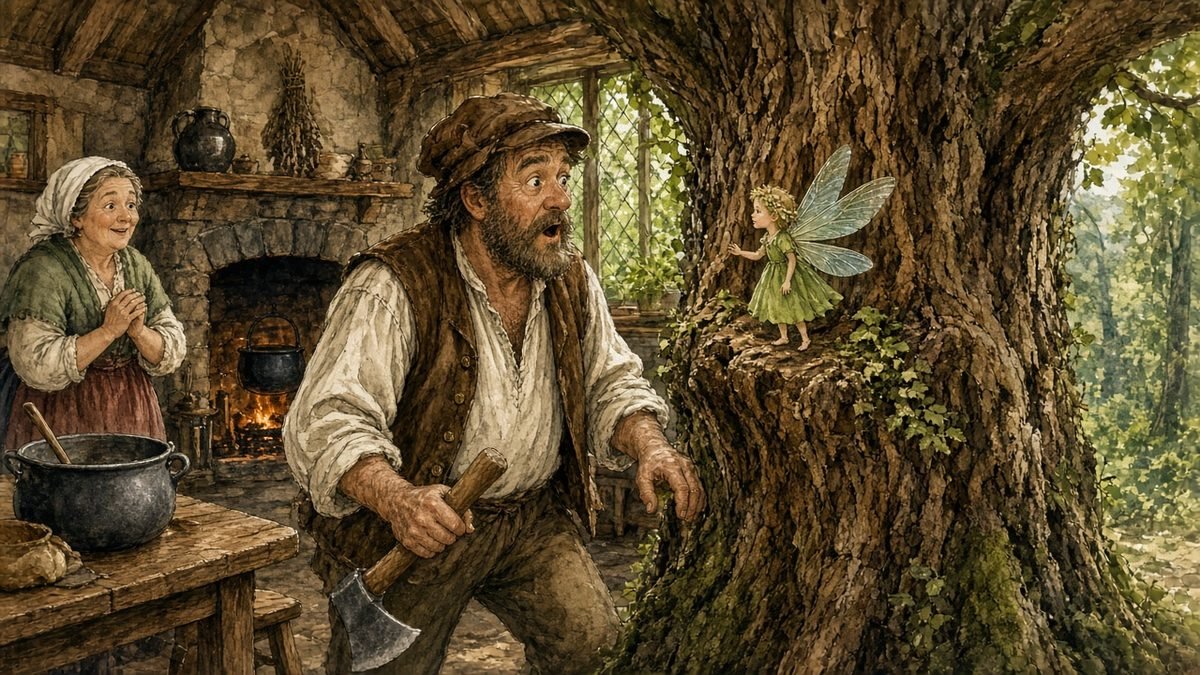
One cold morning, Tom took his ax and went deep into the forest to look for firewood. He walked until he came to an enormous old oak tree. Its trunk was so wide that three men couldn’t have reached around it.
“That tree would keep us warm all winter,” Tom said. He spit on his hands, lifted his ax and swung it back.
“Stop! Please stop!” cried a tiny voice.
Tom lowered his ax and looked around. There, standing on a knot in the bark, was a little fairy no taller than his thumb. She had wings like a dragonfly’s and a dress the color of fresh green leaves.
“Please don’t cut down my tree,” said the fairy. “I’ve lived in it for a hundred years. It’s my home.”
Tom was so surprised he nearly dropped the ax. “Well,” he said, scratching his head, “I wouldn’t want anyone to chop down my home, either. All right. I’ll leave your tree alone and find another.”
The fairy clapped her tiny hands. “Thank you, kind woodcutter! For being so good to me, I’ll give you a gift. The next three wishes you make will come true, whatever they are. But think carefully before you wish.”
And then, with a flash of green light, she was gone.
Part 2: A long day and an empty stomach
Tom stood there for a moment, blinking. “Three wishes,” he said. “Well, I’ll be.”
He found a fallen tree to chop up instead, and he worked all day long. By the time he had tied up his bundle of firewood, the sun was setting and he was very tired. He had been so busy that he forgot all about the fairy.
When he got home, Martha was sitting by the fire. “I’m sorry, Tom,” she said. “There’s not much for supper tonight. Just a bit of bread and some thin soup.”
Tom sat down on his stool and stretched his cold hands toward the fire. His stomach growled. He sniffed the air, but it didn’t smell like much of anything.
“Oh,” he sighed, without thinking, “I wish I had a nice big sausage for supper.”
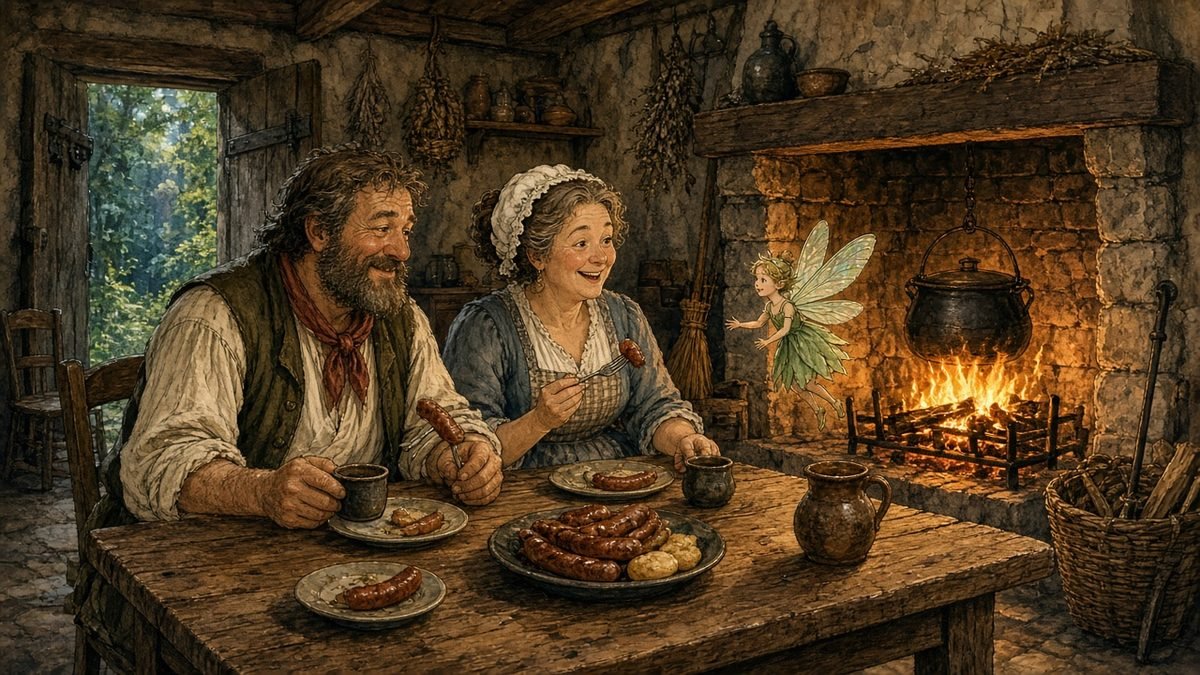
Whoosh! Down the chimney came a puff of sparkly smoke, and there on the table appeared a long, fat, sizzling sausage on a plate. It smelled delicious.
Martha stared at it. “Tom!” she cried. “Where did that come from?”
Part 3: The first wish
All at once, Tom remembered. He told Martha everything: the giant oak, the tiny fairy and the three wishes.
Martha listened with her mouth open. Then she jumped up from her chair.
“Three wishes!” she said. “Tom, we could have wished for anything! A big house! A bag of gold! A field full of cows! And you wasted a whole wish on a sausage!”
“I didn’t mean to,” said Tom. “I forgot.”
“A sausage!” Martha said again, waving her arms. “Of all the foolish things to wish for! You could have had a palace, and instead you have one silly sausage. I can’t believe it. A sausage!”
She went on and on. And the more she went on, the grumpier Tom got. He was tired, he was hungry, and he felt silly enough already.
At last he couldn’t stand it anymore. “Oh, bother the sausage!” he shouted. “I wish the thing were stuck on the end of your nose!”
Part 4: The second wish
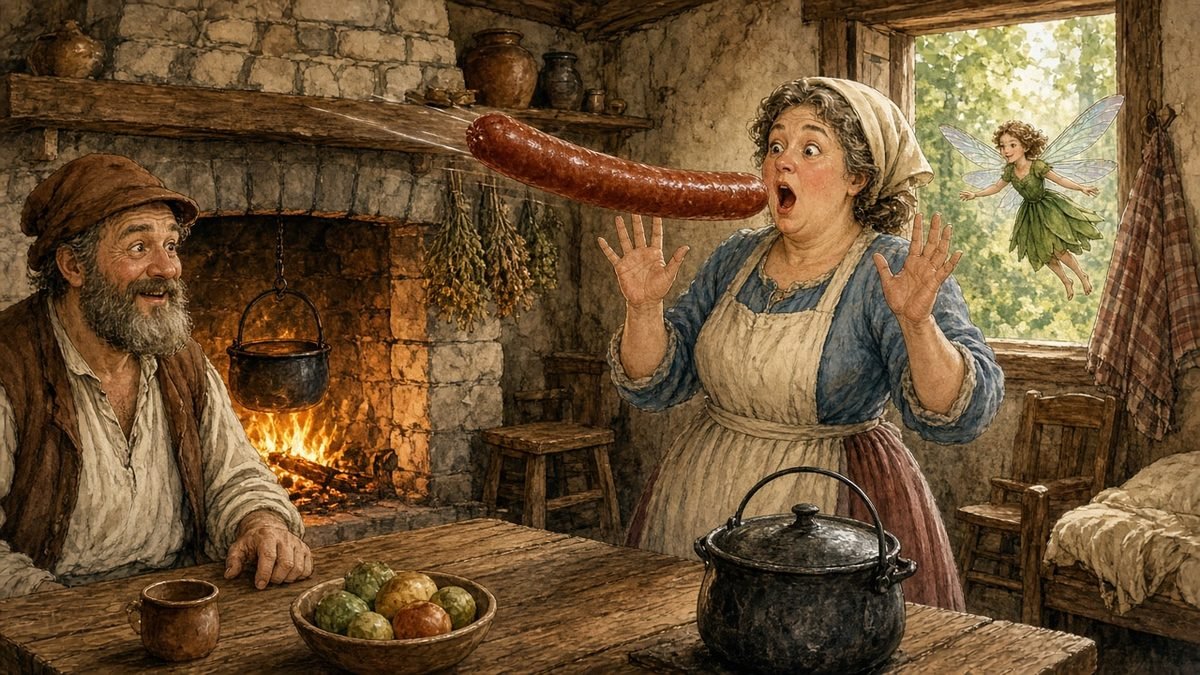
Whoosh! Another puff of sparkly smoke, and the sausage jumped off the plate and flew through the air. It landed right on the end of Martha’s nose, and there it stuck.
Martha squeaked. She grabbed the sausage and pulled. It didn’t budge. She pulled harder. It was stuck tight, as if it had grown there.
“Tom!” she wailed. “Look what you’ve done!”
Tom jumped up. “Oh no. Oh, Martha, I’m sorry! I didn’t mean it!” He took hold of the sausage and tugged. Martha said, “Ow!” He tugged again, gently. It wouldn’t come off.
Martha looked at herself in the bottom of the cooking pot. There she was, with a long, fat sausage dangling from her nose, all the way down past her chin.
“I can’t go around like this!” she cried. “What will the neighbors say? How will I eat? How will I sleep?”
Tom sat down heavily. He felt terrible. “We still have one wish left,” he said slowly.
They looked at each other.
Part 5: The last wish
“We could wish for a bag of gold,” Tom said. “Enough gold to buy a fine house and all the food we could ever want. And then you could wear a gold case over the sausage, and nobody would even notice.”
Martha put her hands on her hips. The sausage swung back and forth. “Tom,” she said, “I would rather be poor with my own nose than rich with a sausage.”
Tom thought about that. Then he nodded. “You’re right,” he said. “You’re the most important thing in this house. More important than any gold.”
So he took a deep breath, held Martha’s hands and said, very carefully, “I wish the sausage would come off Martha’s nose.”
Whoosh! The sausage popped off and landed back on the plate with a plop. Martha touched her nose. It was her very own nose again, just as it had always been.
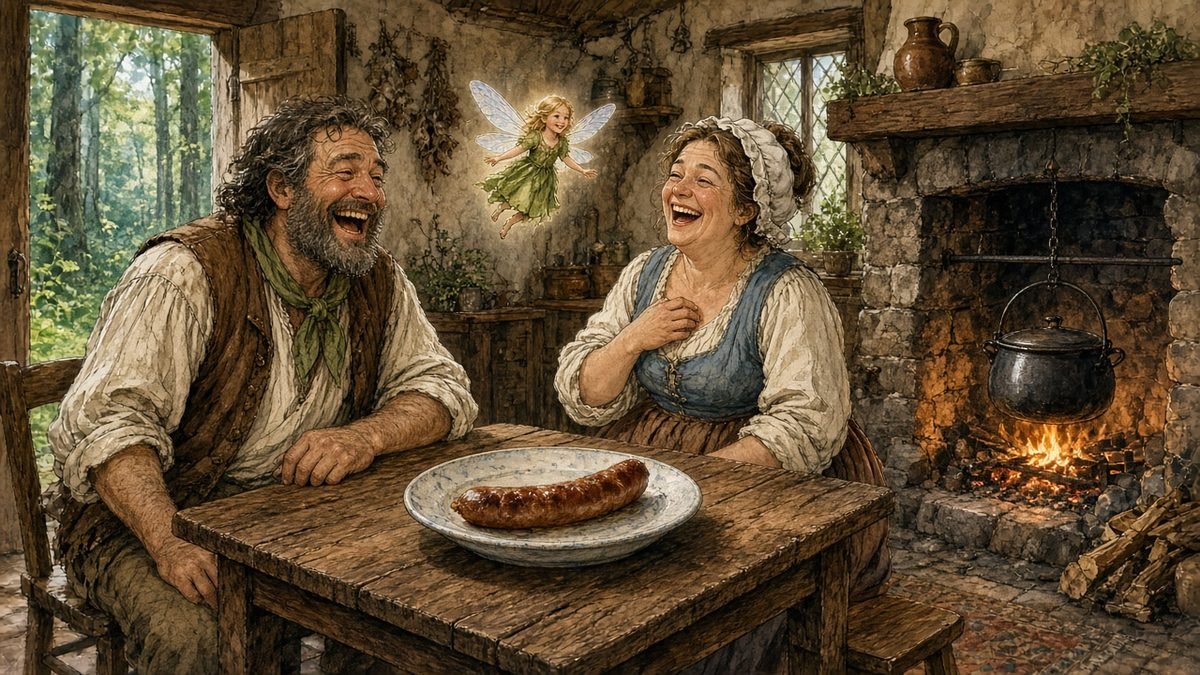
She looked at Tom. Tom looked at her. And then they both started to laugh. They laughed so hard that Tom fell off his stool, and Martha had to hold her sides.
“Well,” said Martha, when she could finally speak, “at least we know where supper came from.”
So they cut the sausage in half and ate it by the fire, along with the bread and the thin soup. It was the best sausage either of them had ever tasted.
They never did get rich. But from that night on, whenever one of them started to grumble or get cross, the other would just tap the end of their nose. And they would both remember the three wishes and laugh all over again.
The End
Moral of the story: Think before you speak
Tom and Martha had three wishes, and they used two of them up by speaking without thinking: once out of hunger and once out of anger. The story is a funny way to show that words said in a hurry, or in a temper, can cause trouble you then have to fix. It also has a second lesson. When they had one wish left, they chose each other over a bag of gold.
What kids can learn from The Three Wishes
- Stop and think before you say something, especially when you’re upset.
- Saying unkind things when you’re angry can make a problem bigger.
- Saying sorry and fixing a mistake is the right thing to do.
- The people we love matter more than money.
Questions to talk about with your child
- Why did the fairy give Tom three wishes?
- Why do you think Tom forgot about the wishes?
- Why did Martha get so upset about the sausage? Why did Tom get upset too?
- Do you think they made the right choice with the last wish? What would you have done?
- If you had three wishes, what would you wish for? How would you make sure not to waste them?
Summary: The Three Wishes
In The Three Wishes story, a poor woodcutter spares a fairy’s tree, and she grants him three wishes. He forgets about them and, feeling hungry at home, wishes for a sausage. His wife scolds him for wasting a wish, and in a temper he wishes the sausage were stuck on her nose. Their last wish has to go to taking it off again. They end up as poor as before, but they learn to think before they speak.
For another story about a fisherman and his wife who are granted wishes, read The Golden Fish. And for a tale about a woodcutter who is rewarded for being good, try The Honest Woodcutter.
Read More: The Elves and the Shoemaker
Frequently asked questions
What is the moral of The Three Wishes?
Think before you speak, and don’t let anger make your choices for you. The story also shows that the people you love are worth more than riches.
Who wrote The Three Wishes?
Nobody knows who first told it. It’s a folk tale with many versions. Charles Perrault wrote a version called The Ridiculous Wishes in 1697, and Joseph Jacobs included The Three Wishes in More English Fairy Tales in 1894.
How does the original story end?
The older versions end the same basic way: the last wish is used to take the sausage off the wife’s nose, and the couple are no richer than before. In Jacobs’s English version, the food is a black pudding, a kind of sausage, and it’s the wife who calls her husband a fool and wishes the pudding onto his nose. In Perrault’s version, the wishes come from the god Jupiter, and the husband wishes the sausage onto his wife’s nose, which is the version this retelling follows. This retelling keeps the ending but makes the argument gentler, has Tom say sorry, and adds the couple laughing and sharing the sausage.
Is The Three Wishes a Christmas story?
No. None of the old versions mention Christmas. With its fireside supper and cold forest, though, it makes a cozy read for a winter night.
What age is this story good for?
It works for ages 5 to 12. Little kids love the sausage on the nose, and older kids can talk about how they would use three wishes.