Androcles and the Lion is an old story about kindness that comes back around. It is often grouped with Aesop’s fables, though a Roman writer named Aulus Gellius also told it long ago. A runaway slave helps a hurt lion in a cave. Years later they meet again in a place neither of them wants to be, and the lion remembers.
This version is written for kids aged 5 to 12 and takes about ten minutes to read aloud. It fits well near Thanksgiving, when families talk about gratitude, and it works any night of the year. After the story you’ll find the moral, questions, a summary and a FAQ.
Part 1: A Boy on the Run
Once upon a time, in a dry, sunny land of olive trees and dusty roads, there lived a boy named Androcles. He was not free. He worked for a hard master who shouted more than he spoke and never said thank you for a job well done.
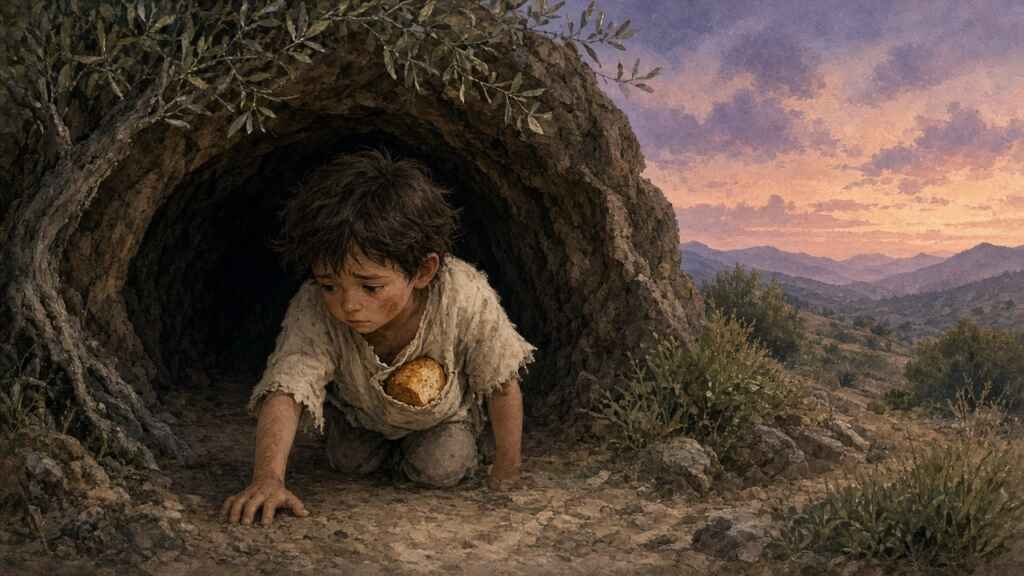
One hot afternoon, when the cicadas buzzed like tiny saws, Androcles could not take it anymore. He slipped through a gap in the fence, tucked a crust of bread into his shirt and ran toward the hills.
He ran until his side ached. He ran until the road turned into a goat path, and the goat path turned into wild scrub. Once he looked back and saw only dust. Once he laughed out loud from pure relief, then covered his mouth, afraid someone might hear. Night came, cool and blue. Stars pricked the sky. Androcles found a dark cave in the side of a rocky hill and crawled inside, hoping for a safe place to sleep.
The cave smelled of cool stone and dry grass. It was not fancy, but it felt safer than any room he had slept in for a long time. He was almost asleep when he heard a sound that made his hair stand up.
It was a groan. A deep, rumbling, unhappy groan.
Part 2: The Lion in the Cave
Androcles sat up fast. At the back of the cave, something large shifted. Two golden eyes opened. A lion. A real lion, with a tangled mane and a paw held awkwardly off the ground.
Androcles wanted to bolt. Every story he had ever heard about lions told him to run. His feet had other ideas and stayed stuck to the cave floor. The lion did not spring. He only groaned again and looked at his paw as if to say, “Do you see this? Do you see how much it hurts?”
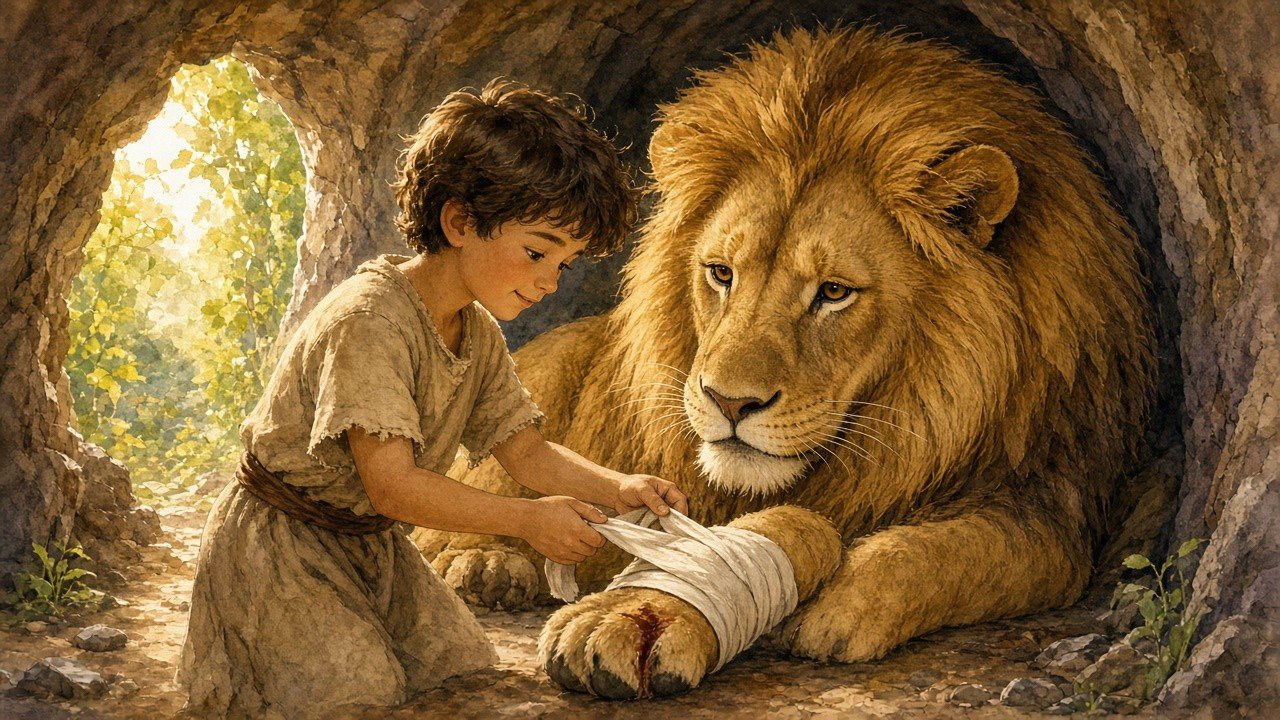
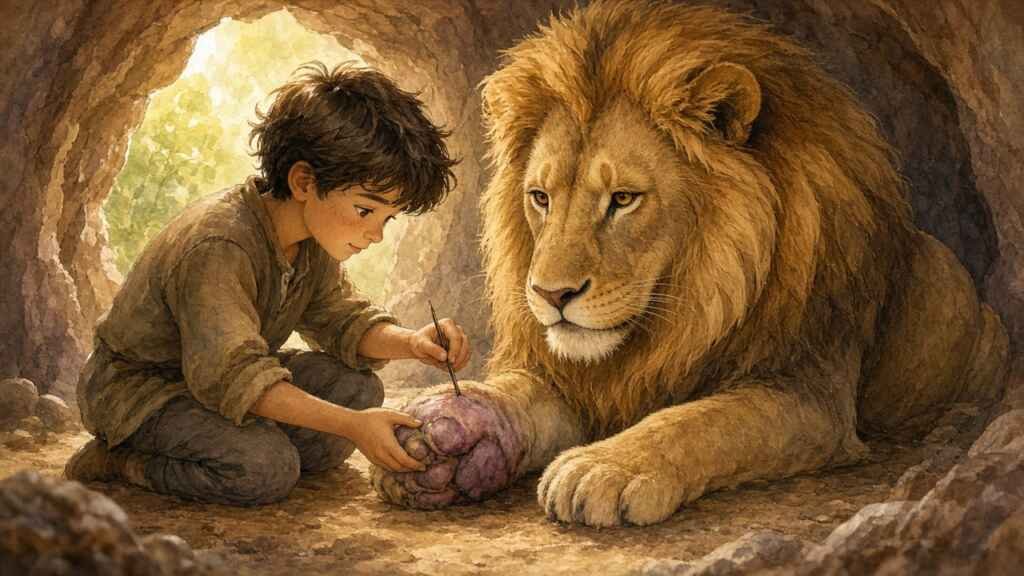
Slowly, very slowly, Androcles scooted closer. Stuck in the soft pad of the lion’s paw was a thick thorn, as long as a finger. The skin around it was red and swollen.
“Easy,” Androcles whispered, the way you talk to a scared dog. “I won’t hurt you. I’m going to help.”
His hands shook. He wiped them on his tunic, then braced himself, pinched the thorn and pulled. The lion jerked and roared once, a short roar that bounced off the cave walls. Then the thorn came free. Androcles wrapped the paw in a strip torn from his own shirt and sat back, heart hammering.
The lion sniffed the bandage. He sniffed Androcles. Then he lay down with a heavy sigh, his big head near the boy’s knees, and went to sleep.
Androcles slept too, somehow. In the morning the lion was still there, calmer, and Androcles shared his crust of bread. They made an odd pair: a skinny boy with dusty knees and a king of beasts with a sore foot. For several days they kept each other company in the cool cave. The lion brought a share of what he hunted and dropped it near the entrance without a growl. Androcles cleaned the paw each morning and talked softly about home, even though home had not been kind. He talked about the taste of ripe figs, about a song his mother used to hum, about how quiet the hills were at dawn. The lion listened the way animals do, with patience and warmth.
Part 3: Caught Again
Kindness does not always keep trouble away. One morning, while Androcles was filling a gourd at a spring, men from the city found him. They grabbed his arms. The lion was off hunting and did not hear the shout.
“A runaway,” one man said. “The master will want him back. And the games will want him too.”
Androcles was taken to the city in chains. The road back felt longer than the road out. In those days, people filled a great stone arena to watch contests. Sometimes the contests were races and music. Sometimes they were cruel. Prisoners were sent into the sand to face wild animals while the crowd cheered from high seats where the sun was kinder.
Androcles sat in a dark cell under the seats and listened to the roar of people he could not see. Water dripped somewhere. A mouse ran along the wall. He thought of the cave. He thought of the lion’s warm breath on his knee. He wondered if anyone in the world remembered him for a good reason, or if kindness was a thing you did and then lost forever.
Part 4: The Arena
The day of the games arrived bright and windy. Flags snapped along the rim of the arena. Guards led Androcles into the open sand. The sun slapped his face. High above, rows of people pointed and shouted. Someone sold roasted nuts. Someone laughed too loud. A gate on the far side of the arena clanged open with a sound like thunder in a bucket.
Out strode a lion. His mane was fuller now, his shoulders thick, but Androcles knew that walk. He knew that face.
The lion saw the boy and stopped so hard that sand sprayed from his paws. The crowd leaned forward, waiting for a charge.
The lion did not charge. He walked forward slowly, as if the sand itself might break. He sniffed Androcles’ hand, then his hair, then rubbed his great head against the boy’s side the way a house cat greets someone it loves. A deep, happy rumble rolled from his chest. Androcles laughed through tears and wrapped his arms around the lion’s neck. On the paw, a pale ring of old scar tissue still marked where the bandage scrap had been.
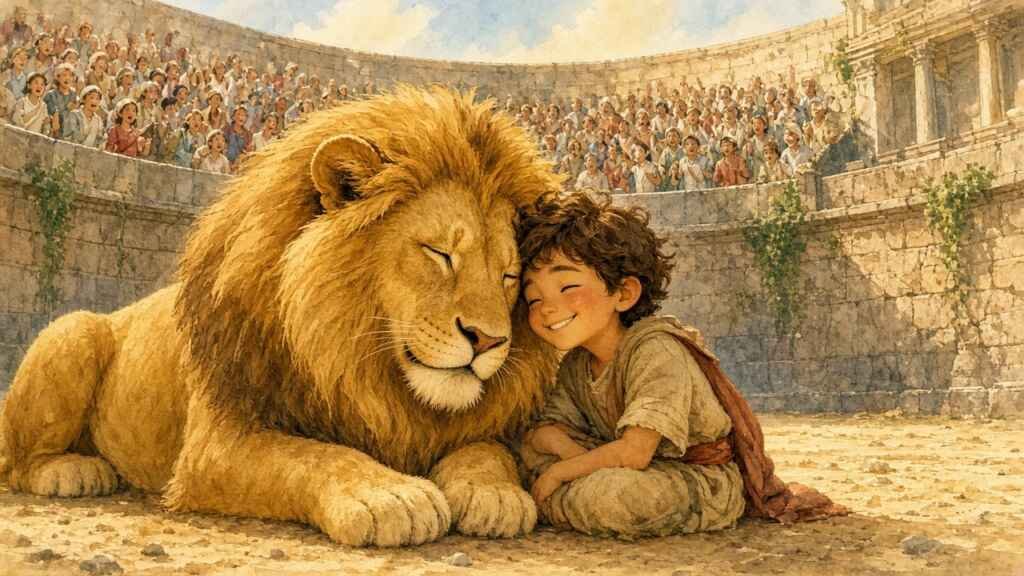
The crowd went quiet, then gasped, then began to clap. Even the emperor in his shaded seat sat up straight.
“What is this?” he called down. “How does a prisoner make a friend of a lion?”
Androcles told the story in a clear voice that carried across the sand: the cave, the thorn, the shared bread, the days of quiet company. The emperor listened. The people listened. When the telling was done, the emperor raised his hand.
“Free the boy,” he said. “Free the lion too. A kindness like that should not be punished.”
Part 5: Walking Out Together
The gates opened a second time, and this time they opened toward the road. Androcles walked out with the lion beside him. Some people tossed flowers. A child waved. Nobody tried to stop them.
They did not go back to the hard master’s house. They did not need a cave anymore either. Androcles found work with a kind farmer at the edge of town, mending fences and minding goats. The farmer’s wife packed extra bread for him without making a speech about it. The lion came and went from the hills as he pleased, but most evenings he appeared at the fence for a scratch behind the ears and a look that said, “I remember.” Sometimes children from the next farm stood on the stone wall to watch, whispering, until the lion flicked an ear and they dissolved into giggles.
On cool nights Androcles told the story to the farmer’s children. He always ended the same way.
“If you can help,” he said, “help. You may not get a parade for it. You may not get anything you can hold. But someday, when you need a friend, the world has a way of sending one you already met.”
The End
Moral of the story: Androcles and the Lion
Kindness is never wasted. A small act of care, given when someone is hurting, can return when you need it most. Androcles pulled out a thorn with no crowd watching. Later, that same care saved his life in front of thousands.
What kids can learn from this fable
- Helping someone smaller or stronger than you still counts. The lion was powerful, yet he needed help.
- Courage can look quiet. Androcles was scared and helped anyway.
- Gratitude means remembering who was good to you.
- People (and lions) notice how we treat them when nobody is keeping score.
Questions to talk about with your child
- Would you have stayed in the cave when you saw the lion? Why or why not?
- Why do you think the lion remembered Androcles after so long?
- What does gratitude look like in your house near Thanksgiving or on an ordinary Tuesday?
- Have you ever helped someone and later been glad you did?
- How did the crowd’s feelings change from the start of the arena scene to the end?
Summary: Androcles and the Lion
Androcles runs away from a hard master and hides in a cave, where he finds a lion with a thorn in its paw. He pulls the thorn out and cares for the wound. Later Androcles is captured and sent into an arena to face a lion. The lion is the same one he helped. Instead of attacking, the lion greets him like an old friend. The emperor frees them both, and Androcles learns that kindness can come back when it matters most.
Read More: The Lion and the Mouse
Frequently asked questions
Who wrote Androcles and the Lion?
The story is ancient. It is often linked with Aesop’s fables and was also written down by the Roman author Aulus Gellius. Later playwrights and storytellers retold it for new audiences.
Is Androcles and the Lion a true story?
It is a legend, not a proven historical report. People tell it because the lesson about kindness and gratitude feels true, whether or not the arena scene happened exactly this way.
What is the moral of Androcles and the Lion?
A common way to say it is “No act of kindness is ever wasted.” Help given freely can return in surprising ways.
Is this a good Thanksgiving or bedtime story?
Yes. The gratitude theme fits Thanksgiving read-alouds, and the ending is gentle enough for bedtime when you use a calm voice for the arena part.
Why do people tell this story near Thanksgiving?
Thanksgiving is a time families talk about what they are thankful for. Androcles and the Lion is about remembering a kindness and answering it with loyalty. That idea sits well beside stories of sharing a meal and saying thank you.