The Honest Woodcutter is an Aesop fable about telling the truth when a lie would be easier. You may also hear it called Mercury and the Woodman, or the story of the golden axe. A poor woodcutter drops his only axe into a river. A spirit of the water offers him a shiny golden axe, then a silver one. What he says next changes everything.
This retelling is for kids aged 5 to 12 and takes about ten minutes to read aloud. After the story you’ll find the moral, questions to talk about, a summary and a FAQ.
Part 1: One Axe and a Long Day
Once upon a time, beside a clear green river that ran under tall pine trees, there lived a woodcutter named Tomas. He was not rich. His cottage had one room, a crooked chimney and a garden that grew more weeds than carrots. What he did have was a strong back, a kind heart and one good axe with a wooden handle worn smooth by years of work. He had named the axe nothing fancy. He just called it “old friend” when nobody was listening.
Every morning Tomas walked into the forest, found fallen trunks and cut them into firewood. He stacked the wood, tied it with rope and sold it in the village. Some days he earned enough for bread and cheese. Some days he earned enough for bread alone. On market days he nodded to the baker’s children and saved the heel of the loaf for the sparrows behind his shed. He never complained out loud, though sometimes he whistled a little off-key to keep himself company.
One bright morning the sun flashed on the river like a tray of coins. Tomas climbed onto a flat rock at the water’s edge to trim a branch. He swung. The axe bit wood. He swung again.
On the third swing, his sweaty hands slipped.
The axe flew from his fingers, spun once in the air and splashed into the deepest part of the river. Ripples raced outward. Then the water went smooth again, as if nothing had happened.
“No!” Tomas cried. He dropped to his knees and peered in. He rolled up his sleeve and reached as far as he dared. Cold water bit his skin. The river was clear near the edges and dark in the middle. He could not see the bottom. He could not see his axe.
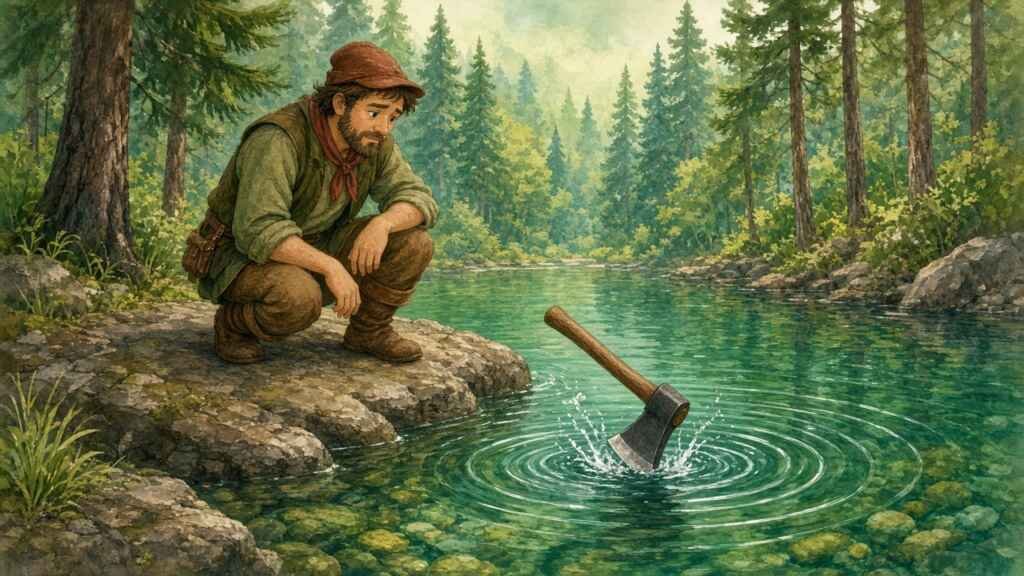
Without that axe, he could not cut wood. Without wood, he could not buy food. Tomas put his face in his hands and did something he almost never did. He cried.
Part 2: The Spirit of the River
A soft light rose from the water, like sunrise caught in a jar. Dragonflies paused mid-air. From the light stepped a tall figure in a cloak the color of wet stones. Some people call this spirit Mercury. Some call him Hermes. Tomas only knew that the figure’s eyes were kind and that the river seemed to hush around him, as if the current itself were listening.
“Why are you weeping, woodcutter?” the spirit asked.
Tomas wiped his nose on his sleeve, a little embarrassed. “I dropped my axe,” he said. “It was the only one I had. I work with it every day. Now it’s gone, and I don’t know what I’ll do.”
The spirit smiled. “Wait here.”
He sank into the water without a splash. A minute later he rose again, holding an axe that shone like the sun. The head was pure gold. The handle was carved with tiny leaves. It was the most beautiful tool Tomas had ever seen.
“Is this your axe?” the spirit asked.
Tomas’s mouth fell open. For one heartbeat he pictured saying yes. A golden axe would buy his cottage three times over. It would buy a new garden, a straight chimney and warm coats for winter. All he had to do was nod. The word sat on his tongue like a coin he was not sure he should spend.
He shook his head.
“No, sir,” he said. “That one isn’t mine. Mine was plain iron, with a handle polished by my own hands. Thank you for looking, though.”

Part 3: Silver and Iron
The spirit’s smile deepened. He sank again. When he rose, he held an axe of shining silver. It gleamed like moonlight on snow.
“Is this yours?”
Tomas felt the pull of wanting so strongly that his fingers twitched. Silver was still more wealth than he had touched in his whole life. He thought of his empty bread box. He thought of the hole in his boot. He thought of how easy it would be to say the axe had “always been a bit shiny in the right light.”
“No,” he said, and his voice was steady. “That isn’t mine either. Mine had a nick on the blade from a stubborn oak stump. I’d know it anywhere.”
Down went the spirit a third time. When he came up, he held Tomas’s own axe, wet and ordinary and perfect. The nick on the blade caught the light.
“Is THIS your axe?” the spirit asked, though his eyes said he already knew.
“Yes!” Tomas laughed, jumping up. “Yes, that’s the one. Thank you. Thank you a hundred times.”
He reached for it. The spirit held up a hand.
“Because you told the truth when a lie would have made you rich,” the spirit said, “these are yours as well.”
He set the golden axe and the silver axe on the rock beside the iron one. Tomas stared. His hands shook.
“I don’t understand,” he whispered.
“Honesty is rarer than gold,” said the spirit. “Use them well.”
Then the light folded into the river, and Tomas was alone with three axes and a heart so full it hurt.

Part 4: News Travels Fast
Tomas walked home carefully, carrying all three axes as if they might vanish if he jogged. In the village he told the story to the baker, who told the blacksmith, who told a man named Greb who lived two doors down and liked shortcuts.
Greb listened with narrowed eyes and a smile that never reached them. “A spirit who hands out gold for crying?” he muttered. “We’ll see about that. Some people get lucky. Some people make luck.”
The next morning Greb took his own axe to the same rock. He did not slip by accident. He flung his axe into the river on purpose, then sat down and forced out a few loud, fake sobs.
The light rose. The spirit appeared.
“Why are you weeping?”
“Oh, woe,” Greb moaned. “My only axe is gone. Whatever shall I do?”
The spirit sank and returned with the golden axe.
“Is this yours?”
“Yes!” Greb snatched at the air. “Yes, that’s mine! Give it here!”
The spirit’s face went still as winter water. He did not hand over the gold. He did not offer silver. He did not even return Greb’s own axe.
“A person who lies for gold,” the spirit said quietly, “deserves none of it.”
Then he was gone. Greb stared at the empty river until his knees got sore. A fish jumped, unimpressed. He walked home with empty hands and a face as red as a boiled beet. For weeks he crossed the street when he saw Tomas, and Tomas, being Tomas, still nodded hello. Once he even offered Greb a spare wedge of cheese. Greb took it, mumbled thanks and looked at his boots.
Part 5: What Tomas Did With the Gift
Tomas did not hang the golden axe on his wall to show off. He sold the gold and silver to a fair merchant in the next town and kept his iron axe for work, because it fit his hands. With the money he fixed his chimney, patched his roof, planted a real garden and put a little aside for hard winters.
He still cut wood most mornings. He still whistled off-key. On Sundays he left a small stack of free kindling by the widow’s gate without leaving a note. But now, when village children asked why the river sparkled so brightly near his rock, he told them the whole story, ending with the same line every time.
“The gold was nice,” he said. “The truth felt better.”
The End
Moral of the story: The Honest Woodcutter
Honesty is better than riches gained by a lie. Tomas could have claimed the golden axe and walked away wealthy. Because he told the truth, he received more than he lost, and he could sleep at night without a secret poking him awake.
What kids can learn from this fable
- Telling the truth can be hard when a lie looks shiny.
- People notice patterns. Greb’s grabby answer showed who he was.
- Real tools, and real habits, often matter more than fancy ones.
- Being honest once makes the next honest choice easier.
Questions to talk about with your child
- What would you have said when you saw the golden axe?
- Why did the spirit test Tomas more than once?
- How was Greb’s plan different from Tomas’s accident?
- Have you ever told the truth when fibbing would have been easier? How did it feel afterward?
- What do you think Tomas meant by “The truth felt better”?
Summary: The Honest Woodcutter
A poor woodcutter named Tomas drops his only axe into a river and weeps. A river spirit offers him a golden axe, then a silver one. Tomas says neither is his. When the spirit returns the plain iron axe, he also gives Tomas the gold and silver as a reward for honesty. A greedy neighbor tries the same trick with a lie and loses everything. Tomas uses his gift wisely and keeps telling the truth.
Read More: The Mice That Ate Iron
Frequently asked questions
Who wrote The Honest Woodcutter?
It is one of Aesop’s fables. Older English versions often call it Mercury and the Woodman, because the messenger god Mercury (Hermes in Greek) is the spirit who rises from the water.
What is the moral of The Honest Woodcutter?
Honesty is the best policy. Truthfulness brings better rewards than a clever lie, even when the lie looks like a shortcut to gold.
Is the golden axe magic?
In the story it is a test and a gift. Whether you picture real gold or enchanted metal, the point is the choice Tomas makes before he knows there will be a reward.
Is this a good bedtime story?
Yes. It has a clear problem, a gentle spirit, a funny greedy neighbor and a warm ending. Kids like guessing what Tomas will say each time the spirit rises.
What happened to Greb’s own axe?
In many tellings the spirit keeps it as part of the lesson. Greb learns that a lie can cost you even the ordinary thing you already had.