The Mice That Ate Iron is a clever little story from the Panchatantra, the famous collection of Indian fables that wise teachers have shared for more than two thousand years. It’s about a merchant who tells a ridiculous lie to keep something that isn’t his, and a friend who beats him at his own game by telling an even sillier one right back.
Kids love the moment when the truth finally comes out in front of the judge. This retelling is written for children aged 5 to 12 and takes about ten minutes to read aloud. In some old versions the boy in the story is shut in a cave, which can worry young listeners. In ours, he is safe and having fun the whole time. After the story you’ll find the moral, questions to talk about, a summary and a short FAQ.
Part 1: The Family Scale
Once upon a time, in a busy town in India, there lived a young merchant named Jirnadhana. He was tall and thin, with a bright blue turban and a white kurta, and he was honest in everything he did.
Jirnadhana had once been well off, but times had been hard. His shop was empty, his money was gone, and almost the only valuable thing he still owned was his family’s weighing scale.
It was a big, old-fashioned balance made of solid iron, with two shiny brass pans hanging from chains. His grandfather had used it, and his father had used it after that. It was so heavy that it took two strong people to lift it.
“I can’t stay here with nothing to do,” Jirnadhana said one day. “I’ll travel to faraway cities, trade there and earn my fortune again. But I can’t carry this heavy scale across mountains and deserts. I’ll have to leave it with someone I trust.”
So he went to see a merchant named Seth Dhanpal, who owned the biggest shop on the street. Seth Dhanpal was a round, cheerful-looking man with a curly black mustache, an orange turban and a green vest stretched tight over his belly.
“My friend,” said Jirnadhana, “will you keep my family’s scale safe until I come back?”
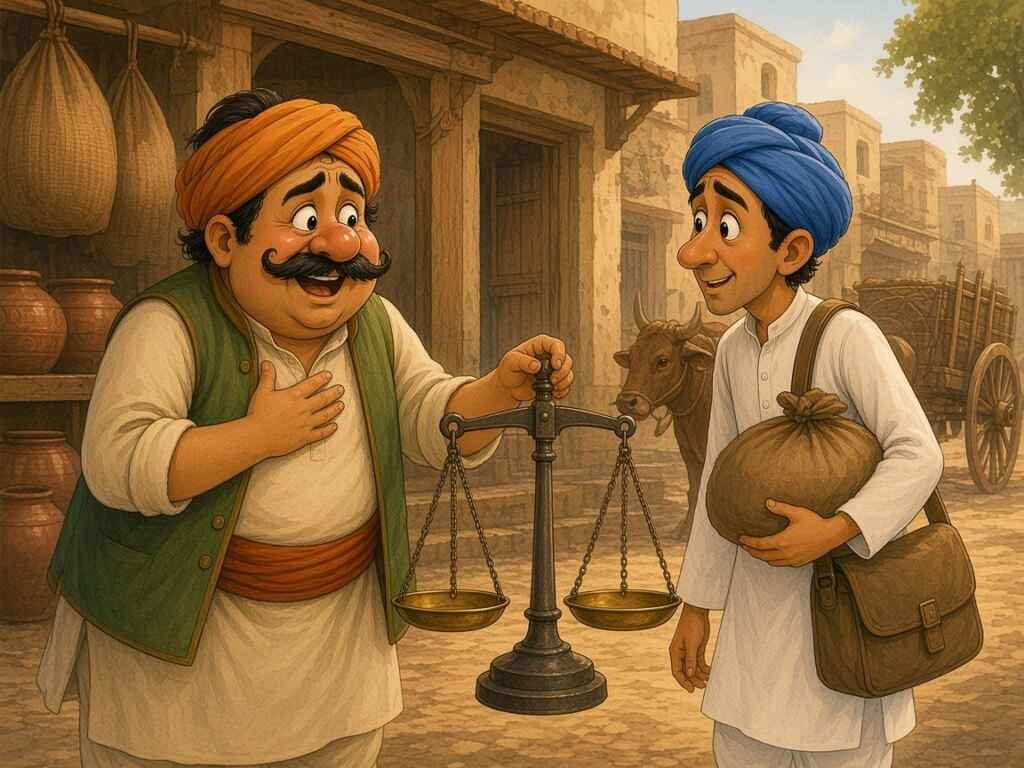
Seth Dhanpal put his hand on his heart. “Of course! Leave it with me. I’ll guard it as if it were my own. When you come back, it will be waiting for you.”
Jirnadhana thanked him, picked up his bundle and set off on his long journey.
Part 2: Where Is the Scale?
Jirnadhana traveled for a long time. Little by little he saved up enough money to start again.
At last, after many months, he came back to his hometown. The first thing he did was knock on Seth Dhanpal’s door.
“Welcome home!” said Seth Dhanpal, a little too loudly. “How was your trip?”
“Very good, thank you,” said Jirnadhana. “I’ve come to collect my scale. I need it to open my shop again.”
Seth Dhanpal’s smile wobbled. He looked at the floor. He looked at the ceiling. Then two big fake tears rolled down his cheeks.
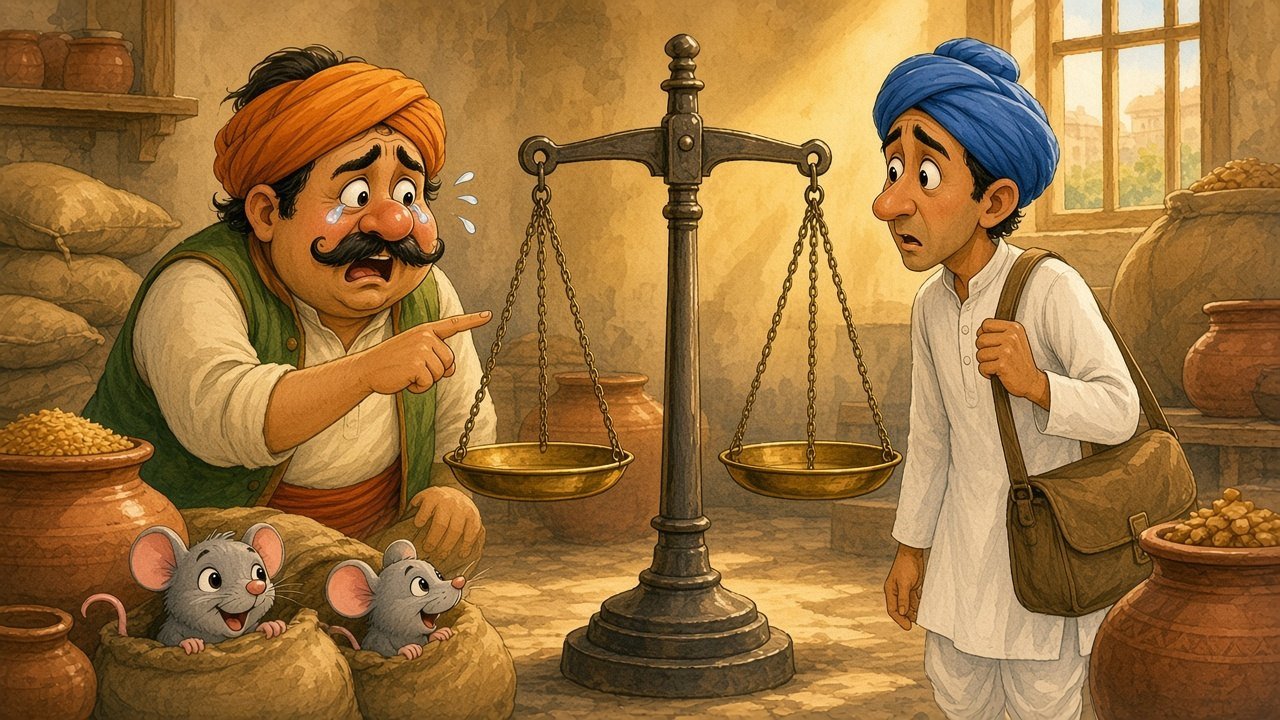
“Oh, my dear friend,” he sobbed. “I have terrible news. I kept your scale in my storeroom, just as I promised. But the mice got in. And they ate it.”
Jirnadhana raised his eyebrows. “The mice ate it?”
“Every last bit!” wailed Seth Dhanpal. “The chains, the pans, the big iron pole, all of it. Those mice must have had very strong teeth. There’s nothing left but a few crumbs.”
Behind a sack of grain, two little gray mice poked their heads out and looked at each other in surprise. They had only ever eaten a few grains of rice in their whole lives.
Jirnadhana knew perfectly well that mice can’t eat iron. He knew Seth Dhanpal had sold the scale or hidden it away. But he didn’t shout, and he didn’t argue. He just nodded slowly.
“Well,” he said calmly, “if the mice ate it, there’s nothing anyone can do. Things like that happen.”
Seth Dhanpal could hardly believe his luck.
Part 3: A Trip to the River
“I’m going down to the river to wash off the dust from my trip,” said Jirnadhana. “Could your son come along and carry my things? I’ll bring him back in time for supper.”
Seth Dhanpal was so relieved that he didn’t think twice. “Gopal!” he called. “Go with our friend to the river and help him.”
Gopal was ten years old and full of energy. He had shiny black hair, a big smile and a yellow kurta that was always getting grass stains on it.
Not far from the riverbank, there was a cool, shady cave in the rocks. Jirnadhana stopped there.
“Gopal,” he said, “how would you like to play a game? It’s a hide-and-seek game, but a special one. You’ll hide in this cave until tomorrow morning, and I’ll make sure everyone wonders where you are. My cousin lives just over there. He’ll check on you, bring your supper and stay with you tonight.”
He opened his bag and handed Gopal a basket of sweet laddoos and a bright red kite.

Gopal’s eyes went wide. “A whole night of camping by the river? With laddoos? And a kite?”
“Deal!” laughed Gopal.
Part 4: The Hawk That Carried Off a Boy
That evening, Jirnadhana walked back into town alone.
Seth Dhanpal was waiting at his door. “Where’s Gopal?” he asked.
Jirnadhana pulled a long, sad face, just as Seth Dhanpal had done that morning.
“Oh, my dear friend,” he said. “I have terrible news. We were standing by the river when a huge hawk swooped down from the sky. It grabbed Gopal by his kurta and carried him away, up over the trees and out of sight.”
Seth Dhanpal’s mouth fell open. “A hawk? Carried off my son? That’s impossible! A hawk can’t carry a boy who’s ten years old! He weighs nearly as much as a sack of flour!”
Jirnadhana just shrugged. “I saw it with my own eyes.”
“You’re lying!” shouted Seth Dhanpal, turning as red as a tomato. “I’m taking you to the judge!”
Part 5: In Front of the Judge
The next morning, the whole town crowded into the court hall to see what all the fuss was about.
The judge was a wise old man with a long white beard and a white turban. He sat on a red cushion and listened carefully.
“Your Honor!” cried Seth Dhanpal, waving his arms. “This man took my son to the river, and now he says a hawk carried him away! Everybody knows a hawk can’t lift a boy. Make him give me back my son!”
The judge turned to Jirnadhana. “Is this true?”
“Yes, Your Honor,” said Jirnadhana politely. “A hawk carried him off.”
“But how can a hawk carry away a boy?” asked the judge.
Just then, as if it had been waiting for its cue, a real hawk flew past the window. Jirnadhana pointed up at it.
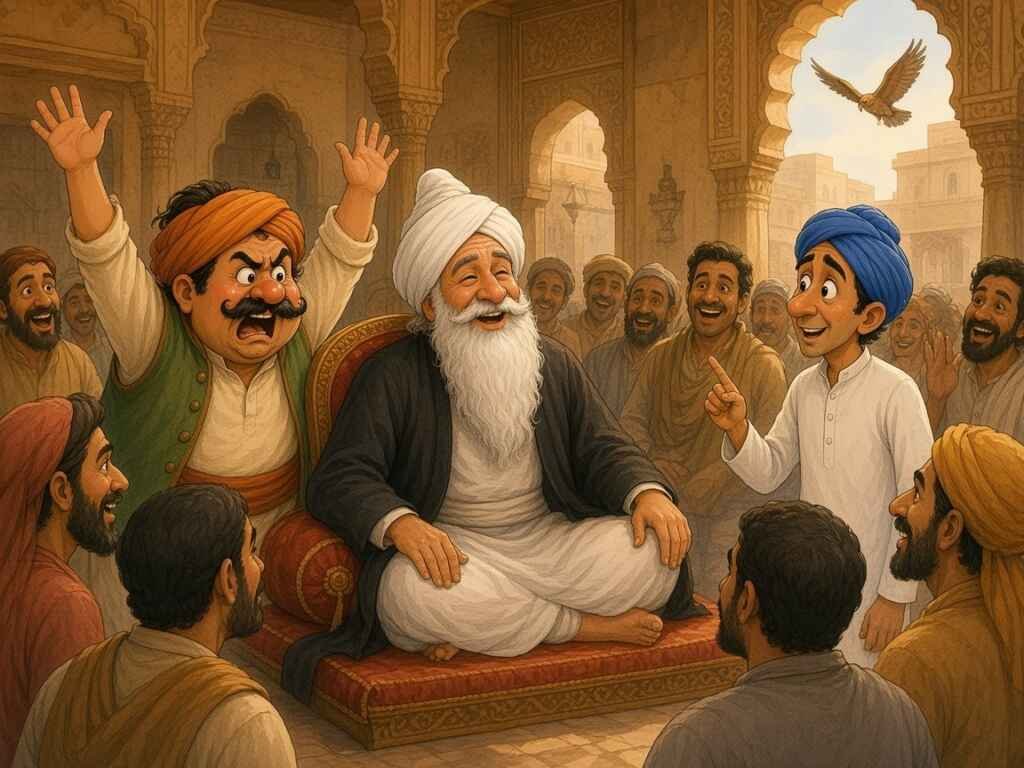
“Your Honor,” he said, “in a town where mice can eat an iron scale, why can’t a hawk carry away a boy?”
The court hall went very quiet.
Then the judge asked, “What scale?”
So Jirnadhana told the whole story: how he had left his family’s iron scale with Seth Dhanpal, and how Seth Dhanpal had told him the mice ate it.
For a moment, nobody said anything. Then someone at the back started to giggle. Someone else snorted. And soon the whole crowd was roaring with laughter, and even the judge was chuckling into his beard.
Seth Dhanpal’s face went from red to purple to pale. He had been caught in his own trap.
Part 6: Everything Comes Back
When the laughter died down, the judge stroked his beard and spoke.
“Seth Dhanpal, you will give Jirnadhana back his scale. And Jirnadhana, you will give Seth Dhanpal back his son.”
Seth Dhanpal hung his head. “The scale is in the back of my storeroom,” he mumbled. “Under some old blankets. I was going to sell it.”
He sent his servants to fetch it, and there it was: the big iron scale, the chains and the shiny brass pans, without a single nibble mark anywhere.
Meanwhile, Jirnadhana walked down to the river and called into the cave. “Gopal! The game is over!”
Out came Gopal, with Jirnadhana’s cousin right behind him. The boy was sticky with laddoo crumbs and grinning from ear to ear. “That was the best game ever,” he said. “Can we play again next week?”
Seth Dhanpal hugged his son tight. Then he turned to Jirnadhana, his ears pink with embarrassment.
“I’m sorry,” he said. “I was greedy, and I told a foolish lie. I thought you’d never notice.”
Jirnadhana set up his shop again with his family’s scale, and it was soon busy with customers. Gopal visited him often to hear more stories. And Seth Dhanpal never again blamed the mice for anything.
The End
Moral of the story: The Mice That Ate Iron
A silly lie can be answered with a silly lie of its own, and the truth will come out in the end. If you’re dishonest with people, don’t be surprised when they find a clever way to show you what you’ve done. It’s better to be honest from the start.
What kids can learn from this story
- Be honest about other people’s things. Seth Dhanpal was trusted with something precious and tried to keep it.
- Silly excuses rarely work. Mice can’t eat iron, and everyone knew it.
- Stay calm when someone is unfair. Jirnadhana didn’t yell or fight. He used his brain to solve the problem.
Questions to talk about with your child
- Why do you think Seth Dhanpal said the mice ate the scale? Did he really think anyone would believe him?
- Why didn’t Jirnadhana just shout at him or call him a liar right away?
- How did Jirnadhana’s hawk story help the judge understand the truth?
- Have you ever made a silly excuse? What happened?
Summary: The Mice That Ate Iron
Before going on a long trip, a merchant named Jirnadhana leaves his family’s heavy iron scale with another merchant, Seth Dhanpal. When he comes back, Seth Dhanpal says the mice ate it. Jirnadhana pretends to believe him, then takes Seth Dhanpal’s son Gopal to the river, where the boy happily hides in a cave for a night of fun with a basket of sweets and a kite. Jirnadhana tells Seth Dhanpal a hawk carried the boy away. In front of the judge, Jirnadhana asks why a hawk can’t carry a boy in a town where mice eat iron. The truth comes out, and each man gets back what belongs to him.
Read More: The Talkative Tortoise: A Panchatantra Story About Thinking Before You Speak
Frequently asked questions
Where does The Mice That Ate Iron come from?
It comes from the Panchatantra, an ancient collection of Indian fables traditionally credited to a teacher named Vishnu Sharma. The story appears in the first book of the collection, which is about how friendships can be broken.
Was the boy in danger in the story?
Not in this version. Gopal thinks it’s a hide-and-seek game, has snacks and a kite, and has a grown-up with him all night. In older tellings, the boy is simply left in a cave. We changed that part so young listeners don’t worry about him.
What is the moral of The Mice That Ate Iron?
The moral is that dishonesty usually catches up with you, and that a calm, clever answer can expose a lie better than shouting. It also teaches kids to be trustworthy when someone leaves something in their care.
What age is this story good for?
This version is written for children aged about 5 to 12. Younger kids enjoy the silly idea of mice chewing up iron, and older kids enjoy figuring out Jirnadhana’s plan before the judge does.