The Pigeons and the Hunter story comes from the Panchatantra, the old collection of animal tales from India. A flock of hungry pigeons spots a feast of rice on the forest floor and lands in a trap. They’re stuck in a net, and they can’t free themselves one by one. It’s one of the best-known stories about teamwork.
The tale is usually told with a pigeon king named Chitragriva, which means “Spotted Neck,” and a mouse named Hiranyaka. This retelling is for kids ages 5 to 12 and takes about 7 minutes to read aloud. It stays close to the original, with a hungry bird-catcher who goes home empty-handed.
Part 1: Rice in the forest
Long ago, in a big forest in India, there lived a flock of pigeons. Their king was a wise, kind pigeon named Chitragriva. He had a spotted gray patch around his neck, and that’s how he got his name.
Every morning, Chitragriva led the flock out to find food. The pigeons flew over fields and rivers, and they stayed together, wing to wing, so nobody got lost.
One morning, they were flying over a quiet part of the forest when the youngest pigeon cried out. “Look down there! It’s rice!”
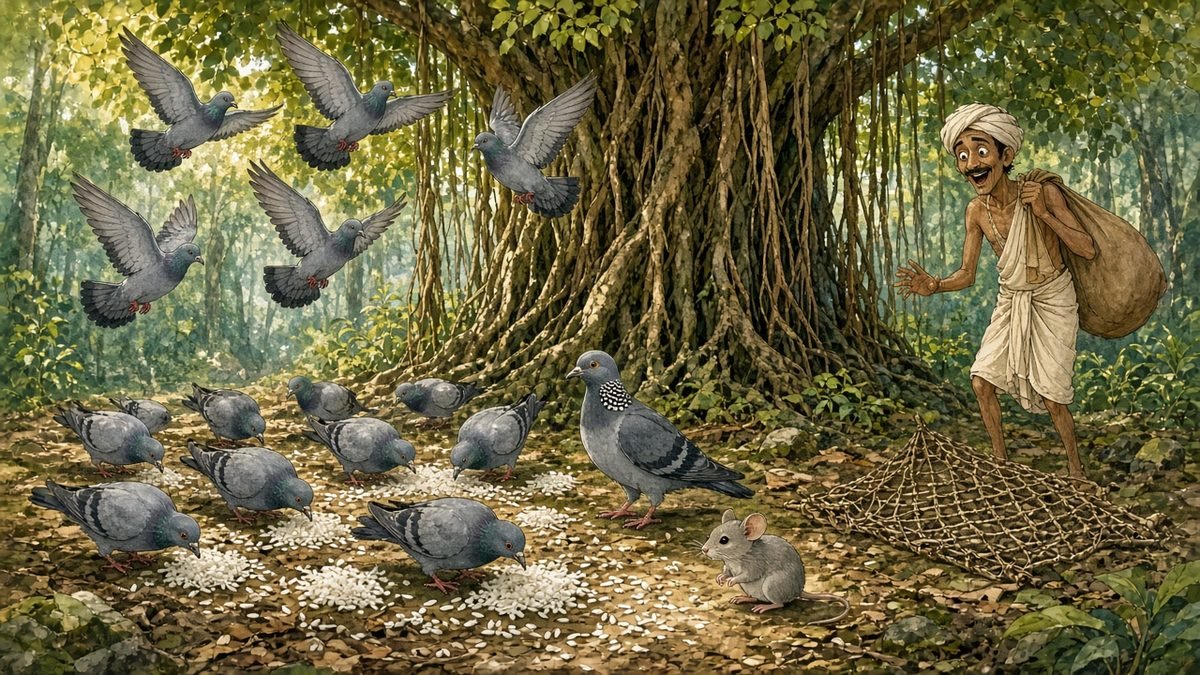
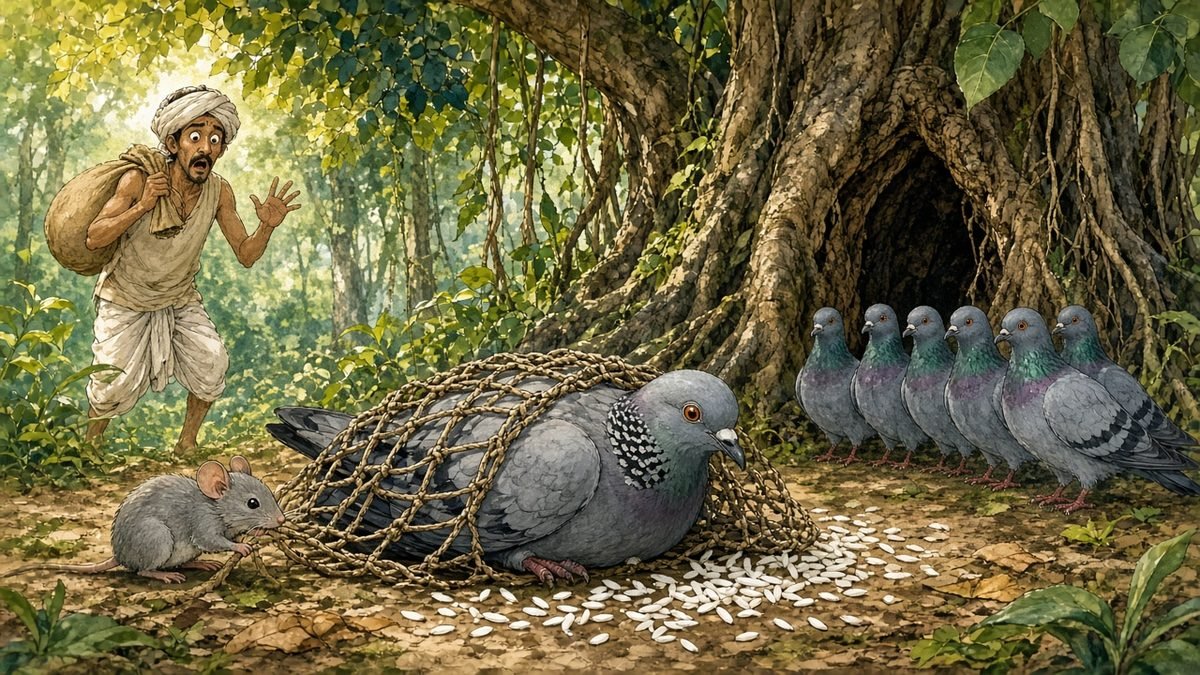
Under a big banyan tree, white grains were scattered all over the ground. There were hundreds of them, glittering in the sun.
“What a feast!” said one of the pigeons. “We haven’t had a meal like this in weeks!”
Chitragriva circled the tree and frowned. “Wait,” he said. “It’s strange to find so much rice in the middle of a forest. Nobody has planted a field here. Who would leave all this food on the ground?”
“Oh, who cares?” said a hungry pigeon. “It’s a gift! Let’s eat before something else finds it.”
Part 2: Stuck in the net
Chitragriva should have trusted his worry, but all the other pigeons were hungry, and he was hungry, too. He took one more look around and saw nothing dangerous. At last, he nodded.
“All right,” he said. “But stay close.”
One by one, the pigeons fluttered down and began to peck at the rice. The grains were sweet, and the birds were so busy eating that nobody noticed the thin, strong strings hidden in the grass.
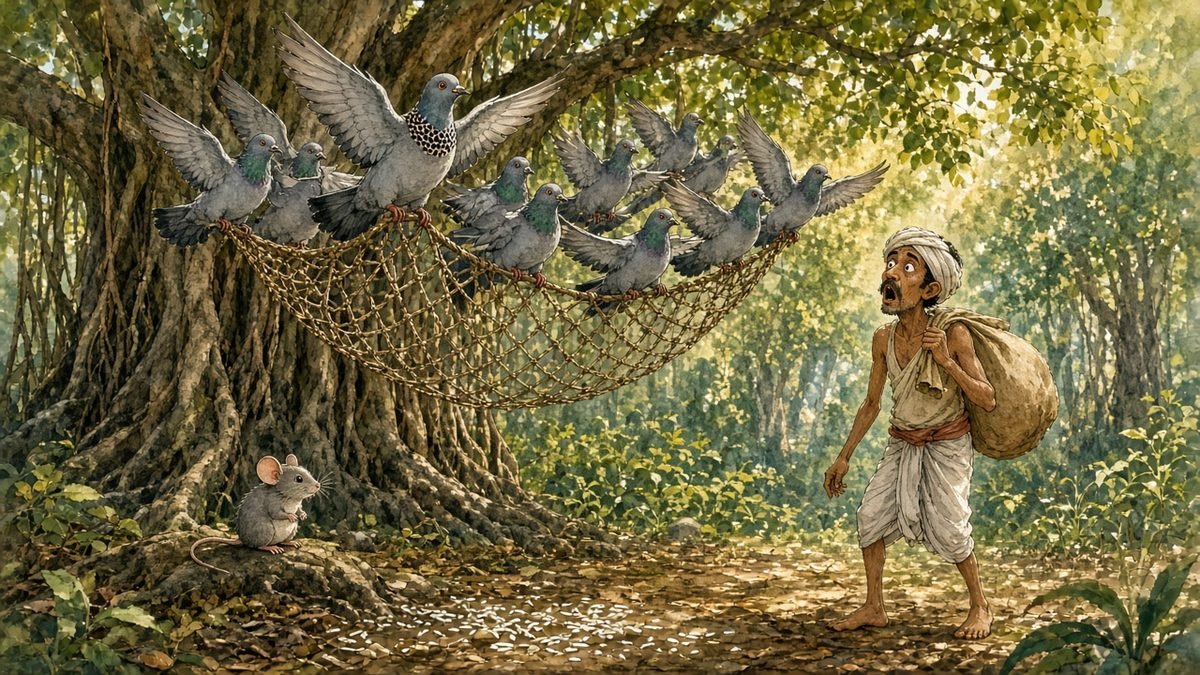
Then, suddenly, a net came down over the whole flock. Whoosh!
The pigeons flapped and flapped, but every time they pushed against the net, they were tangled up even more. Feathers flew. Some of the birds started to cry.
“This is your fault!” one pigeon shouted at another. “You said to land first!”
“I did not! You were the one who said it was a gift!”
In the distance, they heard footsteps crunching on the leaves. A bird-catcher was coming to check his trap. He carried a big sack over his shoulder, and he was smiling.
Part 3: One plan for everyone
“Stop it, all of you!” said Chitragriva, in a loud, clear voice. “Arguing won’t help. We were greedy, and now we need to think. The only way out of this is to work together.”
The pigeons went quiet. Everyone looked at their king.
“Listen carefully,” he said. “One pigeon alone could never lift this net. But the net isn’t heavy if all of us lift it at the same moment. When I say ‘now,’ everyone flap hard, and we’ll fly up together, carrying the net with us.”
“But where will we go?” asked a little pigeon.
“To my friend Hiranyaka the mouse,” said Chitragriva. “He lives in a burrow not far from here, and he has the sharpest teeth in the forest. He can chew through the strings.”
The bird-catcher was getting closer. His shadow was falling across the grass.
“Ready?” called Chitragriva. “One, two, three, NOW!”
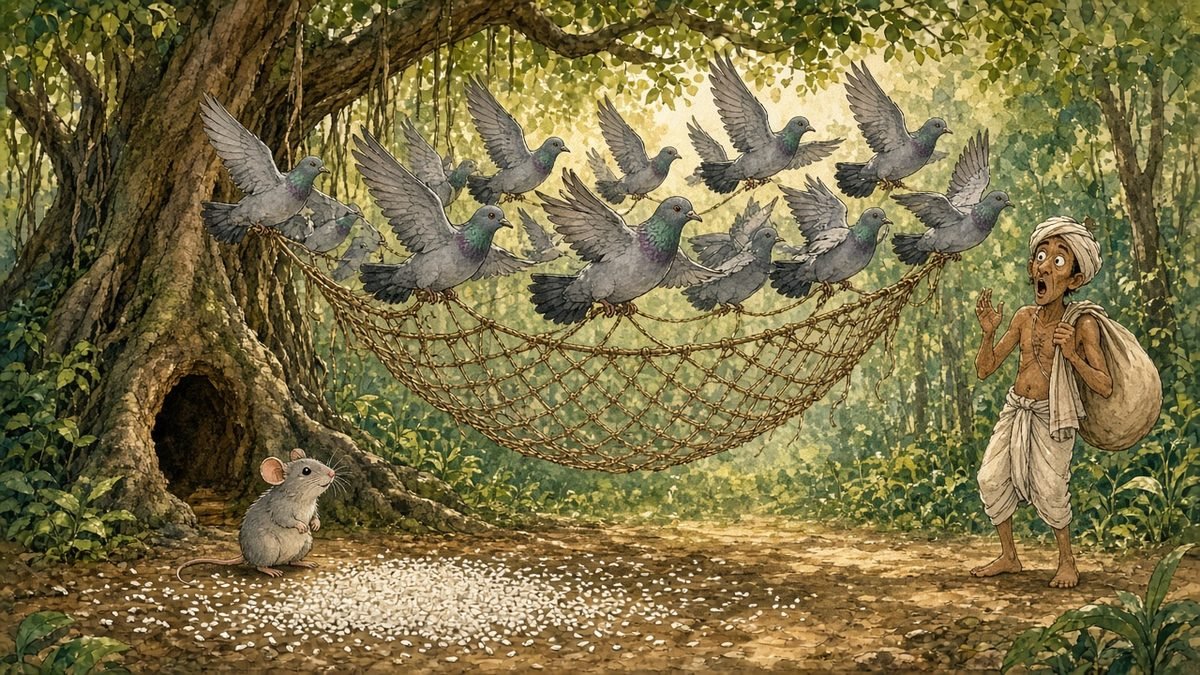
Every pigeon beat its wings at once. The net quivered, lifted and rose off the ground with all of them inside it. They soared above the treetops, flapping as one.
The bird-catcher dropped his sack and stared up at the sky. “My net!” he shouted. “Come back!”
He ran after them for a while, but the pigeons were too fast. At last, he stopped, out of breath, and watched his net fly away until it was a tiny dot above the trees.
Part 4: Hiranyaka the mouse
The pigeons flew until they came to a hillside with a hole at the bottom of a tree. Slowly, together, they brought the net down onto the ground in front of it.
“Hiranyaka!” called Chitragriva. “My old friend! It’s me, Chitragriva. We need your help.”
A small gray mouse popped his head out of the hole, wiggling his whiskers. When he saw the huge net full of pigeons, his eyes went wide.
“Chitragriva! What on earth happened to you?”
The pigeon king told him the whole story, including the rice and the trap. “We were greedy,” he said. “We should have asked more questions.”
“Don’t worry,” said Hiranyaka. “That’s what friends are for.” He scurried up to Chitragriva and got ready to start nibbling at the strings around his legs.
“Wait,” said the king. “Please free the others first. They’re in this net because they followed me, and I want to make sure they’re safe.”
The mouse looked at him for a moment, and his whiskers stopped twitching. “You’d really let me work on your friends before you?” he said. “A king who thinks of his followers first. That’s a rare thing.”
Then Hiranyaka got to work. He nibbled and nibbled, string after string, until the first pigeon was loose, then the next, and the next. His teeth got tired, but he didn’t stop. At last, he nibbled through the final string around Chitragriva’s legs, and the king was free.
Part 5: Free and flying
The pigeons cheered. They hopped around Hiranyaka, bowing their heads and thanking him again and again.
“Thank you, my friend,” said Chitragriva. “You’ve saved every one of us today.”
“You saved yourselves,” said the mouse, smiling. “You kept your heads, and you flew together. All I did was nibble a little.”
The pigeons promised to be more careful from then on. They would always ask who had put food on the ground, and why, before they landed to eat it. They also promised to visit Hiranyaka often, and to bring him the tastiest seeds they could find.
Then the flock took off into the blue sky, wing to wing. They flew home with full hearts, still a little hungry, but very glad to be together.
The End
Moral of the story: Unity is strength
One pigeon couldn’t lift the net, but a whole flock could. The Panchatantra uses this story to teach that people who act together can do things that none of them could do alone. The tale also has a second lesson: Chitragriva’s first worry about the rice was right. If something looks too good to be true, it’s worth stopping to ask why.
What kids can learn from the Pigeons and the Hunter story
- Working together can solve problems that are too big for one person.
- Arguing and blaming others wastes time when you need a plan.
- A good leader thinks of the group first, as Chitragriva did.
- If a free treat shows up for no reason, ask questions before you grab it.
Questions to talk about with your child
- Why did Chitragriva think the rice was strange?
- What happened when the pigeons argued with each other?
- How did the flock lift the net, and why did it work?
- Why did the king ask the mouse to free the others first?
- When have you and your friends or family worked together to solve a problem?
Summary: The Pigeons and the Hunter
In the Pigeons and the Hunter story, a flock of pigeons lands on scattered rice and gets caught in a bird-catcher’s net. Their leader, Chitragriva, tells them to stop arguing and fly up together. The flock lifts the net, escapes and carries it to a mouse named Hiranyaka, who chews it open. The pigeons learn that unity is strength and that unexpected free food can be a trap.
For more stories about teamwork, read The Bundle of Sticks and The Elephant and the Mice.
Read More: The Four Harmonious Friends
Frequently asked questions
What is the moral of The Pigeons and the Hunter?
Unity is strength. A group that works together can solve a problem none of its members could solve alone. A second lesson is to be careful when something looks too easy.
Where does this story come from?
It comes from the Panchatantra, an ancient Sanskrit collection of animal tales that is traditionally credited to a scholar named Vishnu Sharma. It’s usually placed in the second book, which is about making friends. The same tale with different animals also appears in other Indian story collections, and the details vary from one telling to the next.
Does the hunter hurt the pigeons in the original?
No. In the traditional story, the bird-catcher chases the flying net for a while, loses sight of it and gives up. Nobody is harmed. The story goes on to the friendship between the mouse and a crow and a tortoise, and this post keeps only the pigeon part. We made the bird-catcher a little less scary and kept the rest close to the original.
Who is Chitragriva?
Chitragriva is the name of the pigeon king in the Panchatantra. It’s a Sanskrit name that means “spotted neck.” His mouse friend, Hiranyaka, means “golden” or “gold-colored.”
What age is this story good for?
Ages 5 to 12. Younger kids like the “one, two, three, now!” moment, and older kids can talk about leadership, teamwork and why the pigeons should have been careful.