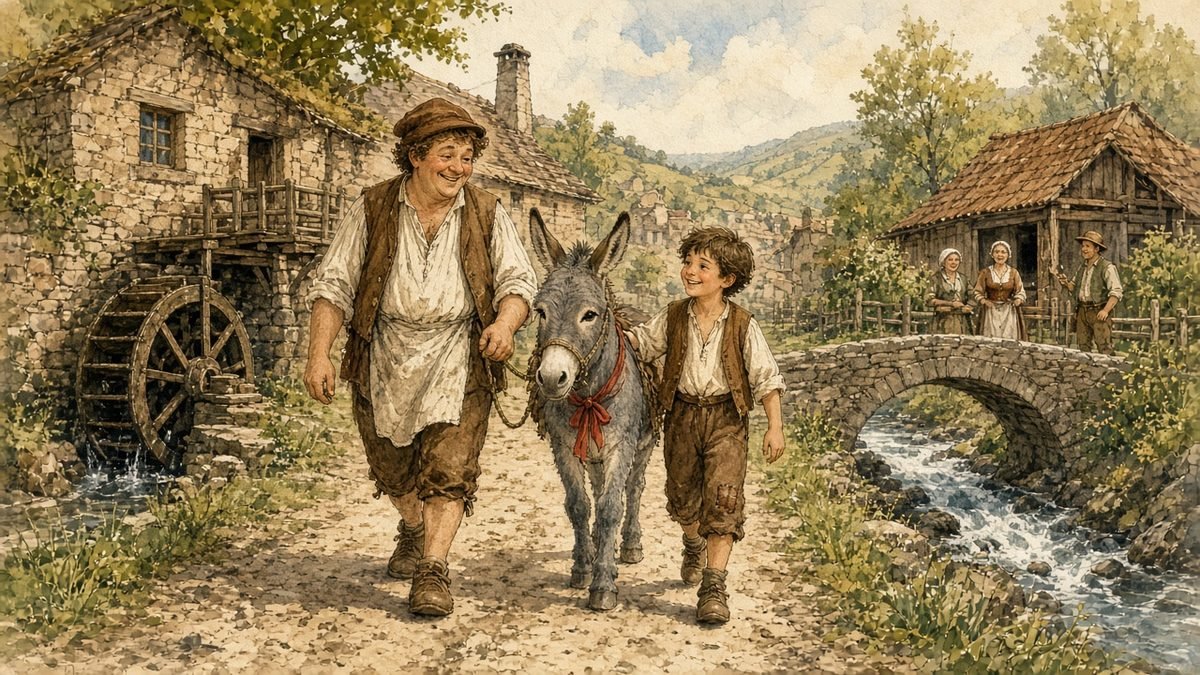
The Miller, His Son, and the Donkey story is one of the best-known fables credited to Aesop, the storyteller said to have lived in ancient Greece. A miller and his son walk a donkey to market, and every person they pass has a different opinion about how they should do it. By the end of the day, they’ve tried every idea, and none of them has worked.
This retelling is for kids ages 5 to 12 and takes about 7 minutes to read aloud. The animal in some old versions meets a sad end, so this one lets the donkey swim to safety. The FAQ explains how the original goes.
Part 1: A donkey for sale
Long ago, a miller named Hugo lived at the edge of a little village. He ground wheat into flour at the mill by the river, and he had a son named Ben, who was about ten years old and helped with everything.
Hugo also had a donkey named Dusty. Dusty was gray, with long ears and a soft, twitchy nose. He was a good donkey, but the mill didn’t need him anymore, and the family needed money for the winter.
“We’ll sell Dusty at the market in the next town,” Hugo said one morning. “He’s strong and he’s gentle. Someone will give us a fair price.”
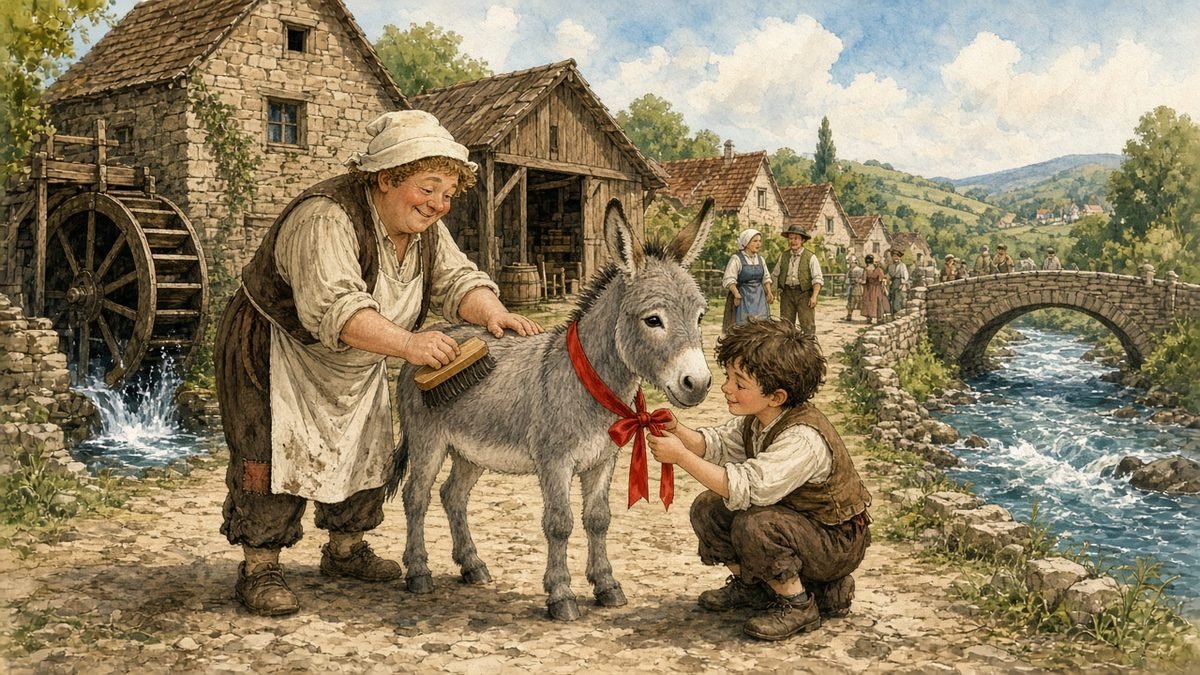
The market was a long way off, over a hill and across a bridge. Hugo wanted Dusty to look his best when they got there, so he brushed the donkey’s coat until it shone. Ben tied a red ribbon around his neck.
“You look very handsome,” Ben whispered, and Dusty flicked his ears.
Then the three of them set off down the dusty road. Hugo and Ben walked, and Dusty trotted along behind them on a loose rope.
Part 2: Who walks and who rides?
They hadn’t gone very far when they passed a group of women washing clothes in a stream. The women looked up and began to giggle.
“Look at those two!” one of them called. “They have a perfectly good donkey, and they’re both walking in the dust. What a pair of fools!”
Hugo felt his cheeks go warm. “Maybe they’re right,” he said. “A donkey is for riding. Climb up, Ben.”
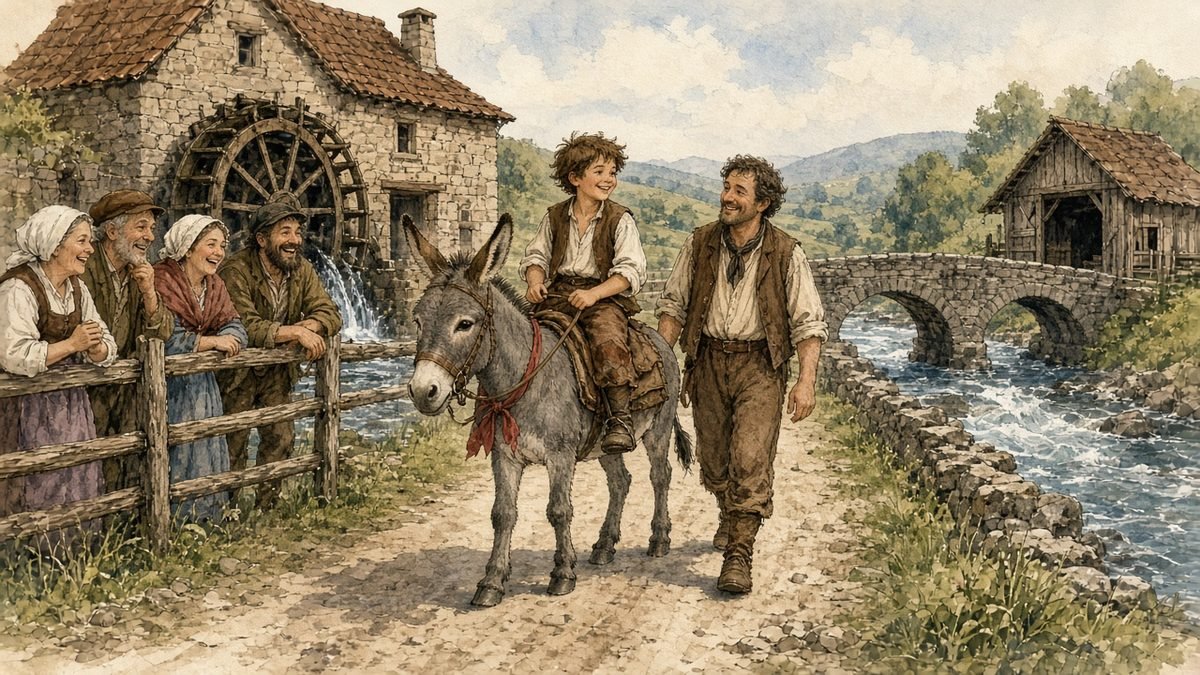
So Ben climbed onto Dusty’s back, and Hugo walked beside them. The road curled around a field where some old men sat on a fence, talking.
When the old men saw them, they shook their heads.
“Shameful,” said one of them. “Look at that boy, riding along like a little prince while his poor father walks. Young people today have no respect!”
Ben’s face turned pink. “I’m sorry, Papa,” he said, and he started to slide down.
“Stay there,” said Hugo. “Let’s try something else.” He lifted Ben off and climbed up himself, and Ben walked beside the donkey.
They kept going. Soon they met a mother with three small children.
“Oh, look at that!” she cried. “That big man is riding, and his little boy has to walk! Why, he’ll be tired out before they reach town. Have you no heart?”
Hugo’s ears went red. He didn’t like being called heartless at all.
Part 3: Both on the donkey
“There’s only one thing left to do,” Hugo said at last. “We’ll both ride. That way, nobody can say that one of us is lazy.”
He pulled Ben up behind him, and the two of them sat together on Dusty’s back. The donkey sighed and kept walking. He was strong, but two people were a lot to carry, and his legs started to wobble a little.
They had almost reached the hill when a farmer came along with a cart of turnips. He stopped and stared at them.
“What a shame,” the farmer said. “That poor donkey is carrying two whole people! You ought to be ashamed. You’re nearly as heavy as a haystack. It would serve you right if you carried the donkey instead!”
Hugo stopped the donkey and climbed down. Ben climbed down, too. Dusty shook himself and looked very relieved.
Hugo sat down on a rock and rubbed his forehead. He had tried walking and riding, and he’d tried riding with Ben, and every time somebody had found something to complain about.
“Papa,” said Ben quietly, “maybe it doesn’t matter what we do.”
But Hugo was tired and flustered, and he wasn’t ready to listen. “I know,” he said. “I’ll give them nothing to complain about. If we carry Dusty, nobody can say we’re being unkind to him.”
Part 4: Carrying the donkey
That was a very silly idea, but Hugo had made up his mind. He found a long, sturdy pole and a few strips of rope. Together, he and Ben tied Dusty’s four legs to the pole.
Dusty did not like this one bit. He rolled his eyes, and he made a loud, creaky noise: “Hee-haw! Hee-haw! Hee-haw!”
Hugo hoisted one end of the pole onto his shoulder, and Ben took the other end. Together, they staggered down the road with the donkey dangling between them, upside down, with his ribbon flapping in the breeze.
Before long, the market town came into sight. The road led to a stone bridge over a wide, fast river. Hugo and Ben shuffled onto it, huffing and puffing.
Everyone in the town came out to see the strange sight. People pointed and laughed until they were holding their sides.
“Look, look!” a boy yelled. “The miller is carrying his donkey! Have you ever seen anything so ridiculous?”
“Hee-haw!” cried Dusty, even louder.
All that noise and laughing was too much for him. The donkey kicked, twisted and wriggled with all his might. One of the ropes slipped, then another. And in the middle of the bridge, the pole slid from Hugo’s shoulder.
SPLASH! Dusty tumbled over the railing and into the river.
Part 5: A very wet donkey
“Dusty!” Ben shouted. He raced to the railing and looked down. Hugo stood frozen, with his hands on his head.
The river was cold and fast, but Dusty was a strong swimmer. He kicked his legs, which were free of the ropes now, and paddled across the current with his nose held high. The red ribbon floated behind him like a tiny flag.
He swam to the bank, climbed out and shook himself from nose to tail. Water flew everywhere. Then he trotted off along the shore and didn’t stop until he got home to his own stable.
The crowd on the bridge went quiet. Hugo and Ben were still standing there, wet and out of breath, holding an empty pole.
The market sellers began packing up their stalls for the day. Hugo had no donkey to sell and no money to take home.
“Ben,” he said slowly, “I think I’ve made a mess of this.”
“It’s all right, Papa,” said Ben, taking his hand. “We’ll walk home and get Dusty. We can try again another day.”
Hugo nodded. “And next time,” he said, “we’ll do what makes sense to us. We’ll let people say whatever they like.”
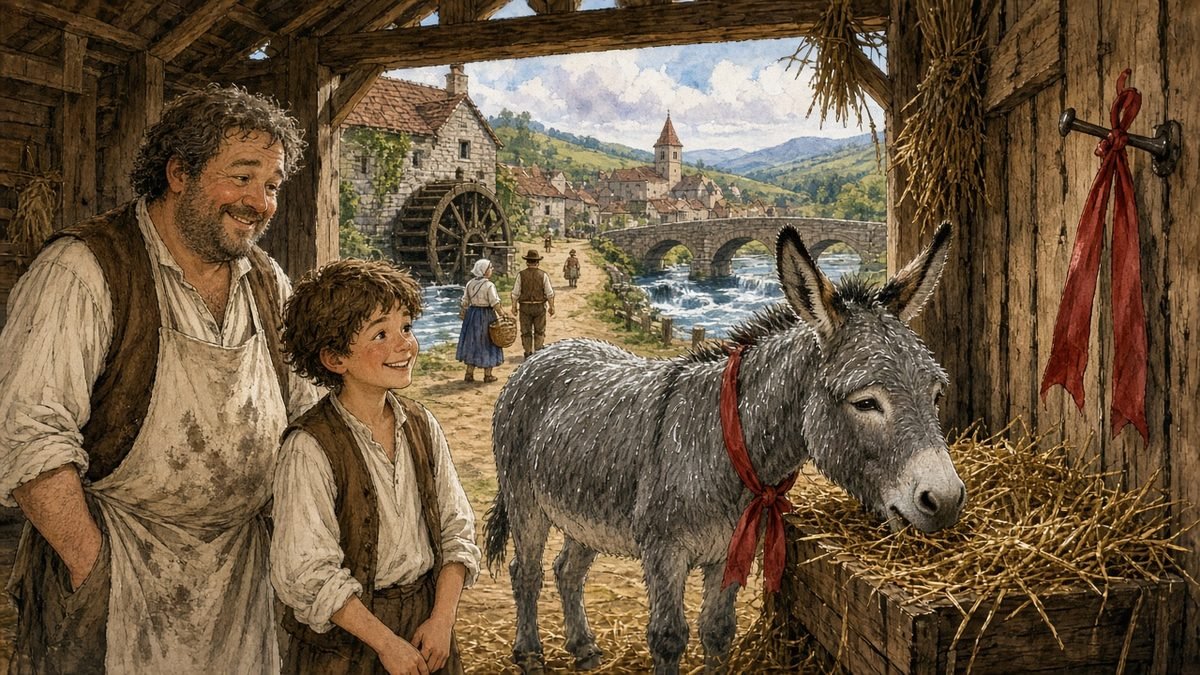
That evening, they found Dusty munching hay in his stable, warm and dry. Hugo gave him an extra carrot, and Ben hung the damp red ribbon on a nail by the stall door.
The End
Moral of the story: You can’t please everyone
Hugo changed his plan four times because of what strangers said, and each change was worse than the one before. People will always find something to say, and many of them don’t know your reasons. The old saying that comes from this fable is: “If you try to please everybody, you will please nobody.” Think about what makes sense, listen to people you trust, and let the rest go.
What kids can learn from the Miller, His Son, and the Donkey story
- It’s fine to listen to advice, but you get to decide what to do with it.
- People who comment from the side of the road don’t always know the whole story.
- Changing your plan again and again can leave you worse off than before.
- Animals deserve gentle treatment, and Dusty never needed to be carried.
Questions to talk about with your child
- Why did the miller keep changing what he and Ben did?
- Which person’s comment would you have listened to? Why?
- What could Hugo have said to the people who laughed at him?
- Have you ever tried to please everyone? How did it go?
- How can you tell good advice from advice you don’t need?
Summary: The Miller, His Son, and the Donkey
In the Miller, His Son, and the Donkey story, a miller and his boy take their donkey to market. Passersby criticize them for walking, then for riding, then for both riding. The miller finally ties the donkey to a pole and carries it over a bridge. The donkey panics, falls into the river and escapes, and the miller learns that he can’t please everybody. In this retelling, the donkey swims home safely.
For more fables about animals and good sense, read The Musical Donkey and The North Wind and the Sun.
Read More: The Dog in the Manger
Frequently asked questions
What is the moral of The Miller, His Son, and the Donkey?
You can’t please everyone. If you change your plans to match every opinion you hear, you’ll end up with a plan that doesn’t work for anybody.
Is it an Aesop fable?
Yes. It’s traditionally credited to Aesop and appears in many collections of his fables. The French writer Jean de La Fontaine retold it in the 1600s as a poem called The Miller, His Son and the Donkey. Some old versions have an old man and a boy instead of a miller and his son.
How does the original fable end?
In the best-known old versions, the man and his son tie the donkey to a pole and carry it across a bridge. The donkey kicks, falls into the river and drowns, and the man loses his donkey while trying to please everyone. This retelling lets Dusty swim safely to shore and run home, which keeps the lesson while sparing younger kids a sad ending.
Where does the saying “you can’t please everyone” come from?
People have said it in many languages for a very long time, and this fable is one of the stories most often used to explain it. The idea is the same in each: no matter what you do, somebody will disagree.
What age is this story good for?
Ages 5 to 12. Younger kids will laugh at the donkey on the pole, and older kids can talk about peer pressure and what other people’s opinions are worth.