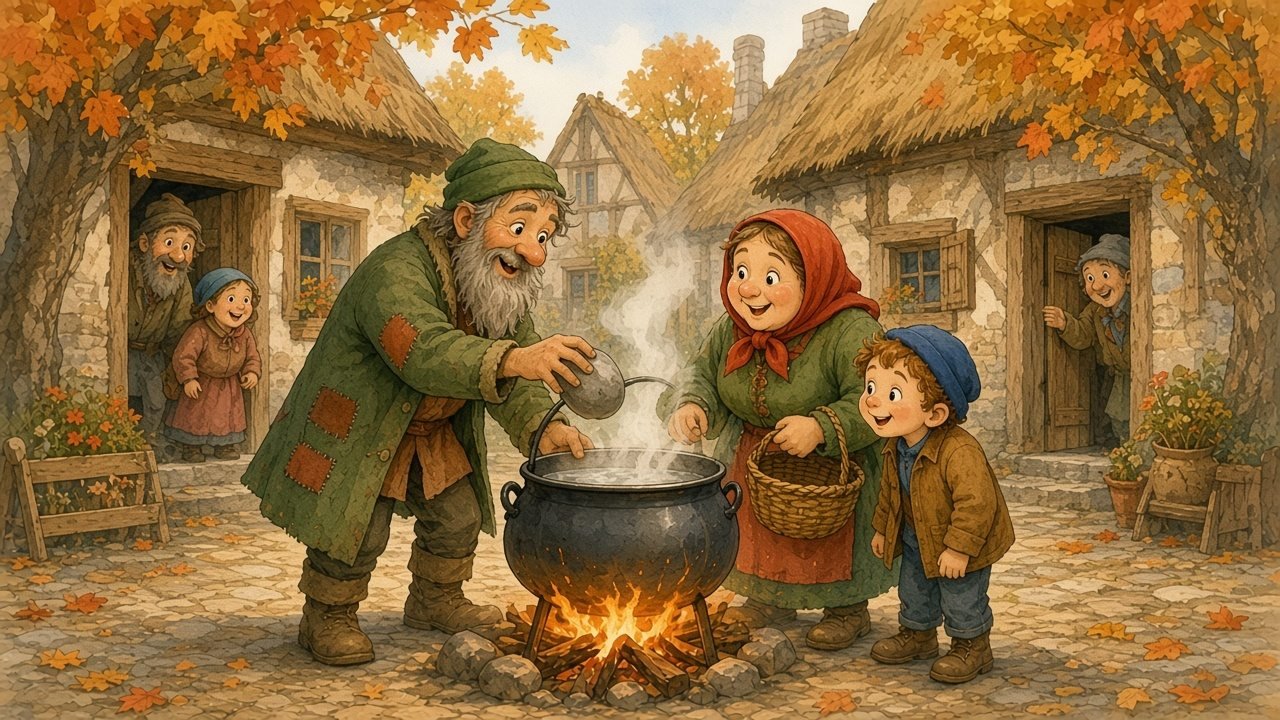
Stone Soup is an old European folk tale about three hungry travelers, one big pot and a very ordinary stone. People have told it for hundreds of years in many countries, and every version ends the same way: a whole village sitting down to a meal that nobody thought they could share. It is a funny, cozy story with a big idea tucked inside it, which is that a little from everyone can add up to plenty for all.
This retelling is written for kids aged 5 to 12 and takes about ten minutes to read aloud. It works well as a bedtime story or as a read-aloud before a family meal. After the story you’ll find the moral, some questions to talk about together, a short summary and an FAQ.
Part 1: Three Tired Travelers
Once upon a time, on a cool fall afternoon, three travelers came walking down a long dirt road. They had been walking for days, and their boots were dusty and their stomachs were empty.
The first traveler was an old man named Tobias. He was tall and thin, with a long gray beard, a floppy green cap and a green coat covered in patches. The second was his sister, Greta, who was short and round and wore a bright red scarf over her hair. She carried a basket on her arm, but the basket was empty. The third was Greta’s grandson, Pip. He was seven years old, with curly brown hair that poked out from under a blue cap,.
“Look,” said Pip, pointing ahead. “A village!”
Down in the valley stood a little village with stone cottages, thatched roofs and smoke curling out of the chimneys.
“Where there’s smoke, there’s a kitchen,” said Tobias with a smile. “And where there’s a kitchen, there might be supper. Come on.”
Part 2: Nothing to Spare
But the people of that village had heard travelers were coming. News moves fast in a small place.
“Strangers on the road!” called the baker’s wife. “Hungry ones, by the look of them!”
And all over the village, people started hiding their food. Farmer Hans pushed a sack of potatoes behind his door. Old Mrs. Becker tucked a ham under her apron. The miller hid his flour in the hayloft, and the Klein family pulled their wooden shutters closed so nobody could see the apples piled on their table.
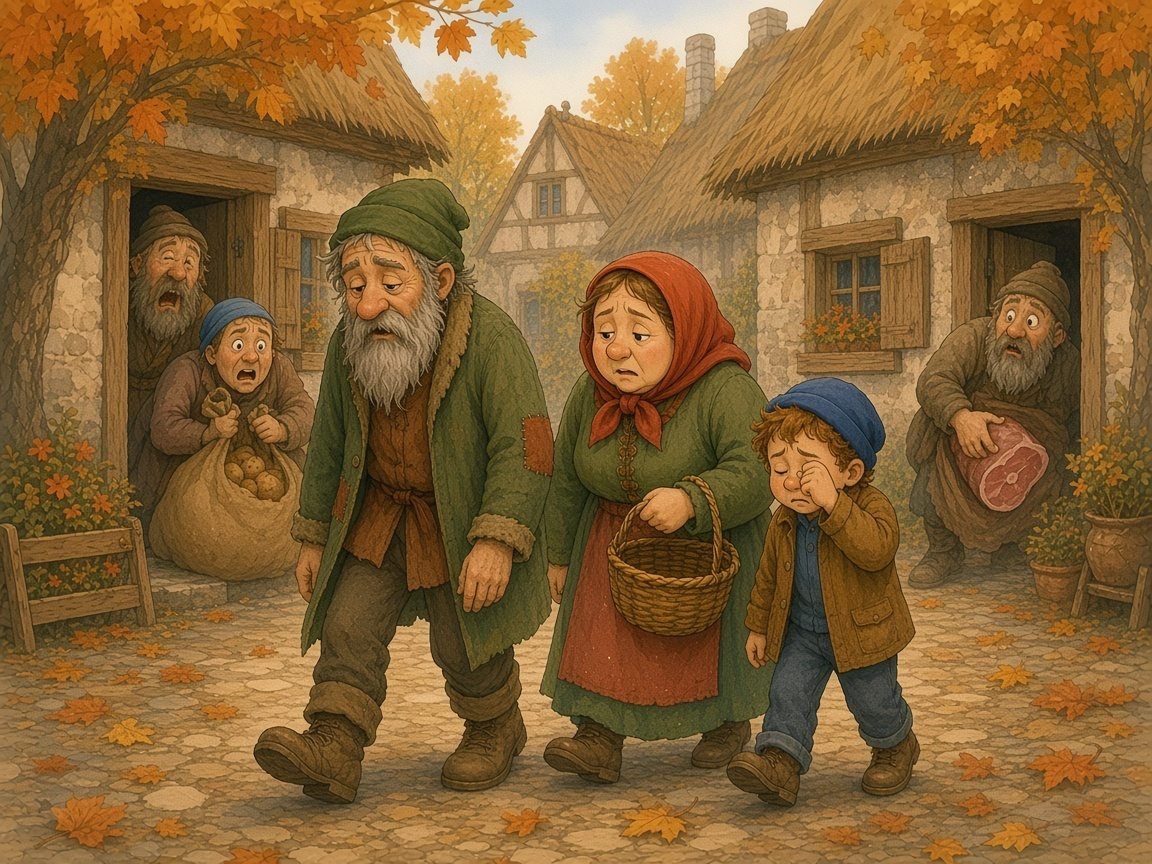
The three travelers walked slowly down the cobbled lane, knocking on doors.
“Good afternoon,” said Tobias politely at the first cottage. “Could you spare a little food for three tired travelers?”
“Oh, we’re so sorry,” said the man inside. “It’s been a poor harvest. We’ve barely got enough for ourselves.”
At the next house, a woman shook her head. “Not a crumb, I’m afraid. The rain ruined our beans.”
It was the same all the way down the lane. Everyone had an excuse, and nobody had anything to spare.
Pip’s lip started to wobble. “Grandma,” he whispered, “what are we going to do?”
Greta looked at her brother. Tobias looked back at her. Then a twinkle came into his eye, and he winked.
“Well,” he said loudly, so that everyone peeking out of their windows could hear, “if nobody has any food, I suppose we’ll just have to make stone soup.”
Part 3: A Pot, a Fire and a Stone
The three travelers walked into the middle of the village square. Tobias set down his bag and began to gather sticks. Greta built them into a neat little pile and lit a fire. Pip ran to the well and filled their old iron pot with water, and together they hung the pot over the flames.
By now, a few villagers had wandered out of their houses. They stood at a distance with their arms folded, watching.
“What’s stone soup?” asked a girl named Lena.
“Why,” said Tobias, “it’s the finest soup in the whole world. And all you need to make it is water, a fire and the right kind of stone.”
He reached into his coat pocket and pulled out a smooth, round, gray stone. It looked like any stone you might find in a creek, and he dropped it into the pot.
Plop!
Then he sat down beside the fire and waited, humming a little tune.
More and more villagers drifted into the square. Nobody wanted to miss this.
After a while, Tobias dipped in a wooden spoon and took a slurp. “Mmm,” he said, smacking his lips. “Coming along nicely. Of course, stone soup is even better with a little salt and pepper. But never mind. We’ll make do.”
“I have salt and pepper,” said Lena’s mother before she could stop herself. “I’ll go get some.”
She came back with a little jar of each, and Tobias sprinkled them in with a grand flourish.
Part 4: Just One More Thing
Tobias tasted the soup again. “Delicious,” he said. “Though I remember the last time I made stone soup, we added a few carrots. That made it as sweet as summer. But never mind. It’s very good just as it is.”
Old Mrs. Becker thought about the carrots in her root cellar. “Well,” she said slowly, “I suppose I might have a carrot or two.” She came back with an armful of bright orange carrots with their green tops still on.
Greta chopped them up, and in they went.
Then Greta took a turn with the spoon. “Wonderful,” she said. “Do you know, a cabbage makes stone soup fit for a king. But I’m sure nobody here has a cabbage.”
“I have a cabbage!” said Farmer Hans, and he hurried home to fetch it.
“What about onions?” asked Pip, who had caught on to the game. “Uncle Tobias always says an onion makes it taste like home.”
“Onions!” cried Lena, and she ran off and came back with a whole string of golden onions.
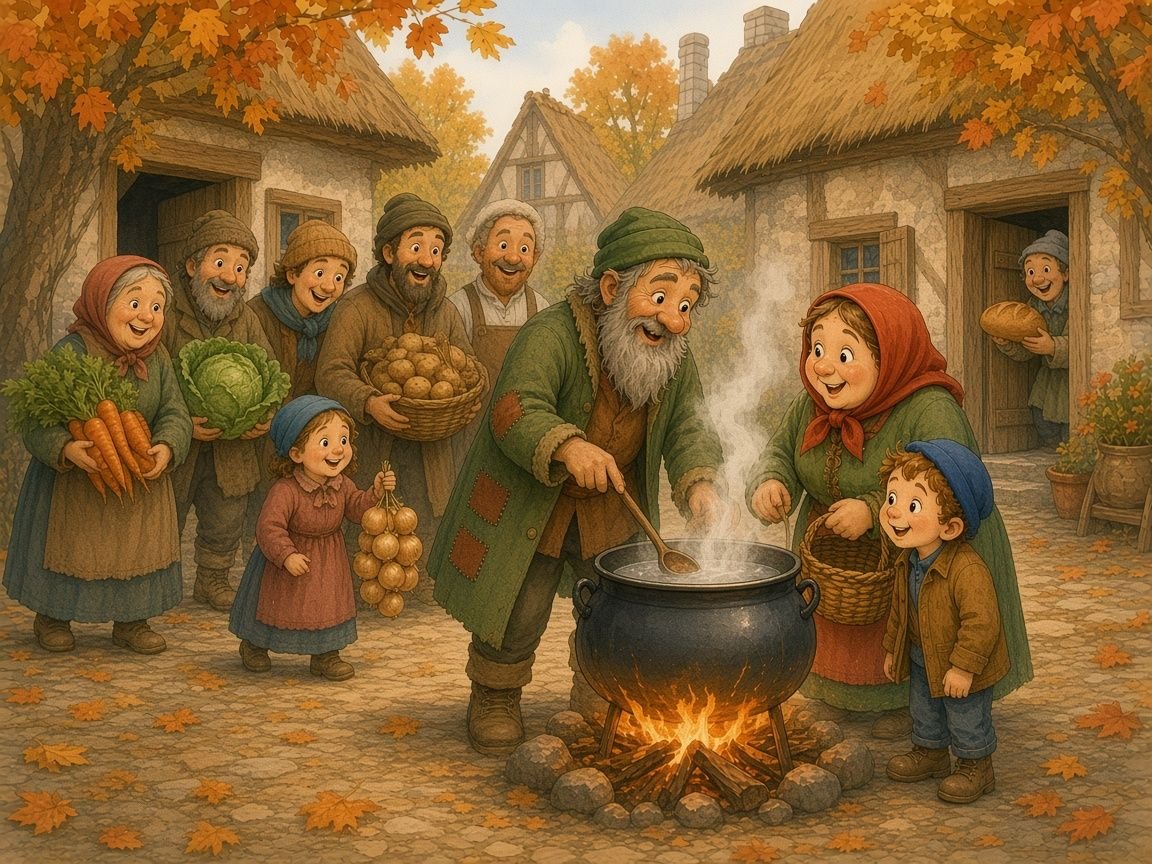
After that, it was as if the whole village had woken up. Somebody remembered a basket of potatoes. Somebody else found a handful of green beans, a few mushrooms, some barley and a bunch of parsley. The miller brought a little flour to make the soup thick. The butcher brought a meaty soup bone. And the baker, who had pretended not to have a crumb, came out with three loaves of warm bread still smelling of the oven.
The pot bubbled and steamed. The smell drifted over the rooftops and down every lane, until even the people who had stayed inside opened their doors to see what was cooking.
Part 5: Supper for Everyone
By the time the sun went down, the soup was ready.
But by then there were far too many people for one little fire in the square. So the villagers carried out tables and benches and set them in long rows. They brought bowls and spoons, cups and candles. Someone hung lanterns in the trees, and an old man with a fiddle began to play.
Then Greta ladled out the soup. It was thick and hot and golden, full of carrots and potatoes and cabbage and beans. There was enough for every single person in the village, with bread to dip in it, and enough left over for seconds.
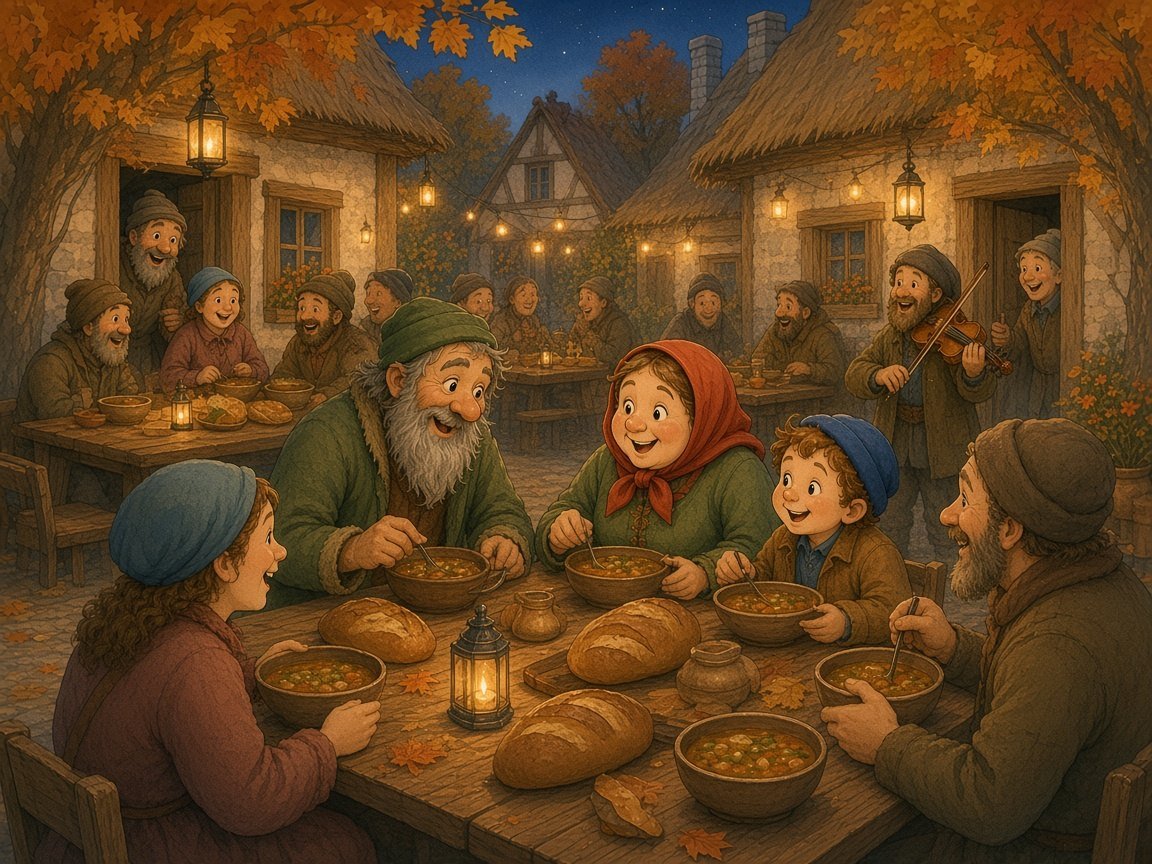
“This is the best soup I’ve ever tasted,” said Farmer Hans, wiping his bowl clean with a crust of bread.
Everyone laughed, ate, sang and danced until late into the night. It was the happiest evening the village had had in a long, long time.
Part 6: The Secret of the Stone
The next morning, the three travelers got ready to leave. They had slept in the best beds in the village, and they each had a full stomach and a full basket for the road.
Lena came running up to them. “Wait!” she said. “Before you go, will you teach us how to make stone soup?”
Tobias knelt down and looked at her kindly.
“I’ll tell you a secret,” he said. “The stone doesn’t do very much at all. What makes the soup is everybody bringing a little something. One carrot doesn’t make a supper. One onion doesn’t make a supper. But when everyone puts in what they have, there’s enough for all of us, and plenty to spare.”
He reached into his pocket, took out the smooth gray stone and put it in her hand. “Keep it,” he said. “Whenever someone in your village is hungry, put it in a pot of water and see what happens.”
And the villagers stood at the edge of the village and waved goodbye as the three travelers walked off down the road, heading for the next town and the next adventure.
As for Lena, she kept that stone on her windowsill for the rest of her life. And whenever times were hard, the people of that village knew exactly what to do.
The End
Moral of the story: Stone Soup
When everyone shares a little, there is enough for everyone. The villagers each thought they had too little to give, but their small gifts together made a feast. Working together and sharing what you have can turn “not enough” into “more than enough.”
What kids can learn from this story
- Small gifts add up. One carrot seems like nothing, but a whole village of carrots, onions and potatoes makes a supper.
- Sharing feels good. The villagers were happier at the end, when they had given food away, than at the start, when they were hiding it.
- Kindness can be catching. Once a few people joined in, everyone else wanted to help too.
Questions to talk about with your child
- Why do you think the villagers hid their food when the travelers arrived?
- Did Tobias trick the villagers, or did he help them? What do you think?
- If you lived in the village, what would you have brought for the soup?
- Can you think of a time when everyone in your family or class shared something and it made things better?
Summary: Stone Soup
Three hungry travelers arrive in a village where everyone hides their food and says they have nothing to share. So the travelers set up a pot of water in the village square and drop in a stone, saying they’re making stone soup. One by one, curious villagers add salt, carrots, cabbage, onions, potatoes and more, until the pot is full of thick, tasty soup. The whole village eats together at long tables, and the travelers explain that the real secret was everyone sharing a little.
Read More: The Little Red Hen
Frequently asked questions
Where does the Stone Soup story come from?
Stone Soup is a European folk tale that has been told in many countries for centuries. Different places have their own versions. In Sweden it is often called Nail Soup, and in Russia it is told as Axe Porridge. In the United States, many children know it from Marcia Brown’s 1947 picture book, which features three hungry soldiers.
What is the moral of Stone Soup?
The main lesson is that sharing and cooperation can create plenty out of very little. When each person gives a small part of what they have, the whole group ends up better off.
Did the travelers trick the villagers?
In a playful way, yes. The stone never made the soup taste good. But nobody was harmed, and the villagers ended up with a feast they all enjoyed. Many families like to talk about whether this was a fair trick, which is one of the reasons the story is so popular in classrooms.
What age is Stone Soup good for?
This version is written for children aged about 5 to 12. Younger kids enjoy the repeating pattern of “just one more thing,” and older kids can talk about sharing, community and what Tobias really meant by the secret of the stone.