Long before trick-or-treating and plastic pumpkins, Americans told a ghost story about a nervous schoolteacher, a prankster, and a rider with no head. This version of the legend of Sleepy Hollow for kids keeps the shivers small and the laughs big, so it works as a cozy October read-aloud for children who like a little spooky but not too much.
Reading time: about 7 minutes | Best for ages: 6–12 | Original author: Washington Irving (1820, public domain)
If your family enjoys gentle spooky tales, keep this one next to our short Halloween stories for kids for the rest of the month.
The Legend of Sleepy Hollow for Kids: The Story
Tucked in a valley beside New York’s Hudson River, there was a little village where everything moved slowly. The brook gurgled slowly. The cows chewed slowly. Even the breeze seemed to yawn. People called the place Sleepy Hollow, and they said the air there made folks dreamy and full of stories.
One story was told more than any other. On dark nights, people whispered, a rider on a huge black horse galloped through the woods looking for something he had lost long ago: his head.
Into this drowsy valley came a new schoolmaster named Ichabod Crane. He was so tall and skinny that he looked like a scarecrow that had wandered off from a cornfield. His arms dangled, his feet were as big as shovels, and his neck was long like a crane’s. When he walked against the wind, his coat flapped like a flag.
Ichabod loved three things. He loved to eat, and he could finish a whole apple pie and look around for another. He loved to sing, and on Sundays his high, quavering voice rang out over everyone else’s in church. And he loved ghost stories. He would listen to the village wives tell tales by the fire until his knees knocked together. Then he would walk home in the dark, singing loudly to keep the ghosts away.
That autumn, Ichabod noticed someone else he liked very much: Katrina Van Tassel, the cheerful daughter of the richest farmer in the valley. Her father’s farm was bursting with plump pigs, fat geese, and barns stuffed with corn. Ichabod admired Katrina, and he admired her father’s pantry nearly as much.
But Ichabod had a rival. Brom Van Brunt, whom everyone called Brom Bones, was broad-shouldered, loud, and the best horseman in the county. Brom liked Katrina too, and he did not like the skinny schoolteacher who kept visiting her house. Brom never picked a real fight. Instead, he played pranks. He stuffed the schoolhouse chimney so it filled with smoke. He sent his dog to howl outside Ichabod’s singing lessons. The whole valley chuckled.
Then came the night of the Van Tassels’ harvest party. Ichabod borrowed an old plow horse named Gunpowder, a bony gray animal with one wild eye, and trotted proudly to the farm. The tables groaned with doughnuts, crullers, honey cakes, ham, and pies of every kind. Ichabod danced, ate, and ate some more.
Later, the guests gathered on the porch to swap ghost stories. Someone mentioned the Headless Horseman. Brom Bones leaned back and said he had once raced the Horseman himself. “I beat him to the church bridge,” Brom said, “and the moment we reached it, he burst into a flash of fire and vanished.” Ichabod swallowed hard.
It was very late when Ichabod rode home alone. Clouds hid the stars. The road wound past a giant old tulip tree with twisted branches, and every creak made Ichabod jump. He sang a hymn, loudly and badly.
Then he heard it. Clop. Clop. Clop. Hoofbeats behind him.
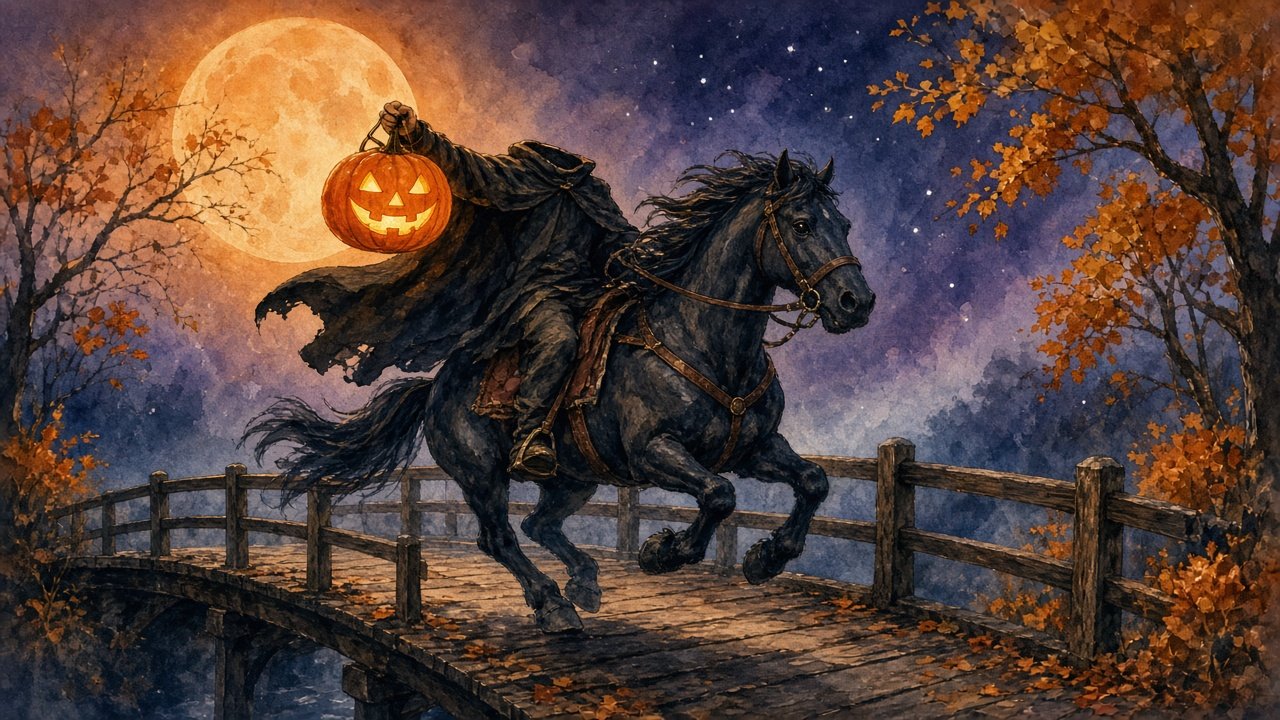
Ichabod turned. In the shadows stood an enormous rider on a black horse, wrapped in a cloak. Ichabod sped up. The rider sped up. Ichabod slowed down. The rider slowed down. And when the moon slid out from behind a cloud, Ichabod saw something that turned his legs to jelly. The rider had no head on his shoulders. Instead, he carried something round on his saddle.
“Go, Gunpowder, go!” Ichabod cried. The old horse thundered down the road, with Ichabod bouncing like a sack of potatoes. He remembered Brom’s words: get to the church bridge and you’ll be safe.
The bridge came into view. Gunpowder’s hooves clattered across the planks. Ichabod turned around, hoping to see the rider vanish in a flash of fire. Instead, the Horseman stood up in his stirrups and hurled the round thing straight at him.
Thunk! It struck Ichabod, and he tumbled into the dust.
The next morning, Gunpowder was found calmly munching grass at his owner’s gate. Down by the bridge, the villagers found Ichabod’s hat. Beside it lay a smashed pumpkin.
Ichabod Crane was never seen in Sleepy Hollow again. Some said the Horseman carried him off. Years later, a traveler reported that Ichabod was alive and well in another part of the state, where he had become a lawyer and a judge.
And Brom Bones? He married Katrina not long after. Whenever anyone told the story of Ichabod and the Headless Horseman, Brom would get a funny twinkle in his eye and laugh the loudest of all, especially when someone mentioned the pumpkin.
Moral of the Story
Things are often less scary than they seem, especially when our imagination does the running. Ichabod let spooky stories grow so big in his mind that he never stopped to ask the obvious question. Was that a head, or just a pumpkin? Staying calm and looking closely can turn a fright into a laugh.
Questions to Talk About After Reading
- Who do you think the Headless Horseman really was? What clues in the story point to your answer?
- Why did Ichabod get so scared on the ride home? Had anything earlier in the night made it worse?
- Brom Bones played lots of tricks. Were they funny, or did some go too far? Where is the line between a joke and being unkind?
- What is something that seemed scary to you at first but turned out to be no big deal?
- If you could add one more scene to the story, what would happen?
A Little Background for Parents
Washington Irving published the tale in 1820, and it is one of the first American stories that people still read today. The Hudson Valley setting is real: Sleepy Hollow, New York, renamed itself after the story in 1996 and still has its Old Dutch Church. Irving’s original runs long and uses old-fashioned words, so this retelling trims the descriptions and softens the scary bits while keeping the plot and the famous pumpkin twist.
Kids who enjoy the twist ending might like puzzling over our Halloween riddles for kids, and if they want a classic tale with a lighter mood afterward, The Emperor’s New Clothes has a similar “the joke’s on him” feel. You can find more classics in our fairy tales for kids collection.
Frequently Asked Questions
Is The Legend of Sleepy Hollow too scary for kids?
Washington Irving’s original is more funny than frightening, and this retelling keeps the spooky parts light. Most kids 7 and up enjoy it. For sensitive 5- and 6-year-olds, read it in daylight and point out that the ‘horseman’ was most likely a prank.
Who wrote The Legend of Sleepy Hollow?
Washington Irving wrote it. It was published in 1820 in a collection called The Sketch Book of Geoffrey Crayon, Gent. The story is in the public domain, so families and teachers can retell it freely.
Was the Headless Horseman real?
No. The story never says for sure, but Irving drops strong hints that Brom Bones dressed up as the Horseman and threw a pumpkin to scare Ichabod away. That clue is a fun one for kids to spot.
Where is Sleepy Hollow?
Sleepy Hollow is a real village in New York’s Hudson Valley, near Tarrytown. It even has an Old Dutch Church and a burying ground like the ones in the story, and the town holds Halloween events every fall.
What age is this retelling best for?
It works best for ages 6 to 12. Read time is about 7 minutes, which makes it a good Halloween-week bedtime story or a read-aloud for a classroom party.