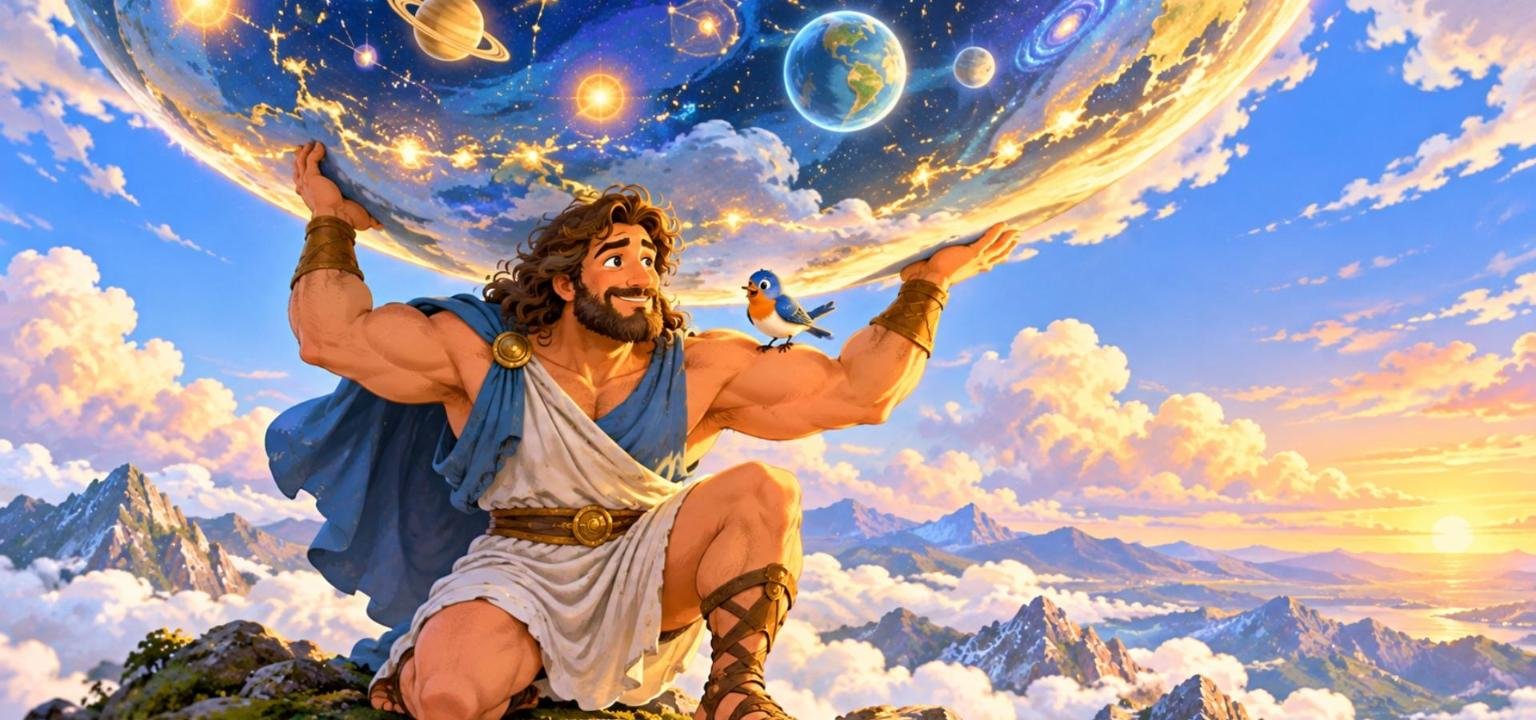
In the vast pantheon of Greek mythology, few figures are as iconic as Atlas, the Titan renowned for his immense strength and the eternal punishment he endures1. His story is one of rebellion, cosmic consequence, and interactions with some of Greece’s greatest heroes. More than just a symbol of endurance, Atlas was also a figure of great wisdom and knowledge, whose legacy is imprinted on our maps and oceans today18.
Who Was Atlas in Greek Mythology?
Atlas was a member of the Titans, a powerful race of deities who ruled before the Olympian gods2. He was a second-generation Titan, the son of Iapetus and the Oceanid Clymene (or Asia)18. His brothers were the famous Prometheus and Epimetheus, making him part of a significant lineage in mythological history1. Atlas fathered many children, most notably the Hesperides, the Pleiades, the Hyades, and the nymph Calypso1.
Regarded as a leader among his kind, Atlas was considered the strongest of the Titans and second only to his father in power3. His name itself is thought to mean “very enduring” or “suffering,” a direct reflection of his ultimate fate48.
The Titanomachy and an Eternal Burden
Atlas played a leading role in the Titanomachy, the great decade-long war where the Titans fought against the younger Olympian gods, led by Zeus, for control of the heavens28. Because Atlas was a principal general for the Titans, his punishment after their defeat was particularly severe47.
While many other Titans were condemned to Tartarus, the underworld’s abyss, Zeus singled out Atlas for a unique torment4. He was condemned to stand at the western edge of the world and hold up the heavens, or the celestial sphere, on his shoulders for eternity12. This punishment served a dual purpose: not only was it an agonizing task for Atlas, but it also enforced the separation of Uranus (the Sky) and Gaia (the Earth), preventing them from uniting again4. This enduring image of Atlas carrying the sky—often misinterpreted in later art as carrying the Earth or a stone globe—has become his defining characteristic26.
Encounters with Greek Heroes
Atlas features prominently in the myths of two legendary Greek heroes: Heracles and Perseus1.
Heracles’s Eleventh Labor
The demigod Heracles (known as Hercules in Roman mythology) encountered Atlas during his quest to retrieve the golden apples from the Garden of the Hesperides, who were Atlas’s daughters47. Following advice from Prometheus, Heracles offered to take the weight of the heavens onto his own shoulders if Atlas would fetch the apples for him7. Atlas agreed, but upon his return with the apples, he was reluctant to take his burden back7. Heracles, known for his cunning as well as his strength, tricked the Titan. He asked Atlas to hold the sky for just a moment so he could place a cushion on his head for comfort. The unsuspecting Atlas set the apples down and resumed his post, at which point Heracles simply picked up the apples and left7.
Perseus and the Atlas Mountains
In another myth, the hero Perseus crosses paths with Atlas after slaying the Gorgon Medusa8. In one version of the tale, Atlas, weary from his eternal labor, asks Perseus to use Medusa’s head to turn him to stone and end his suffering5. In another, more common version, Atlas denies Perseus hospitality and, as a punishment, Perseus petrifies him with the Gorgon’s head8. This event is said to have created the Atlas Mountains in North Africa, a huge stone range that still appears to hold up the sky8. This story is immortalized in art, such as the painting Atlas Turned to Stone by Edward Coley Burne-Jones5.
Powers, Strengths, and Legacy
Atlas’s primary attributes were his godly strength and limitless endurance, necessary to bear the weight of the celestial sphere4. In terms of sheer physical power, he is considered one of the two strongest beings in Greek mythology, rivaled only by Heracles3. The fact that Heracles required assistance from the goddess Athena to briefly hold the heavens highlights Atlas’s extraordinary might3. While direct comparisons are not made in myths, his role as a war general and his cosmic punishment suggest a level of strength far exceeding gods like Hermes3.
Beyond his brawn, Atlas was revered for his intellect. He was said to be skilled in philosophy, mathematics, and astronomy1. Ancient sources credit him with inventing the first celestial sphere and even astronomy itself, teaching humanity how to navigate by the stars and measure the seasons147.
His influence extends to modern language and geography:
- The Atlantic Ocean is named the “Sea of Atlas”13.
- The Atlas Mountains in North Africa are named for the petrified Titan18.
- An Atlas book of maps is named in his honor. The 16th-century geographer Gerardus Mercator first used the term for his collection as a tribute1.
- Atlantis, the mythical island from Plato’s dialogues, derives its name from “Atlantis nesos,” meaning “Atlas’s Island”1.
While some may feel sympathy for his unending plight, Atlas’s story is not one of simple good versus evil6. He was an adversary to the Olympian gods, but his character is defined more by his leadership, strength, and the profound consequences of his choices, making him one of the most compelling and enduring figures from the age of Titans28.
- https://en.wikipedia.org/wiki/Atlas_(mythology)
- https://www.centreofexcellence.com/atlas-in-greek-mythology/
- https://worldhistoryedu.com/greek-titan-atlas-origin-story-powers-symbols/
- https://study.com/academy/lesson/atlas-in-greek-mythology-story-facts.html
- https://southamptoncityartgallery.com/object/sotag-105/
- https://www.reddit.com/r/GodofWar/comments/wdz3y6/do_you_think_atlas_is_still_holding_the_greek/
- https://www.theoi.com/Titan/TitanAtlas.html
- https://www.worldhistory.org/Atlas/
- https://www.britannica.com/topic/Atlas-Greek-mythology
- https://mythopedia.com/topics/atlas
- https://kids.britannica.com/kids/article/Atlas/390238
- https://www.shutterstock.com/search/greek-mythology-atlas
- https://stock.adobe.com/search/images?k=atlas+greek
- https://in.pinterest.com/pin/597289969366988052/
- https://www.shutterstock.com/search/greek-god-atlas
- https://www.youtube.com/watch?v=T9mHbBJ3IKw
- https://greekgodsparadise.com/2024/10/22/best-books-about-greek-mythology-and-gods/
- https://www.familyeducation.com/pregnancy/boy-names/100-greek-mythology-boy-names
Read next: Discover the legacy of Atlas in Greek mythology. Atlas also had a famous brother! Meet Prometheus, the clever Titan who gave fire to humans, or learn about Eris, the goddess of strife.